Who Pays When a Condo Association Contractor Damages Your Unit
When a condo board's roofing contractor damages a private unit, managers often tell owners to file on their own insurance. Here is the legal chain of responsibility.
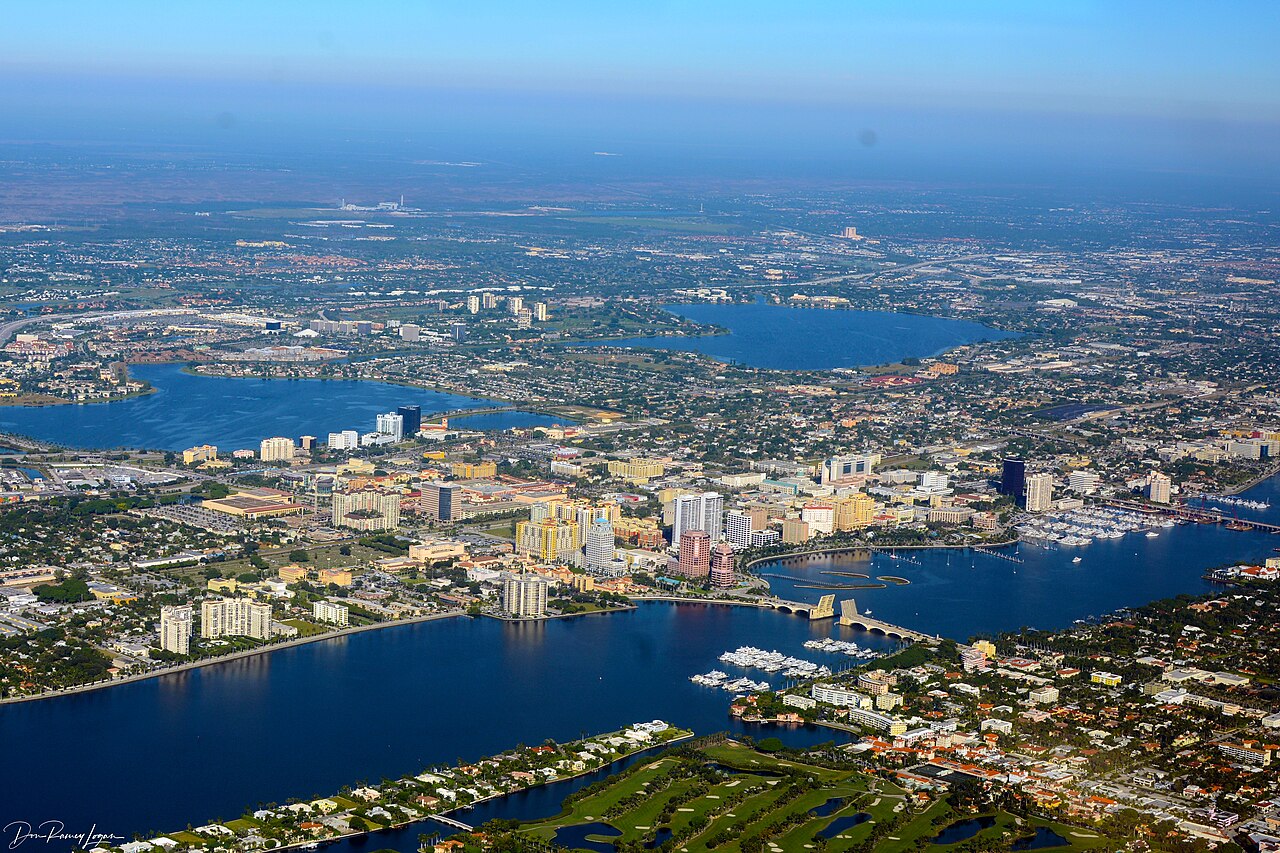
Photograph by Don Ramey Logan: West Palm Beach Aerial November 2014 photo Don Ramey Logan, on Wikimedia Commons under the CC BY 4.0 licence
A steady drip through ceiling drywall can ruin a rental calendar in minutes. When an association hires a commercial roofer to replace aging membranes on a multistory building, water intrusion below is a known hazard of the job. But when the water pools in a finished living room, soaking baseboards and ruining furnishings right before a scheduled guest check-in, the immediate question is not just how to dry the room out. The question is who writes the check for the repairs and the lost income.
For many condominium owners, the first answer from on-site management is reflexively unhelpful. Property managers routinely instruct the unit owner to open a claim with their own personal insurance carrier. That advice shifts the immediate financial burden, the deductible, and the risk of future rate hikes squarely onto the person who had nothing to do with hiring the contractor or swinging the hammer.
The issue touches thousands of condominium owners across the country who operate short-term rentals on Airbnb and Vrbo, where an unexpected closure costs hundreds of dollars a day in cancelled reservations. Understanding the proper chain of insurance recovery, the legal rights governing association documents, and how property management handles construction risk can save an owner thousands of dollars after a major renovation mishap.
What happened
The standard industry dynamic between condominium boards, property managers, and damaged unit owners was addressed directly by Ryan Poliakoff, a board-certified specialist in condominium and planned development law based in Boca Raton, Florida. Writing in his regular legal advice column originally published by the Palm Beach Post, Poliakoff took up a question from an owner whose building was undergoing a major roof renovation.
During the roofing project, the association's hired contractor caused an undeniable water leak that traveled into the owner's individual unit, damaging interior finishes. When the owner approached the building's property manager about covering the costs, the manager gave a familiar answer: submit the claim to your personal property insurance company. The owner questioned why the association's own policy was not paying for the negligence of the association's hired vendor, noting that filing a personal claim would likely cause their individual premiums to increase down the road.
Poliakoff explained that the manager's response bypassed the most logical first step in any commercial property dispute. Because the contractor's negligence caused the damage, the contractor's commercial general liability policy is the primary target for recovery. Poliakoff pointed out that associations typically require commercial vendors to provide proof of insurance before beginning work, and noted that if management refuses to hand over the contractor's certificate of insurance voluntarily, an owner has the statutory right to request it through an official records inspection.
The column also addressed a related governance dilemma involving Florida condominium administration: whether condo boards can prevent owners from live-streaming in-person meetings over Zoom. Poliakoff explained that under Florida Chapter 718, statutory requirements for video meetings apply when the association itself sponsors the broadcast. While owners have a legal right to make audio or video recordings of open meetings, that does not grant an automatic right to broadcast proceedings live to the general public, and boards have legitimate grounds to restrict live streaming to protect community privacy.
The chain of insurance in condominium buildings
To understand why a property manager's first answer is so often wrong, an owner has to look at the structural layers of condominium insurance. In every condominium community, property coverage is divided between the master policy held by the association and the individual unit policy held by the owner. How those two policies interact depends on state law, the recorded declaration of condominium, and who was actually at fault for the physical loss.
A condominium master policy generally covers the building exterior, the roof, structural foundations, and common areas. In many states, master policies operate under either bare walls coverage, which leaves everything from the perimeter drywall inward to the owner, or single-entity coverage, which includes original interior finishes like standard cabinets and drywall but excludes owner additions and personal property. Individual owners carry an HO-6 policy, or a commercial short-term rental equivalent, to cover personal belongings, interior upgrades, and loss of use.
When an outside contractor damages property, however, third-party liability principles supersede normal casualty claims. If a roofing crew punctures a pipe, tears an exposed waterproofing membrane during an afternoon downpour, or drops heavy equipment through a ceiling, the contractor is a negligent third party. Their commercial general liability coverage is designed specifically to pay for property damage caused by their operations.
Filing a claim through the contractor's liability policy avoids triggering the owner's personal loss history entirely. For a host whose policy renewal depends on a clean claims record, keeping that loss off the personal policy is essential.
When an association's contractor causes interior damage, their commercial general liability policy is the primary target for recovery.
Why property managers push claims to owners
If the contractor's carrier is the obvious payer, property managers still frequently advise owners to look to their own carriers first. That reaction is rarely malicious, but it is shaped by administrative convenience and self-protection for the association.
First, property managers want to protect the association's own claims record. Filing any claim against the building's master policy risks driving up association premiums or losing underwriting eligibility altogether. In coastal areas and urban high-rises, commercial property insurance rates have climbed dramatically in recent years. Condo boards instruct their managers to keep master policy claim counts as low as humanly possible, reserving the master policy exclusively for catastrophic structural losses.
Second, association deductibles on commercial policies are substantial. While an individual owner might have a $1,000 or $2,500 deductible on an interior policy, an association's commercial master policy deductible routinely sits at $10,000, $25,000, or even higher for water damage. If a contractor causes $8,000 worth of drywall, trim, and flooring damage, the master policy will not pay a single dollar because the loss falls entirely under the deductible threshold.
Third, managers often default to recommending personal insurance because they assume subrogation will sort it out. Subrogation is the legal process where an owner's insurance company pays for the immediate repairs and then files a formal demand against the negligent party's insurer to recoup the money. While subrogation does often recover the funds, it can take six months to two years, during which the owner has paid their deductible out of pocket and carries an open claim against their personal policy record.
Demanding the certificate of insurance
The fastest route to a clean resolution is obtaining the contractor's insurance details on day one. Before any major project begins, a prudent condominium board requires the general contractor to supply a certificate of insurance, standardly documented on an ACORD 25 form. This certificate names the association as an additional insured and lists the contractor's commercial general liability policy numbers, effective dates, and policy limits.
When an owner discovers damage inside their home, their first formal communication to the property manager should include a written request for a copy of that certificate of insurance. If the manager stalls or argues that vendor contracts are administrative property that cannot be shared with owners, state condominium statutes provide direct leverage.
In Florida, for instance, Chapter 718 of the Florida Statutes governs condominium associations and gives every unit owner the right to inspect and copy official records of the association. Construction contracts, contractor insurance certificates, and maintenance records are categorized as official records under the law. Similar statutory inspection rights exist in California under the Davis-Stirling Common Interest Development Act, in Illinois under the Illinois Condominium Property Act, and across most other jurisdictions.
To exercise this right effectively, owners should submit a formal written document inspection request via certified mail or through the association's designated electronic submission system, citing the governing state condominium statute. Once the certificate is in hand, the owner or their representative can contact the contractor's insurance carrier directly to initiate a third-party property damage claim, entirely bypassing both the association's master policy and the owner's personal carrier.
“One obvious question is why are you not filing a claim with the contractor's insurance, given that they are the obvious responsible party?”
The short-term rental complication: lost bookings and business interruption
For an owner who uses a condominium as a primary residence, a contractor leak means dealing with industrial fans, moisture meters, and paint swatches. For a short-term rental operator, it creates an immediate commercial crisis. Water dripping from a ceiling creates an uninhabitable environment, forcing immediate guest cancellations, refunds, and emergency rebooking assistance.
A host who has back-to-back bookings on Airbnb, Vrbo, or direct reservation engines faces two distinct categories of damages: physical property damage and consequential economic loss. Physical damage includes the soaked furniture, warped baseboards, ruined drywall, and damaged rugs. Economic loss includes the cancelled reservation revenue during the days or weeks required for remediation and reconstruction.
Standard homeowner policies (HO-6) routinely deny claims involving commercial short-term rental activity unless an explicit short-term rental endorsement is attached. Hosts who carry specialized commercial policies designed for vacation rentals typically have coverage for business interruption, often labeled as loss of rental income or fair rental value. However, filing that loss of income under a personal commercial policy still counts as a loss event against the host's policy.
When pursuing the negligent contractor's liability carrier, hosts can and should include business interruption damages in their formal third-party demand. A commercial liability policy covers damages for which the insured contractor is legally liable due to their negligence, and that liability extends to foreseeable economic harm caused by their physical damage. To substantiate this claim, an operator must supply concrete financial proof: past occupancy rates, confirmed booking confirmations for the cancelled period, platform payout histories, and tax receipts showing established revenue for that specific unit.
Board meetings, recordings, and remote access
The second legal issue highlighted in Poliakoff's column touches another operational pressure point for short-term rental owners: staying informed about building projects when you live in another city or state. Many vacation rental investors own units hours away from their primary residence, making in-person attendance at condo board meetings impractical.
The issue before Poliakoff centered on Florida Chapter 718, which regulates how condominium boards conduct their business. Under Florida law, if a condo board chooses to hold an official meeting via videoconference tools like Zoom, specific statutory guidelines kick in. The association must include the meeting hyperlink in the advance agenda notice, provide a designated physical meeting place with adequate audio or visual equipment for members who wish to attend in person, and maintain the recording as an official association record.
Some condo boards, seeking to minimize administrative friction or avoid public scrutiny, choose to hold strictly in-person meetings. In the case presented to Poliakoff, an owner asked whether a member could simply broadcast the in-person meeting over Zoom themselves so remote owners could watch, and whether the board could legally ban that broadcast.
Poliakoff clarified an important legal distinction: having the statutory right to record an open board meeting does not equate to a right to broadcast that meeting live to an outside audience. Under Florida law and broad association governance standards, owners possess the legal right to record board meetings using audio or video devices, provided they do not disrupt the proceedings. However, broadcasting introduces privacy considerations, especially when personal delinquency matters, neighbor disputes, or confidential vendor negotiations might be discussed.
A condominium board has the legal authority to enact reasonable rules governing the conduct of its meetings, provided those rules are reasonably related to a legitimate association interest. Protecting owner privacy and managing building administrative risks qualify as legitimate interests. For out-of-state hosts, this distinction means you cannot simply demand that a neighbor livestream an executive board session; instead, owners must rely on designated proxy voting, authorized remote attendance where officially adopted, and formal requests to listen to official audio recordings retained in the association records.
State variations in association governance and casualty repairs
While Poliakoff's analysis was rooted in Florida law, condominium casualty and governance rules across the country share basic frameworks while exhibiting key state-level differences. Short-term rental hosts operating across state lines must recognize how local statutes shape repair obligations and contractor disputes.
In California, condominium governance is governed by the Davis-Stirling Common Interest Development Act. Under Civil Code Section 4775, unless the association's declaration provides otherwise, the association is responsible for repairing common areas, while the owner is responsible for maintaining the separate interest. If an association contractor damages a separate interest, the board remains accountable for vendor oversight, but California courts consistently treat contractor negligence as a third-party tort claim that should be directed against the vendor's liability insurer.
In Illinois, Section 12 of the Illinois Condominium Property Act establishes comprehensive insurance rules. Illinois law explicitly addresses deductible allocations: if a loss to a common element or another unit results from the act or neglect of a unit owner or the association, the responsible party can be held liable for the deductible. When an outside contractor causes the damage, Illinois boards are required to hold reasonable certificates of insurance from those vendors, protecting individual unit owners from absorbing common repair costs.
In Texas, Chapter 82 of the Texas Property Code—the Uniform Condominium Act—governs repair responsibilities after casualty loss. Texas law specifies that any portion of a condominium for which insurance is required that is damaged must be repaired or replaced promptly by the association unless the community votes otherwise. However, Texas courts also separate structural casualty events like fires or natural disasters from intentional or negligent acts committed by third-party contractors, where direct tort claims against the contractor remain the primary vehicle for recovering unit-level losses.
The other view
While unit owners feel understandably frustrated when a property manager tells them to call their personal insurance, the association and its management staff are operating under real practical constraints. Understanding the board's perspective helps owners negotiate the situation without unnecessary hostility.
Property managers are charged with running daily building operations, not arbitrating insurance disputes between independent contractors and private homeowners. When a leak occurs, a manager's primary emergency objective is stopping the active water intrusion, protecting the building's structural integrity, and ensuring common elements are secured. They are not legal counsel for individual owners, and they frequently fear that admitting association liability or directing owners how to handle their private claims could expose the association to third-party litigation.
Furthermore, managers know that commercial general liability adjusters are notoriously slow. A commercial contractor's insurer may take several weeks to assign an adjuster, inspect the premises, and confirm liability coverage. In the meantime, water-soaked drywall develops mold within 48 to 72 hours. If an owner waits for a contractor's insurer to cut a check before beginning mitigation, the interior damage will multiply, increasing repair costs and extending the property's downtime.
When a manager advises an owner to call their personal insurer, they are often suggesting the fastest practical method to get mitigation crews on-site immediately. A homeowner carrier can dispatch emergency water extractors the same afternoon, dry out the structure, and handle the heavy lifting of pursuing the contractor later through subrogation. From the manager's viewpoint, this recommendation ensures the unit gets dried out before secondary mold damage spreads into common-area wall cavities.
What to do with this
When an association contractor causes damage to your short-term rental unit, taking immediate, structured steps protects both your property and your financial ledger.
- Document all physical damage immediately with high-resolution photography, video walk-throughs, and timestamped moisture meter readings before any clean-up begins.
- Issue an immediate written request to the property manager and board of directors requesting the contractor's full legal name, project contract, and certificate of insurance (ACORD form).
- Mitigate active damage promptly by hiring a certified water extraction or restoration company, keeping detailed invoices and specifying that the mitigation is due to external contractor intrusion.
- Contact the contractor's commercial liability insurance carrier directly to open a third-party claim for property repairs and business interruption loss.
- Assemble your commercial loss dossier, including confirmed Airbnb, Vrbo, or direct bookings that had to be cancelled, previous calendar revenue histories, and platform fee documentation.
- If the property manager refuses to provide contractor insurance documents, submit a formal statutory records inspection demand under your state's condominium act.
Condominium governance, contractor liability, and insurance policies vary across state statutes and individual community declarations; this analysis provides general commercial information and hosts should confirm specific loss procedures with a qualified attorney or licensed insurance professional.
The standards desk (June Ashby) went over this story: 34 details tested; 14 matched to the source material; 19 kept as general background; 1 cut before it ran.
STR Gazette is general information for hosts in the United States. It is not legal, tax or financial advice; confirm rules and figures with your city, your state agency or a qualified professional.

What readers say