How a single house in Sedona takes direct bookings
A Sedona house sends visitors from one page to Airbnb, Vrbo, Booking.com and a manager's direct site. Its public pages, Arizona statutes and the city's own figures show what a direct page changes for a one-house host and what stays the same.
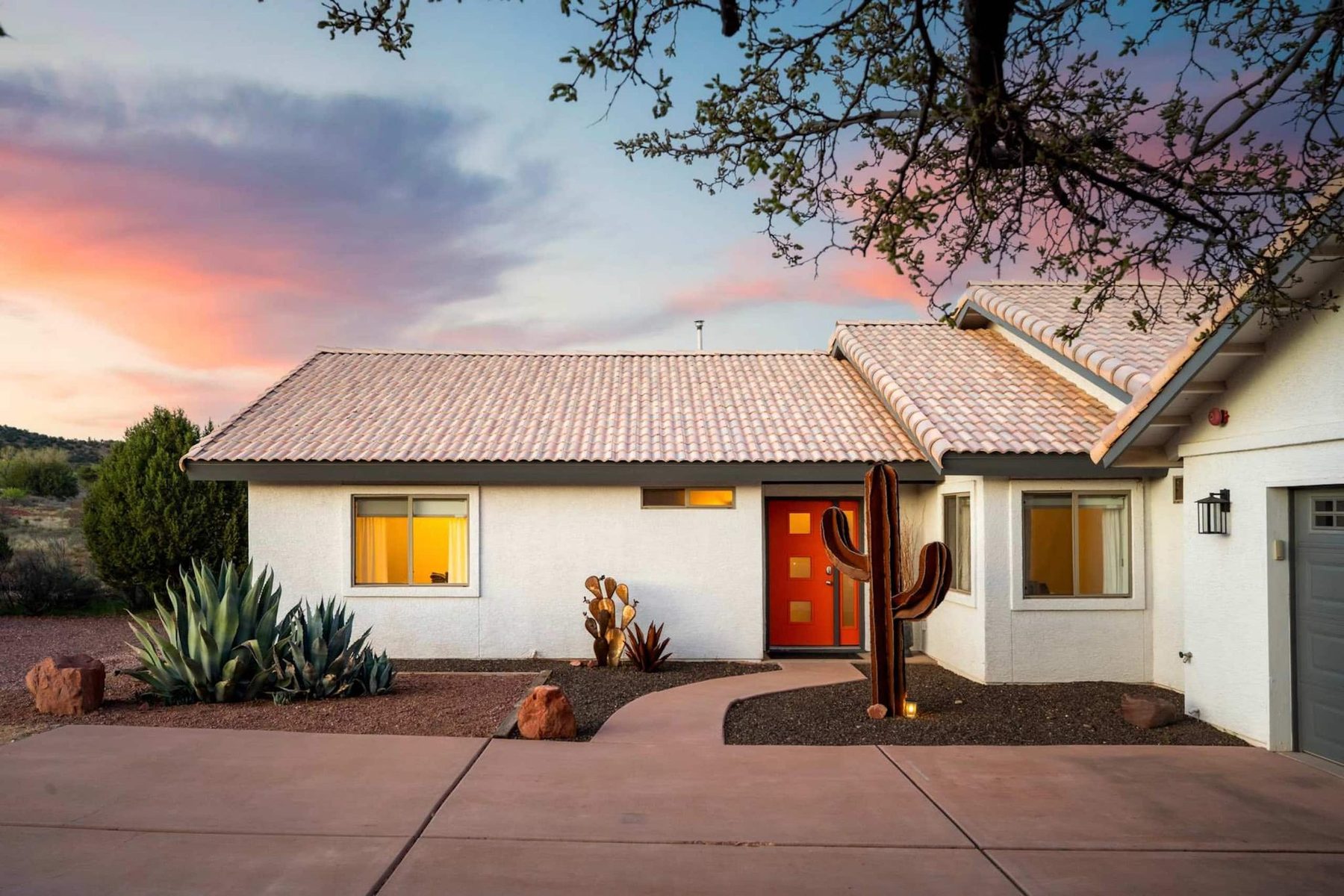
Photograph courtesy of Sedona Pickler.
On the home page of Sedona Pickler, a visitor picks a check-in date, a check-out date and a party size from one to eight. A button then sends the visitor to Airbnb with those choices carried in the link. Below it sit more ways into the same house: Vrbo, Booking.com, a link labeled Book Direct and a link to a pickleball travel network.
The house, which its own pages place in West Sedona, Arizona, is listed as four bedrooms sleeping eight, and its press page names the owners as Brian and Joanna Stoll. It is one property with one calendar, which makes it a tidy case for a question every small host asks sooner or later: what does a direct booking page change, and what does it leave exactly as it was?
This story follows the path as the property's public pages showed it on 23 October 2026. It then spends most of its length on the rules, taxes and visitor figures that any Arizona host reads, whichever channel a guest used. It makes no statement about how any one property meets those rules. Each figure carries its publisher and the date it was read, and the sources are listed at the end.
Where the booking path starts
The page is the property's own website, not a reservation system. Its panel is a small form with two date fields and a guest count. It does not check availability and it does not take a payment. When a visitor presses the button, the page builds a link to a channel and adds the dates and the guest count to it.
The markup shows how. Four of the outbound links are tagged with the names their channels use for the same two dates: check_in and check_out for Airbnb, startDate and endDate for Vrbo, checkin and checkout for Booking.com, and checkIn and checkOut for the direct page. The fifth, to the pickleball network, carries no dates. The channel then does the real work, which is to show whether the nights are open and what they cost. The panel says so in one line: “Airbnb shows live availability with instant booking.”
A visitor does not have to begin at the panel. The home page links to a Sedona guide that it describes as 73 in-depth pages, a journal, pages on heat and climate, drive-time pages for six cities and a set of pickleball reference pages. The booking buttons in the header, the hero, the package cards and the footer all point at the Airbnb listing and are marked to open the same panel.

Four channels, one house
The panel's main button goes to Airbnb, and the line under it reads “Instant book” and “Free cancellation for 24 hours after booking.” Under the heading “Also listed on” come Vrbo, labeled a whole-home rental, Booking.com, labeled free-cancellation rates, a link labeled Book Direct with the caption “HomeTeam VR direct site,” and CrewDogs, which the page calls a pickleball travel network.
The direct link does not lead to a booking engine on the property's own domain. It opens a page on guestybookings.com, a domain tied to the property-management software company Guesty, whose title names the house followed by Home Team Luxury Rentals. The property's press release says the home is run by its owners and their property manager.
That makes the structure the property's own site, three marketplaces, a pickleball network listing and one booking page run through a manager's software. Only the last is a direct booking in the sense hosts usually mean: a reservation made on a page the host side controls, without a marketplace's checkout.
The page keeps one kind of conversation inside Airbnb. For a group buyout, a club trip or a stay of 28 nights or more, it tells visitors to add dates in the panel “or message the host through Airbnb to set it up.” The group quote button on the home page points at the same Airbnb listing.
The terms the page publishes
The page lists its terms in plain blocks, the kind a guest reads once and a host keeps in step across four channels: arrival after 4:00 PM and departure before 10:00 AM, no more than eight guests, a booking guest of 25 or older, and no pets, parties, events or smoking.
Cancellation has two versions. The standard option allows free cancellation within 24 hours of booking and is non-refundable after that. A refundable option is also offered, with free cancellation up to about five days before check-in and a partial refund if the guest cancels before arrival. The page adds that exact terms “depend on your dates and the rate you choose, and are confirmed at checkout.” The checkout, in other words, carries the final terms, and the page is a summary of them.
Other lines cover the edges of a stay. Damage-waiver coverage is included for accidental damage that the guest reports before checkout. A quick guest verification and a short rental agreement with a valid ID “may be requested before arrival.” The Good to Know section also lists an Arizona TPT license number, a state tax license that comes up again below.
The page shows the reviews behind its rating. It reproduces guest reviews from Airbnb, labels them as Airbnb's, and links to them on Airbnb, where the listing showed a 5.0 rating across seven reviews on 23 October.
What each channel says it charges
A one-house host weighs several sets of fee terms, and each channel publishes its own. Table 1 sets out what three of them print for United States hosts, as the channels print it and as read on 23 October 2026.
| Channel | Fee as published | Charged on |
|---|---|---|
| Airbnb, split fee | 3% host fee for most hosts, plus a guest fee of 14.1% to 16.5% | Host fee: nightly price and host-set fees, excluding taxes. Guest fee: booking subtotal, excluding taxes |
| Airbnb, single fee | 15.5% for most hosts and typically 14% to 16% for the rest, all deducted from the payout | Mandatory for most hosts, including those who use property management software |
| Vrbo, pay per booking | 12% commission; no separate processing fee when Vrbo processes the payment | Rental amount and extra fees such as cleaning, pet and boat fees; not charged on traveler service fees, taxes, refundable deposits or insurance products |
| Booking.com | A set percentage that depends on country, property type and agreement; the page prints no single rate | Total booking amount, including fees such as cleaning, applied once the guest checks out; not charged on local taxes such as a city tax |
Airbnb says it is moving all home hosts to the single fee, and that some hosts pay more than the headline figure. A Vrbo host who uses its own payment processor also pays that processor's fees.
Source: Airbnb Help Center, Airbnb service fees; Vrbo Help, About the pay-per-booking (PPB) model; Booking.com for Partners, Understanding your commission. All read 23 October 2026.
Each channel gives a reason, and the reasons are worth reading. Airbnb says it charges a fee “to cover the cost of services like 24/7 customer support.” Vrbo describes pay-per-booking as a model in which a host pays commission only on the bookings received, with no upfront costs. Booking.com describes its commission as the price of access to its platform and its travelers, charged once the guest has checked out.
Two details in the Airbnb page are easy to miss. The page says Airbnb is moving all home hosts to the single fee and phasing out the split fee, and that the single fee is mandatory for “hosts who use property management software.” Under the split fee the 3% host charge is not the whole cost of the platform, because the guest also pays a service fee of 14.1% to 16.5% of the booking subtotal, charged on top of the price.
A direct booking skips the marketplace commission. It does not skip the cost of taking a card payment, which a payment processor charges, or the cost of the software behind the booking page, which each vendor prices in its own agreement. Vrbo's page shows how the pieces can stack. A host who lets Vrbo process the payment pays the 12% commission and no separate processing fee, while a host who uses its own payment processor pays the same 12% plus whatever that processor charges.
Booking.com's page adds the paperwork side of a commission. It sends one invoice a month, covering every reservation whose guest checked out the month before, and it does not charge commission on local taxes such as a city tax. It asks hosts to mark no-shows, cancellations and other changes within 48 hours of checkout, or pay full commission on the original booking. And it notes that marketing programs such as Preferred Partner and Visibility Booster add a percentage on top of the base commission.
Whether a direct price is lower for the guest depends on what the host decides to charge there. A host can find out the way a guest would, by searching the same dates and party size on every channel and comparing the totals.

What a direct page can and cannot do for a one-house host
The first limit comes from the marketplaces. Airbnb's pricing and payment transparency policy requires payments for current, future and repeat bookings to stay on its platform. Among the things it does not allow are asking a guest to communicate off the platform before booking, putting links in listing pages or messages that take people off Airbnb or steer an existing reservation or inquiry to another booking method, offering or soliciting discounts to book off Airbnb, and rebooking or extending an Airbnb reservation somewhere else.
The policy states its purpose as transparency and the protection of guests and hosts, which is why it also requires every mandatory fee to appear in the price a guest sees before booking. The page's list of related articles makes the guest-side argument, that paying and communicating through Airbnb helps keep a guest “protected under all of our host and guest safeguards.” Airbnb says its response to a violation can run from a warning to a suspended or removed listing or account, so a host reads the policy before moving anything.
One passage speaks to managers who run a house through software. The policy says some hosts, “including select software-connected hosts,” may collect mandatory fees or a security deposit off Airbnb, provided the amounts sit in the right pricing field so the guest sees them before booking. Where a host has to collect a tax by hand, the host must show it, either through Airbnb's custom tax tool or inside the nightly price.
What is left is the host's own audience: people who find the property's website or search for the house by name. A direct page serves those guests without a marketplace commission. Each channel's text remains the authority on what a host may say to a guest first met there.
The second limit is time. A host listed on several channels has to keep one set of nights true everywhere. Airbnb's help page describes the calendar-link route: a host copies a link from one calendar and adds it to another, and each side refreshes on a schedule. Airbnb says its calendar updates every three hours and that it can request updates from another site only so many times. A night booked elsewhere can therefore still show as open on Airbnb until the next refresh. The same page adds two details that matter to a one-house host. Nights booked on a connected calendar are blocked on Airbnb, but nights a host blocks elsewhere for preparation time or advance notice may or may not carry over. And Airbnb imports up to two years of data from a connected calendar, so the far end of the calendar needs the same care as next weekend.
The third difference is who does the paperwork. For a marketplace booking, Airbnb's Arizona page says guests pay the state, county and local taxes as part of the reservation and that Airbnb collects and remits them on the host's behalf where it facilitates collection. Arizona law also requires a city that asks for a guest background check to waive it when a marketplace has run one. For a direct booking, the host or the host's manager does both. State law lets a city require liability insurance of at least $500,000, or listing through a marketplace that provides equal or greater coverage. A property sold only through its own page has the first route and not the second.
What a direct page adds is control of the page itself: the terms, the rate, the guest's contact details and the follow-up. What it adds to a host's obligations is the paperwork that a marketplace would otherwise carry in part. For a single house that is a real trade, and each host can price it in hours and dollars before deciding.

Arizona's rules for a short-term rental on any channel
In Arizona the Legislature sets the outer limits, and cities and counties work inside them. Senate Bill 1350, approved on May 12, 2016 and effective after December 31 of that year, added the first version of the state's preemption: section 9-500.38 for cities and towns and section 11-269.15 for counties. The same act created the system under which an online lodging marketplace can register with the Department of Revenue to pay lodging taxes on the transactions it facilitates.
The central sentence of the current section 9-500.39 is short: cities and towns “may not prohibit vacation rentals or short-term rentals.” Beyond that, a city or town may not restrict or regulate them based on classification, use or occupancy except as the section provides. Counties have a parallel section, 11-269.17, for their unincorporated areas.
The reason behind the 2016 law was put plainly by the governor of the time. According to Capitol Media Services, then-Gov. Doug Ducey said opening a home to out-of-state guests gave thousands of residents “the financial breathing room they need to provide for their family.” The cities' reason for wanting more room is the housing argument in the Sedona section below.
The 2022 law, Senate Bill 1168, approved on July 6, 2022, set out what a local government may do, and the current text works as a checklist for a host on any channel. A city may require a local permit, for a fee no higher than the actual cost of issuing it or $250, whichever is less, and must decide an application within seven business days. It may require written notice before the first rental to the single-family homes next door and directly or diagonally across the street. It may require liability insurance of at least $500,000, or listing through a marketplace that provides equal or greater coverage. It may fine an owner on a scale tied to verified violations and, past a threshold, suspend the permit for as long as a year.
The item that bears most directly on a direct page is about advertising. A city may require the local permit number on each advertisement the owner maintains, and a city that issues no permit may require the state TPT license number instead.
The current text on azleg.gov carries a few more lines. A city may require an owner to live on a property that has an accessory dwelling unit approved on or after September 14, 2024. A rental that fails to apply for a required permit within 30 days of the city opening its application process must stop operating. And a rental may not be used for nonresidential purposes, including a special event that would otherwise need its own permit.
The list does not include a limit on how many rentals a city may have. Sedona's mayor at the time asked for that power in 2025, and the 2026 bill described below would have granted it in its first form. For a host the practical point is simpler: the same permit, notice, insurance, license and penalty rules sit behind a booking whichever channel produced it. A direct page changes who collects the tax and who runs the checks. It does not change whether the rules apply.
Taxes on a rental night
Arizona taxes lodging through the transaction privilege tax, called TPT. Under section 42-5070 a rental is transient lodging when the stay is fewer than 30 consecutive days. A person who receives income on which TPT is imposed applies to the Department of Revenue for an annual TPT license, and section 42-5005 sets the fee at $12, with a municipal license of up to $50 where a city imposes its own tax. The state license runs for a calendar year and renews with no state fee; a municipal renewal of up to $50 falls due on January 1.
The marketplace changes who reports. Section 42-5076 defines an online lodging marketplace as a person that provides a digital platform for compensation through which an unaffiliated third party offers to rent lodging. Where a registered marketplace documents to the host that it has remitted or will remit the tax, section 42-5070 takes that income out of the host's own tax base. A booking that does not pass through a marketplace stays in it.
Section 42-5042 then speaks to the direct host. It says an online lodging operator may not offer or rent lodging without a current TPT license and must list the license number on each advertisement, including marketplace postings. The definition of operator reaches an owner whose rental is not offered through a marketplace. The civil penalty is $250 for a first offense and $1,000 for a second or later one.
Airbnb's Arizona page puts the marketplace side in guest terms: on reservations of 29 nights or fewer, guests pay the 5.5% state tax, a county tax and local transient taxes as part of the reservation. It also tells hosts they are “responsible for assessing all other tax obligations,” and that hosts authorize Airbnb to collect and remit occupancy taxes where it facilitates collection.
The rate itself is a stack. Northern Arizona University's W. A. Franke College of Business prints the combined lodging rate for each community, and its July 2026 table, revised in June, gives Sedona two totals because the city straddles two counties: 13.325% in its Yavapai County part and 13.9% in its Coconino County part. Both combine a 3.5% city additional tax, a 3.5% city tax, a county tax and the 5.5% state tax. Phoenix comes to 13.07% in the same table.
Which layers apply to an address depends on whether it is inside a city's limits and which county it is in, so a host confirms the rate for the exact address with the Department of Revenue and the city or county, and checks it again, because the university reissues the table as rates change.
Sedona's permit and the housing argument
The City of Sedona publishes a rental owner's duties on one property owner page, which the Internet Archive captured on May 4, 2026. Before renting, an owner applies for a state TPT license and gets a city permit at $210 per rental unit per year, a fee the city calls non-refundable and non-transferable. The owner provides contact details for the owner, a designee and an emergency contact, carries liability insurance of at least $500,000 per unit, holds any required building approvals, and notifies neighbors adjacent, across the street and diagonally across, in writing by certified mail or hand delivery.
While renting, the owner pays sales and bed tax on time or ensures that “a third-party vendor does this on your behalf,” puts the permit number on every advertisement, and posts a notice within 10 feet of the main entrance. The owner runs a sex offender background check at least 24 hours before check-in or shows that the marketplace did. Special events are not allowed, and the city's examples are weddings, wedding receptions, retreats, conferences, trainings and workshops. The city says violations are a misdemeanor and a civil offense with penalties from $500 up to $3,500, and that a permit can be suspended for up to 12 months.
The city's reason is housing. By the city's own count, AZFamily reported in February 2025, short-term rentals roughly tripled, from about 400 in 2020 to over 1,200 by the close of 2024. The city had declared a housing shortage that December and asked the state for the power to cap rentals.
The 2026 session tested that request. HB 2429, sponsored by Rep. Selina Bliss, would at first have let cities set a maximum number of rentals and minimum distances between them. KJZZ reported that the Arizona Association of Realtors and Airbnb opposed that version and the League of Arizona Cities and Towns supported it. The bill was then rewritten around what the sponsor called repeat bad actors, and she said the Realtors dropped their opposition because the new text protected “the private property rights of homeowners.”
The version that passed the House in March 2026 would have let local governments limit overnight occupancy, at two adults per bedroom plus two more, not counting minors, and suspend permits after three violations in 24 months. The Legislature's bill status data lists its final disposition as “Held in Senate,” and the Sedona Red Rock News reported on April 25, 2026 that the bill was likely dead after two Senate committees did not hear it.
None of that changes what a host does today. A bill that did not pass is not in force, and the statute described above stands as it is. The argument continues in Sedona, because the city says rentals are a large part of its housing and the state has not given it a cap.
Visitors, seasons and one calendar
The City of Sedona's tourism program publishes a monthly lodging report that combines STR hotel data, KeyData's scraped Airbnb and Vrbo listings and TravelClick booking pace. The edition this story could open covers October 2025. Two of its visitor figures bear on a host's own site. Just under half of that month's visitors, 46%, had been to Sedona before, and Phoenix supplied 48.1% of them, far ahead of the next origin markets, Los Angeles at 3.7% and Tucson at 3.6%.
The same report shows how far a rental calendar moves in three months. Scraped Airbnb listings in the city's residential zones filled 30.6% of their available nights in August 2025 and 60.5% in October, and their average daily rate rose from $380 to $504 over the same months. Hotels in the report's study area went from 59.6% occupancy in August to 74.8% in October.
The report prints its own limits, and they apply here. The rental figures are scraped listing data, not tax receipts, and they count listings, which are not the same as permits or homes.

A hotel spreads a swing like that across many rooms, rate plans and channels, while a single house takes the whole swing on one set of dates. The visitor figures allow one reading: nearly half of the visitors come from one metro area and nearly half have been before, which is the audience a host's own site would aim at, with no marketplace commission in the middle. The report does not split visitors by where they stay, so it cannot say how many of them rent houses.
What to do with this
- List every channel the house is on and read each channel's fee page and its rules on off-platform bookings in full. Table 1 names the pages. Keep a dated copy, because the terms change.
- Search the same dates and party size on every channel, as a guest would, and write down the totals. Set the direct price from that comparison rather than from an assumption that direct is cheaper.
- Confirm who collects and remits lodging tax on direct bookings: the host, a manager or the booking software. Check that the TPT license number appears in every advertisement, including the direct page, as section 42-5042 requires.
- Confirm the jurisdiction of the address and read the current permit, insurance, notice and background-check rules from the city or county itself. In Sedona that starts with the city's property owner page.
- Pick one calendar as the source of truth and note the refresh interval of every synced calendar, so the gap in which a night could be sold twice is known. Check which blocked nights, such as preparation days, each sync does not carry.
- Decide where reviews for a direct page will come from before sending guests there, since the reviews a host shows today may be Airbnb's.
This story reports public pages and published figures as of October 2026. It is general information and not legal, tax or financial advice, and a host should confirm requirements with the city, the county, the Arizona Department of Revenue or a qualified professional. Sedona Pickler keeps its own pages, including a press page and a photo credits page, at sedonapickler.com.
Common questions
Can an Arizona city ban short-term rentals?
No. Section 9-500.39 bars cities and towns from prohibiting vacation rentals or short-term rentals, and it lists the purposes for which one may regulate them. Counties have a parallel section, 11-269.17, for their unincorporated areas.
Does a host who takes direct bookings need a TPT license?
Yes. Section 42-5042 says an online lodging operator may not offer or rent lodging without a current TPT license and must list the license number on each advertisement. The definition of operator includes an owner whose rental is not offered through an online lodging marketplace.
Can a host offer a lower price to guests who book direct?
Each channel's terms decide. Airbnb's pricing and payment transparency policy does not allow hosts to offer or solicit discounts to book off Airbnb, and it keeps payments for repeat bookings on its platform. A host reads each channel's current text before pricing differently.
What does a Sedona short-term rental permit cost?
The city's property owner page, captured on May 4, 2026, lists $210 per rental unit per year, non-refundable and non-transferable. State law caps any local permit fee at the actual cost of issuing it or $250, whichever is less.
Is there a cap on short-term rentals in Sedona?
AZFamily reported in February 2025 that the city had no cap and no way to prevent more rentals, and that the mayor at the time was asking the state for the power to set one. HB 2429, which in its original form would have allowed local maximums, was narrowed in the House and shows a final disposition of Held in Senate.
Sources
- Sedona Pickler, Home page (page title: Sedona Home with a Private Indoor Pickleball Court, Sleeps 8) (Read 23 October 2026).
- Sedona Pickler, Press page: facts and photos for journalists (Read 23 October 2026).
- Sedona Pickler, Press release page, dated October 9, 2026 (Read 23 October 2026).
- Home Team Luxury Rentals on Guesty booking sites, Direct booking page for the property (page title only: Sedona-Pickler, Pickleball, Tubs & Fire Pit, Sedona, Home Team Luxury Rentals) (Read 23 October 2026).
- Airbnb, Airbnb service fees (Help Center) (Read 23 October 2026).
- Airbnb, Pricing and payment transparency, community policy (Help Center) (Read 23 October 2026).
- Airbnb, Sync your home host calendar to other websites (Help Center) (Read 23 October 2026).
- Airbnb, Occupancy tax collection and remittance by Airbnb in Arizona (Help Center) (Read 23 October 2026).
- Vrbo, About the pay-per-booking (PPB) model (Help) (Read 23 October 2026).
- Booking.com for Partners, Understanding your commission (Read 23 October 2026).
- Arizona Legislature, Arizona Revised Statutes 9-500.39, limits on regulation of vacation rentals and short-term rentals by cities and towns (Read 23 October 2026).
- Arizona Legislature, Arizona Revised Statutes 11-269.17, the same limits for counties (Read 23 October 2026).
- Arizona Legislature, Arizona Revised Statutes 42-5042, online lodging operators (Read 23 October 2026).
- Arizona Legislature, Arizona Revised Statutes 42-5070, transient lodging classification (Read 23 October 2026).
- Arizona Legislature, Arizona Revised Statutes 42-5076, online lodging marketplace classification (Read 23 October 2026).
- Arizona Legislature, Arizona Revised Statutes 42-5005, transaction privilege tax and municipal privilege tax licenses (Read 23 October 2026).
- Arizona Legislature, Laws 2016, chapter 208 (Senate Bill 1350), relating to online lodging (Read 23 October 2026).
- Arizona Legislature, Laws 2022, chapter 343 (Senate Bill 1168), vacation rentals and short-term rentals (Read 23 October 2026).
- Arizona Legislature, Bill status for HB 2429, short-term rentals, vacation rentals, occupancy (2026, 57th Legislature, 2nd Regular Session) (Read 23 October 2026).
- Northern Arizona University, W. A. Franke College of Business, Transient Lodging Tax Rates: Arizona Communities, July 2026 (revised June 2026) (July 2026, read 23 October 2026).
- City of Sedona, Property Owner Responsibilities (short-term rentals), Internet Archive capture (Captured 4 May 2026, read 23 October 2026).
- City of Sedona Tourism Program, October 2025 Lodging and Spending Reports, Internet Archive capture (Captured 11 May 2026, read 23 October 2026).
- Sedona Red Rock News (Joseph K. Giddens), Senate stalls Bliss' STR bill indefinitely (April 25, 2026).
- KJZZ (Howard Fischer, Capitol Media Services), Arizona short-term rental bill now goes after repeat bad actors to limit overnight occupancy (March 11, 2026).
- AZFamily (Mason Carroll), Short-term rentals could be to blame for Sedona housing shortage (February 3, 2025).
A note on this story: STR Gazette's publisher works with Sedona Pickler on its marketing. The facts here come from the property's published pages and the public sources listed below.
Rules and fees change, so check the source before you act. This is general information, not legal, tax or financial advice.

More guides and features
 Photograph by Larry D. Moore on Wikimedia Commons, CC BY 4.0 licenceGuide · Direct BookingHow Direct Booking Works for a US Short-Term-Rental HostBy Owen Barrett · 22 min read
 Photograph by Gillfoto from Juneau, Alaska, United States on Wikimedia Commons, CC BY-SA 4.0 licenceExplainer · RulesHow Short-Term-Rental Rules Work in the United StatesBy Grant Whitaker · 20 min read
 Photograph by exilexi on Wikimedia Commons, CC BY 4.0 licenceGuide · RulesHow to Find and Read Your City’s Short-Term-Rental RulesBy Grant Whitaker · 21 min read
What readers say