The Ghost in the Garage: Why Hosts Secretly Live in Whole-Home Rentals
Crushed by debt service and falling revenue, hosts are hiding in basements and campers while renting out the main house. The fallout is about to detonate.
The floorboards on the ground floor of an old split-level in suburban Nashville or a bungalow outside Austin speak an uncomfortable language. When guests pay $450 a night for the privilege of an unshared sanctuary, they expect the silence of complete ownership. They unpack groceries into a sanitized refrigerator, kick off shoes in the entryway, and assume the locked interior door near the back hallway leads to a utility closet or an owner storage room packed with spare linens. They do not expect a living, breathing human being to be curled on a twin mattress on the other side of that hollow-core door, listening to their footsteps and praying they do not run the washing machine after ten at night.
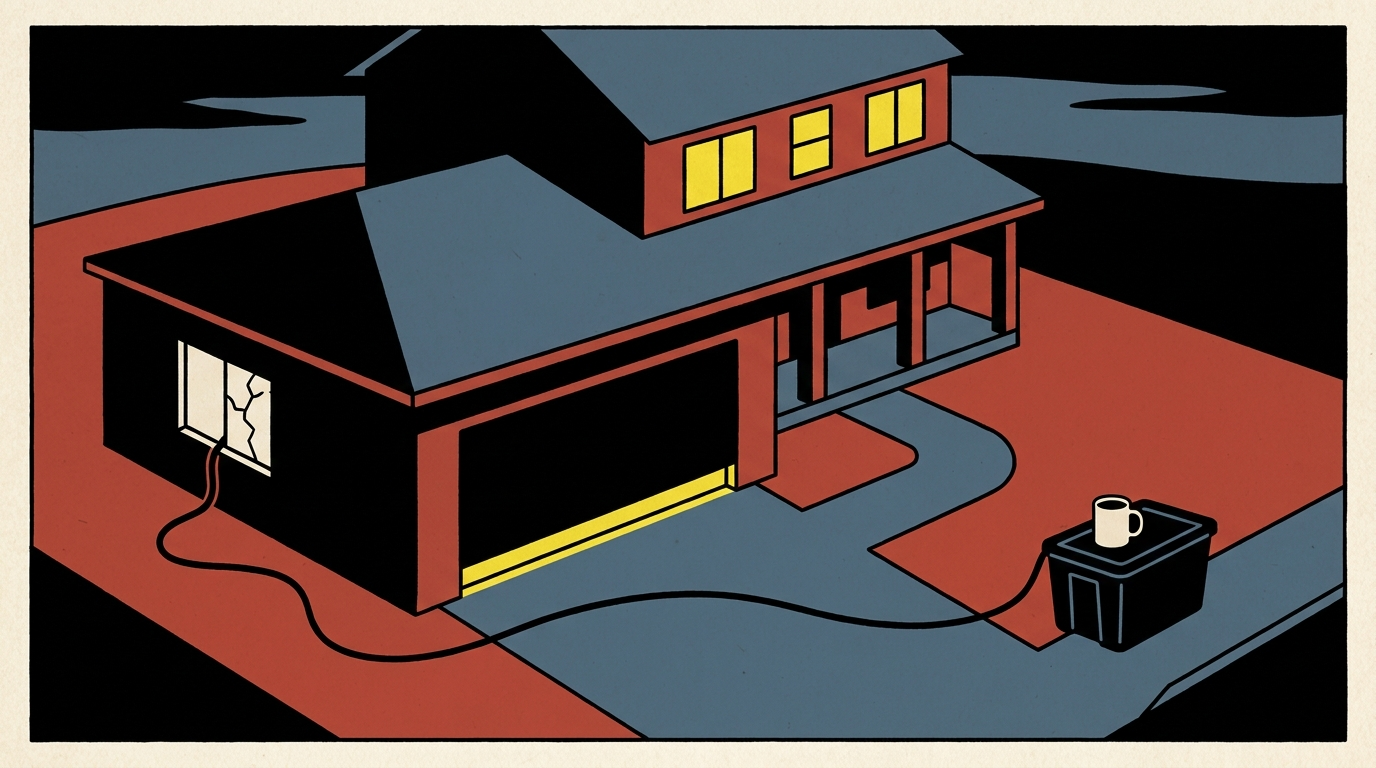
Yet that is precisely what is happening across hundreds of residential neighborhoods. Facing punishing interest rates, brutal revenue per available room declines, and mortgage payments calibrated to the frothy peaks of 2021, a growing contingent of short-term rental operators has slipped into the shadows of their own deeds. They have converted detached garages, unfinished crawlspaces, garden sheds, basements, and parked recreational vehicles into clandestine living quarters. They advertise the property as an entire place, charge the premium rates associated with sole possession, and spend their weekends tiptoeing around their own perimeter like ghosts haunting an asset they can no longer afford to inhabit.
This is not a quaint return to the original couch-surfing origins of home sharing. It is a desperate operational gambit born of financial overextension, algorithmic incentives, and regulatory corner-cutting. It turns the basic contract between guest and host into a high-stakes shell game. When the illusion shatters, the collateral damage cuts through platform terms of service, municipal fire codes, commercial insurance policies, and basic human dignity.
How it actually works
The operational mechanics of stealth co-habitation require strict discipline and daily architectural deception. To pull off the entire home classification while remaining physically present, an operator must sever the property into two operational zones: one visible, polished, and monetized; the other dark, silent, and concealed. The separation is almost never built to commercial code. It relies on deadbolted interior doors, decorative screens obscuring basement stairwells, or exterior side gates marked with private maintenance signs.
The host lists the property on Airbnb or Vrbo by selecting the whole home checkbox. In platform taxonomy, that box is an explicit contractual representation. It tells the prospective guest that they will have exclusive, unshared access to the entire residential structure, its grounds, its amenities, and its entry points. The host uploads photographs that deliberately crop out the detached two-car garage or the lower-level egress door. If the property has an attached mother-in-law suite, the listing copy refers to it vaguely as an off-limits owner closet or a mechanical room used solely for inventory storage.
Once the booking is confirmed, the daily choreography begins. The host parks their personal vehicle three streets away to ensure the driveway matches the vacant look shown in the listing photographs. They enter their secondary quarters through an alleyway or a side gate while the guests are out for dinner. Water usage must be calculated to avoid dropping the water pressure in the primary master bath. Cooking is restricted to induction burners or microwaves that do not vent cooking odors into the shared ductwork of the central heating, ventilation, and air conditioning system. The host tracks the guest movements via exterior doorbell cameras and connected smart locks, waiting for the front door to bolt shut before venturing into the yard to take out the trash or retrieve packages.
This arrangement persists until a single variable fails. A circuit breaker trips because the guest plugged in a curling iron while the host ran a space heater in the basement. The guest investigates the electrical panel, follows the conduit into an unfinished basement room, and finds a space heater, a laptop, and an unmade bed. In an instant, the premium entire-home retreat transforms into an active invasion of privacy, setting off a cascade of operational and financial consequences.
The spreadsheet panic behind the curtain
Nobody volunteers to sleep on a cot behind a plywood partition next to a noisy water heater because they enjoy the ambiance. The rise of the clandestine resident host is the direct consequence of balance-sheet distress. Between 2020 and 2022, thousands of retail real estate investors acquired residential properties at historic market highs, often financing their acquisitions with adjustable-rate debt, debt-service coverage ratio loans carrying rates north of seven percent, or cash-out refinances that left them with crushing monthly debt service obligations.
When travel patterns normalized and platform inventory surged over the subsequent years, performance metrics deteriorated rapidly. According to data tracked across the sector by analytics providers like AirDNA, revenue per available room compressed across dozens of suburban and secondary leisure markets. Properties that generated $8,000 a month in gross booking revenue in 2021 saw monthly yields drop toward $4,500. Yet fixed operating costs moved in the opposite direction. Municipal property tax assessments caught up with peak sales valuations. Residential utility costs expanded. Commercial property and casualty insurance premiums in states like Florida, Texas, and California doubled or tripled as underwriters pulled back from catastrophic risk zones.
Consider the basic arithmetic facing an owner who purchased a suburban single-family property for $650,000 with a monthly carrying cost of $4,800, inclusive of principal, interest, taxes, and specialized insurance. Under full long-term tenant occupancy, the asset might fetch $3,200 per month on a standard twelve-month lease, locking in an immediate monthly cash deficit of $1,600. To bridge that gap, the owner turns to short-term rentals. If the property books twenty nights a month at an average daily rate of $300, the gross revenue reaches $6,000. After platform commissions, cleaning subsidies, software subscriptions, and consumables, the owner retains roughly $4,900, barely enough to service the debt.
The owner has no capital remaining to pay their own rent elsewhere. Moving into an apartment in the same city requires an additional $1,800 to $2,400 each month, pushing the operator into deep personal insolvency. The only variable within the owner control is their own standard of living. By vacating the main house and slipping into the utility footprint of the property, the host eliminates their personal housing overhead entirely. The asset becomes a life-support machine for its own mortgage note.
The host vacates the primary footprint, slips into the utility space, and turns the asset into a life-support machine for its own mortgage.
The price canyon between shared and whole-home
The structural incentive driving this deception is the immense revenue disparity between listing categories. Platforms structure their algorithms around user intent, and user intent heavily favors absolute privacy. A guest searching for a family vacation, a romantic weekend, or an executive work trip will check the Entire Place filter almost by default. Unchecking that box collapses the addressable market.
In almost every market globally, the average daily rate for an entire home is dramatically higher than that of a private room in an occupied house. While a four-bedroom residential home might command $400 a night, a single private room within that same home rarely commands more than $80. Listing the asset honestly as a shared house or a suite with an on-site resident host drops the listing into a bottom-tier pricing bracket populated by budget backpackers, traveling medical workers, and solitary contract workers. The revenue potential plunges by sixty to seventy-five percent overnight.
Furthermore, platform discovery engines penalize ambiguity. If a host attempts to market an attached mother-in-law suite as an entire home, but includes disclosures stating that the host lives in the primary house and shares the backyard, the conversion rate craters. Prospective guests bounce from the listing page the moment they realize they will not have total control over the outdoor space, the parking area, and the visual environment. The search algorithm observes this bounce rate, concludes the listing is uncompetitive, and drops its ranking down the search result pages.
The operator understands this algorithmic penalty completely. They realize that honesty costs thousands of dollars a month in visibility and revenue. To capture the entire-home rate, they must deliver the promise of total solitude on the screen, even if they must physically hide behind a drywall barrier to do so. The platform taxonomy creates a binary financial choice: lie about the level of isolation and pay the mortgage, or tell the truth and face foreclosure.
The surveillance trap and the quiet creep
Maintaining a covert presence on a property requires active operational reconnaissance. This necessity has turned smart home security infrastructure into a tool of domestic surveillance. Devices originally installed to protect property and verify quiet hours are repurposed to track guest movements in real time.
Hosts hiding in secondary spaces rely on networks of smart devices to navigate their own property without being spotted. Video doorbells, floodlight cameras monitoring side yards, and decibel monitors like Minut or NoiseAware become essential navigation systems. The resident host monitors these feeds from a smartphone inside the crawlspace or garage. They watch the front camera to ensure the family has loaded into their minivan before slipping out to run an errand. They monitor internal decibel readings to gauge which room the guests are gathered in, timing their own movements to coincide with higher ambient sound levels inside the main structure.
This arrangement creates severe privacy risks. When an operator lives in extreme proximity to paying guests while concealing that presence, the boundary between legitimate property monitoring and illegal surveillance breaks down completely. A host anxious about being discovered will naturally inspect guest movements more frequently. They notice when guests leave windows open, when they invite extra visitors onto the patio, or when they walk into areas of the yard near the host hiding spot. Inevitably, the host issues a message through the platform app warning the guest about an infraction that could only have been observed through continuous visual tracking.
The psychological friction this produces is profound. Guests possess an instinctive awareness of their surroundings. They notice when the heating system behaves strangely, when a car engine starts in an attached structure that was supposed to be vacant, or when outdoor sensor lights trigger without an animal in sight. The resulting atmosphere is not one of peaceful relaxation, but of an unacknowledged shared space where the guest feels constantly observed by an invisible entity. When guests eventually discover the hidden host, the confrontation is rarely polite; it is fraught with fear, accusation, and immediate demands for police intervention.
The regulatory crossfire and local ordinances
This clandestine practice does not occur in a regulatory vacuum. It is often the direct result of poorly constructed municipal short-term rental frameworks that inadvertently trap property owners between compliance and economic survival.
Across North America and Europe, municipal governments have enacted strict regulations designed to protect permanent housing stock. Cities like Denver, Colorado, and Los Angeles, California, built their regulatory regimes around strict primary residence mandates. Under these frameworks, an owner can only operate a short-term rental if the property is their legal, principal residence for the majority of the calendar year. The policy objective was straightforward: prevent corporate syndicates from purchasing single-family housing stock purely for conversion into commercial tourist lodging.
Simultaneously, cities like New York implemented aggressive restrictions through Local Law 18, which requires hosts to be physically present in the dwelling during short-term stays, bans internal locking doors between host and guest quarters, and limits the total number of guests to two. In other jurisdictions, municipal codes ban unhosted rentals in residential zones outright, permitting only hosted homestays where an owner remains on site to manage parking, noise, and neighborhood impact.
These diverging legal structures create bizarre operational paradoxes. An owner caught between local zoning inspectors and platform search algorithms faces a terrible dilemma:
- To satisfy the municipal code, the owner must document that they reside on the parcel permanently and maintain continuous physical occupancy.
- To satisfy the guest and capture the market clearing nightly rate, the listing must present the physical asset as an exclusive, unshared, entire-home rental.
- To satisfy platform listing categories, the presence of any other individual on the parcel must be explicitly configured as a shared space, which destroys listing visibility and revenue.
- To avoid neighborhood complaints, the host must physically monitor the guests while remaining entirely invisible to the neighbors who might report an illicit hotel operation to city code compliance.
Faced with these competing constraints, operators choose operational fraud. They present an affidavit of primary residency to the municipal licensing bureau, complete with voter registration and utility bills, asserting that they live inside the structure. Then, they publish an entire-home listing on the booking platforms, tell the guests they will have exclusive use of the estate, and retreat into the unpermitted garage to keep watch. They are compliant with the letter of the municipal residency mandate while committing systematic contractual misrepresentation against the consumer and the platform.
The insurance time bomb in the crawlspace
While platform disputes result in financial refunds, the safety and liability consequences of stealth living represent an existential hazard. The spaces hosts convert into hidden shelters are almost never legally permitted for human habitation. Garages, tool sheds, basements with low ceilings, and attic spaces rarely meet basic municipal building codes or life-safety standards.
The most immediate point of failure is fire safety and emergency egress. International Residential Code standards require every habitable room used for sleeping to have at least one operable emergency escape and rescue opening, typically an egress window of specific minimum net clear opening dimensions and sill height. A host sleeping in an unfinished basement or an enclosed garage partitioned with temporary studs and acoustic foam rarely has compliant egress. If a fire starts in the primary kitchen above—perhaps triggered by a guest leaving a pot of oil on the range—the host beneath is trapped behind a wall of smoke with no second route of escape.
Conversely, the host presence introduces extreme fire hazards to the guest structure. Without a permitted kitchen, hidden operators rely on portable electrical devices to sustain themselves. Space heaters, electric hot plates, toaster ovens, and daisy-chained extension cords overloaded onto residential circuits represent the leading causes of residential electrical fires. If a space heater catches fire in a concealed utility room while the paying guests sleep overhead, the results can easily prove lethal.
From an insurance standpoint, this arrangement constitutes a total coverage void. Specialized commercial short-term rental policies issued by carriers like Proper Insurance or CBIZ require policyholders to disclose the true operational nature of the insured property. Homeowner policies with short-term rental endorsements contain strict warranties regarding occupancy, building code compliance, and structural modifications.
When a loss occurs, forensic claims adjusters examine the site thoroughly. If an adjuster discovers that an unpermitted garage conversion or basement warren was being used as an undisclosed living space, the carrier will deny coverage based on material misrepresentation. The policyholder is left entirely exposed to personal liability, third-party bodily injury claims, and structural replacement costs. A host attempting to protect a $4,000 monthly cash flow can find themselves facing a multimillion-dollar civil judgment and personal bankruptcy after a single structural fire.
Platform retribution and the instant refund
For the guest who unlocks a front door expecting privacy and discovers that an undisclosed landlord is lingering on the property, the reaction is swift and punitive. Platforms have zero tolerance for listing misrepresentation that borders on a privacy violation. What a host views as an innocent survival tactic, the platform Trust and Safety desk treats as an urgent security breach.
Under current guest refund policies, discovering an undisclosed person living within the demised premises of an entire-home listing grants the guest immediate grounds for cancellation. The platform will not simply mediate an apology. Trust and Safety teams routinely execute three punitive actions:
- One hundred percent reservation clawback: The platform will immediately reverse the payout for the entire reservation, refunding the guest in full, regardless of how many nights of the booking have already elapsed.
- Relocation cost assessment: The offending host is billed for the emergency rebooking costs incurred to move the displaced guests into equivalent alternative lodging, often at last-minute premium market rates.
- Immediate listing suppression or permanent deplatforming: The property is suspended from search results pending an investigation. If the investigation confirms that the host was living covertly in unlisted sections of the property while marketing it as a solitary entire home, the host account and all associated listings are permanently banned.
When this enforcement hammer falls, the operator financial model breaks completely. In a single evening, a host can lose a $3,000 anticipated payout, incur a $1,500 relocation penalty fee, and lose access to the booking distribution network that services their debt. The illusion of safety evaporates instantly.
The reputation rot across the industry
Beyond individual host economics and municipal citations lies a broader existential threat: the destruction of consumer trust. The short-term rental industry expanded over the past decade by convincing mainstream travelers that private residential spaces could match or exceed the reliability, cleanliness, and security of professional hotels.
That hard-won consumer trust is fragile. It does not take many viral videos showing guests discovering a concealed door behind a bookshelf or finding a host living in a garden shed with an extension cord to poison the well. When travelers begin to fear that booking an entire place means sharing breathing room with an unvetted, undisclosed person listening through the floorboards, they return to traditional hotels. A hotel room may be smaller, but the door deadbolts reliably, the fire exits are marked with illuminated signage, and the building manager does not hide in the basement to avoid being seen.
This behavioral retreat damages the honest operator who invested hundreds of thousands of dollars to construct a truly independent, legally permitted, unshared accessory dwelling unit or who carries the full cost of an unhosted single-family home. The rogue operator cuts prices, captures the booking by deception, poisons the customer relationship, and leaves the rest of the market to pay the reputational tax.
What hosts should do now
Operators who find themselves backed into this operational corner must dismantle the deception before a regulatory enforcement action, an insurance denial, or a safety catastrophe does it for them.
- Audit your listing classifications with brutal objectivity: If you or anyone else occupies any structure on the parcel—whether it is a detached garage, an accessory dwelling unit, a basement apartment, or a parked camper van—you cannot check the unconditioned entire home box without comprehensive, explicit disclosures. Clearly define what is private, what is shared, and whether an on-site manager resides on the grounds.
- Obtain legal permits for your accessory spaces: If you intend to operate a split-parcel model legally, hire a licensed contractor and pull the required municipal permits. Ensure the secondary unit meets residential building codes, including ceiling heights, dedicated electrical sub-panels, proper plumbing connections, and code-compliant egress windows.
- Transition to the mid-term furnished market: If your local market ADR has compressed to the point where short-term vacationers cannot service the debt, pivot the asset to thirty-plus-day stays. Traveling medical staff, corporate transferees, and displaced insurance policyholders care far less about absolute vacation seclusion and are frequently comfortable with an owner living in an adjacent mother-in-law suite if properly disclosed.
- Update your commercial insurance schedule: Call your commercial underwriter and explicitly review the physical configuration of your property. If your insurer believes they are underwriting a vacant single-family residence, but an individual is residing in an unpermitted garage space, execute a policy endorsement immediately to avoid complete coverage cancellation during a catastrophic casualty event.
- Execute a financial exit if the numbers fail: If the property only functions when you sleep on a folding cot behind a utility closet while charging deceptive whole-home premiums to unsuspecting travelers, the real estate investment has failed. Cut your losses, list the home on the open market, and redeploy your remaining equity into an asset that generates legitimate, legally compliant returns.
The era of treating platform listings as fictional advertising copy is over. Guests demand absolute transparency, municipalities are enforcing their zoning boundaries with aggressive data matching, and platform algorithms are punishing deceptive listings with total account cancellation. If you are operating as a shadow in your own basement, step into the light, correct your classification, or hand the keys to someone who can afford to own the property honestly.
Checked by the standards desk (Eleanor Quist): every specific in this story was traced to its source material before publication.
About this piece
An original expert-analysis column by the Stay Gazette desk. Figures are illustrative of how the market behaves; confirm specifics for your own market before you act.




Read the desk every morning.
The day's crackdowns and platform moves, the money, the design and the stays going viral, plus the desk's verdict, in one short email every morning.