The End of the Scarcity War: Why the STR Industry Must Now Fix Dying Towns
For a decade, the short-term rental debate was defined by housing shortages. Now, the industry is being asked to absorb millions of empty homes in shrinking regions.
Every host and property manager knows the script by heart. The city council meets. The affordable housing advocates present their data. The local hotel lobby quietly funds a political action committee. Then the gavel falls, the ordinance passes, and another major metropolitan market effectively regulates short-term rentals out of existence. For a decade, the entire operational and political posture of the short-term rental industry has been built around one overriding concept: scarcity. The business model thrived by taking residential inventory in places where housing was already desperately needed and converting it into transient lodging. We fought a ten-year war over density and displacement. We lost most of the major battles.
But a profound structural shift is occurring just past the city limits of these regulatory war zones. While the industry fixates on the loss of primary markets, a massive, quiet crisis is unfolding in the secondary and rural markets of the developed world. Governments are waking up to a terrifying municipal reality: they have too many houses and not enough people. The math of depopulation is ruthless. The tax base evaporates, the infrastructure crumbles, and the empty buildings become public liabilities. Now, in a total inversion of the last decade, regional governments are looking at the short-term rental industry not as a parasite, but as a municipal utility. They want operators to take over the empty homes. The problem is that the traditional Airbnb model breaks down completely when you try to apply it to a dying town.
What happened
The pivot from managing scarcity to managing abandonment is now generating hard data and actual state intervention. As Skift reported, the short-term rental debate is fracturing into two distinct, opposite realities. On one side are the housing-scarce cities continuing their crackdowns to prevent displacement. The numbers there are stark and final. In New York, following the implementation of Local Law 18 in September 2023, Airbnb listings for stays under 30 days fell 83 percent in a single year, plummeting from 21,900 to just 3,700. In Barcelona, where officials have taken an exceptionally hard line, the justification is rooted in widely cited studies estimating that Airbnb activity raised average rents by 1.9 percent overall, and by roughly 7 percent in the neighborhoods with the highest concentration of short-term rentals.
But the other side of the reality is defined by structural vacancy. According to Skift, Japan currently sits on roughly 9 million empty homes, representing a staggering 13.8 percent of its total housing stock. Rural regions in Italy, Germany, and elsewhere face similar crises of abandoned or underused buildings. For these municipalities, tourism offers a way to absorb unwanted housing without displacing a single resident. The proposed solution is a revival of the Italian albergo diffuso, or scattered hotel. This 40-year-old model converts empty village homes into a single distributed hotel with centralized reception, housekeeping, and management. It is designed to keep guests among the remaining residents and force the money to stay in shrinking communities.
The model is highly labor-intensive. Skift noted that a typical 20-room property employs roughly 5 permanent and 11 seasonal workers, with the majority being women. Because of the sheer difficulty of operating scattered assets, it has historically failed to scale, resulting in only about 150 full properties in Italy over four decades. Now, governments are attempting to force the issue through public planning rather than waiting for lone entrepreneurs. In Japan, a project called NIPPONIA has restored 220 buildings across 108 regions. In Europe, Germany's Black Forest is launching a five-village pilot program slated for 2025 and 2026 to test if the scattered hotel model can be successfully implemented by tourism boards.
The anatomy of structural vacancy
To understand why this shift matters to a property manager or an investor, you have to understand the brutal real estate mechanics of a depopulating town. An empty house in a shrinking village is not a blank canvas waiting for a quirky interior design and a ring light. It is a depreciating liability sitting in a market with no liquidity. In a booming market like Austin or Nashville, an investor buys a property knowing that the underlying asset will appreciate, the long-term rental market provides a safety net if short-term regulations change, and the local economy provides a deep pool of plumbers, cleaners, and electricians to service the property. The short-term rental premium is just the icing on a very solid cake.
In rural Japan or the remote mountains of Italy, none of that is true. There is no long-term rental fallback because there are no local jobs to attract tenants. The property values are often effectively zero. If the roof caves in, the property is simply abandoned because the cost of repair exceeds the market value of the home. This structural vacancy creates a death spiral for the local municipality. Empty homes do not pay adequate property taxes, which means the municipality cannot maintain the roads, the water lines, or the local school. This drives the remaining working-age population away, leading to more empty homes. The local government cannot simply bulldoze the homes, because demolition costs money they do not have, and in many of these historic villages, the buildings are physically attached to one another or protected by heritage laws.
Standard short-term rental operators have tried to enter these markets and failed miserably. The lone wolf host model—buying one cheap house, putting it on Airbnb, and managing it remotely—does not work here. A single house in a dying village cannot generate enough destination demand to keep occupancy high. More importantly, the operational infrastructure does not exist. You cannot hire a reliable cleaning crew on contract when the nearest working-age adult lives forty miles away. You cannot get an emergency plumber at midnight. The platform model, which relies on the host outsourcing the physical labor to a robust local gig economy, completely collapses when the local economy ceases to exist. The only way to make the unit economics work is to scale up, control multiple properties, and hire your own full-time staff. You have to build the exact hotel infrastructure that Airbnb originally promised to disrupt.
The forty-year Italian experiment
This is where the Italian albergo diffuso enters the picture. The scattered hotel is not a new concept; it is a 40-year-old survival mechanism born out of necessity following earthquakes and economic abandonment in rural Italy. The premise is conceptually brilliant. Instead of building a new concrete block hotel on the edge of town—which ruins the aesthetic appeal and extracts money from the local economy—you use the empty housing stock right in the center of the village. One building becomes the lobby and breakfast room. Another building down the street holds three guest suites. A house around the corner holds two more. The entire village becomes the footprint of the hotel.
This model deliberately rebuilds the heavy, centralized hospitality operation. There is a real front desk. There is a unified housekeeping staff. There is a single management entity responsible for the guest experience from check-in to check-out. By centralizing the management but decentralizing the rooms, the operator solves the primary problem of rural tourism: guest trust. A tourist might be hesitant to book a standalone Airbnb in a remote, decaying village where they have to rely on a lockbox and a host who lives in Milan. But they will book a room in a scattered hotel because they know there is a front desk with a human being who can fix the boiler if it breaks.
The short-term rental industry spent ten years fighting governments over the right to exist in overcrowded cities, only to discover that the next frontier requires acting as a municipal utility for places running out of people.
The economic impact on the ground is entirely different from the standard platform model. When a remote investor buys a house and puts it on Airbnb, the bulk of the revenue leaves the community. The investor takes the profit, the platform takes the fee, and only a fraction remains to pay the contract cleaner. The scattered hotel model traps the money locally. Because it requires centralized operations, it creates actual, permanent jobs. Employing 5 permanent and 11 seasonal workers for a 20-room operation is an exceptionally high labor-to-room ratio. In a village with a population of 300, creating 16 jobs is an economic earthquake. It provides a reason for young people to stay, and it creates a micro-economy that can support a local bakery, a local laundry service, and a local tradesman. It is exactly what rural mayors dream of.
The friction of fragmented ownership
If the scattered hotel is such a perfect solution, why are there only roughly 150 full properties in Italy after four decades of trying? The answer lies in the nightmare of fragmented ownership and real estate law. Building a standard hotel is legally simple: you buy a plot of land, you secure a commercial construction loan, you build the box, and you own the asset. Assembling a scattered hotel requires dealing with the most toxic, complicated real estate on earth: inherited rural property.
Imagine a property manager wants to launch a 20-room scattered hotel in a dying village. They need to secure five or six different empty buildings. Those buildings are rarely owned by a single entity. They are owned by the grandchildren of the original residents, who inherited the properties in fractions when their parents died. To secure a long-term master lease on one decaying stone house, the operator might have to negotiate with four different cousins who live in four different cities and who hate each other. If one cousin refuses to sign, the deal dies. Multiply that process across six buildings, and the legal friction becomes insurmountable for a normal hospitality entrepreneur.
Even if the operator manages to secure the leases, the physical renovation is a massive capital sink. These are not standardized drywall boxes. They are historic structures with strict heritage protections. You cannot standardize the plumbing. You cannot standardize the HVAC systems. Every room requires a custom renovation plan approved by a local preservation board. The operator is forced to pour hundreds of thousands of dollars in capital expenditures into buildings they do not actually own, relying entirely on the ironclad nature of a 20-year master lease to recoup their investment. When you combine the legal costs of title assembly with the hyper-customized renovation costs, the return on investment stretches out to a timeline that private equity simply will not touch.
The debt problem and capital expenditure
This brings us to the core reason the model has failed to scale globally: debt financing. The explosive growth of the short-term rental industry over the last decade was fueled by easy money. Investors could secure residential mortgages at low interest rates, buy a house, furnish it quickly, and immediately generate cash flow. The asset itself served as clean, easily appraised collateral for the bank. If the short-term rental business failed, the bank could foreclose on the house and sell it on the residential market.
Financing a scattered hotel is a commercial banking nightmare. A bank looks at the proposal and sees an operator asking for a massive commercial loan to renovate assets they do not own, in a market with zero population growth, operating a highly labor-intensive business model. There is no hard collateral. If the scattered hotel fails, the bank cannot foreclose on the master leases and sell them, because the underlying buildings are worthless without the operating business. The traditional banking sector refuses to finance these projects without massive personal guarantees or government backing.
Because private debt is unavailable, operators are forced to rely on equity, which demands high returns, or government subsidies, which come with crippling bureaucratic oversight. This is why the lone entrepreneur has largely abandoned the model. The only entities capable of swallowing the upfront capital costs and surviving the prolonged stabilization period are either massive institutional players with patient capital or public governments treating the project as a loss-leading infrastructure investment.
Japan's regulatory forcing function
This is exactly why Japan is currently the most fascinating market in the world for the short-term rental industry. Japan has 9 million empty homes, but it also has a regulatory hammer that forces the market into consolidation: the 180-day minpaku cap. Under national law, standard residential short-term rentals are strictly capped at 180 operating days per year. This regulation was designed to appease the powerful domestic hotel lobby and prevent the residential housing stock in Tokyo and Kyoto from turning into full-time tourist lodging.
But apply that 180-day cap to a rural village in the Japanese Alps. A standalone Airbnb host cannot survive on 180 days of revenue. The carrying costs of the property, the winter heating, and the maintenance of an aging timber home require year-round cash flow. The 180-day cap destroys the unit economics of the casual, asset-light host. To operate legally for 365 days a year, the property must be fully licensed under the Hotel and Ryokan Business Act. Getting that license requires strict fire safety upgrades, proper reception facilities, and professional management.
The regulation effectively outlawed the amateur host and mandated the creation of distributed hotels. If you want to monetize empty rural homes in Japan, you have to professionalize. This is why projects like NIPPONIA have successfully restored 220 buildings across 108 regions. They are not acting as casual hosts; they are acting as institutional regional developers. They secure the full hotel licenses, they centralize the operations, and they work directly with local governments to absorb the empty housing stock. The 180-day cap acted as a forcing function, clearing out the bottom tier of the market and leaving room only for heavily capitalized, professional operators who can run a true scattered hotel.
The institutional takeover in the Black Forest
The realization that private entrepreneurs cannot easily scale this model has led to a major shift in Europe. Governments are no longer waiting for the private sector to figure it out; they are stepping in to act as the developers themselves. The Black Forest pilot in Germany, targeting five villages across 2025 and 2026, is a prime example of this institutional pivot. The tourism boards and regional governments are attempting to deliberately plan a scattered hotel into existence.
This represents a massive philosophical shift for the short-term rental industry. For years, platforms and hosts operated aggressively outside of municipal planning. The ethos was to move fast, list the property, and ask for forgiveness later. Now, in these depopulating zones, the municipality is the lead partner. The government identifies the empty buildings, the government helps clear the title issues, the government provides the grant money for the heritage renovations, and then the government issues a request for proposals to find a property manager to run the operation.
But tourism boards are notoriously terrible at running hospitality businesses. Bureaucracies move slowly. They design pilot programs based on political optics rather than guest demand. A government can spend two years and two million euros perfectly restoring five historic homes in a Black Forest village, but if the local tourism board does not understand dynamic pricing, channel distribution, and modern guest communication, the project will bleed money. The friction between the rigid expectations of a government grant and the fast-moving reality of digital hospitality is where these public pilots usually fail. They need professional short-term rental operators to manage the assets, but those operators demand operational control that governments are often reluctant to give.
The operational reality on the ground
For the property manager who actually wins the contract to run one of these scattered hotels, the day-to-day operational reality is a logistical nightmare. Running twenty units in a single apartment building in Miami is easy. The cleaner takes the elevator from floor to floor. The linens are stored in a central closet on the ground floor. The WiFi runs on a single mesh network. The maintenance technician can check all twenty HVAC units in an afternoon.
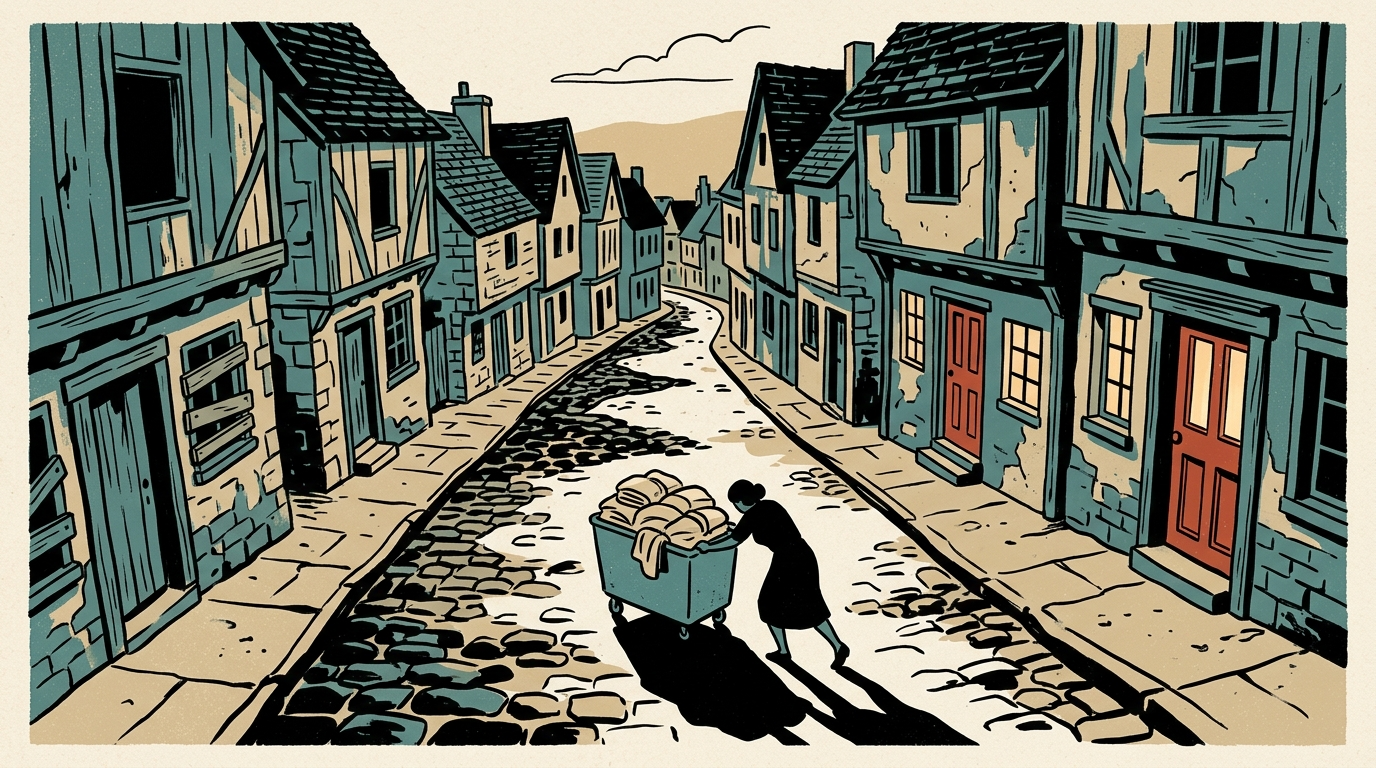
Running twenty units scattered across a medieval village is warfare. The housekeeper has to push a commercial linen cart over uneven cobblestone streets in the rain. Every building has a different lock, a different boiler, and a different set of quirks. If the WiFi drops in a 300-year-old stone house, the signal cannot penetrate the walls, and the router is locked in a basement that requires a physical key. When a guest arrives at midnight and cannot find their specific house down a poorly lit alleyway, the front desk agent has to physically walk out into the weather to guide them.
This operational density destroys margins. The labor costs are staggering because you are paying for travel time between units. The maintenance costs are unpredictable because you are dealing with failing, century-old infrastructure. Furthermore, there is a massive gap in guest expectations. When a guest books an Airbnb, they expect a certain level of self-sufficiency. When a guest books a room in what is marketed as a scattered hotel, they expect hotel-level service. They want fresh towels delivered immediately. They want the room temperature adjusted perfectly. Trying to deliver Marriott-level immediate response times across a scattered footprint of rural homes requires a massive, highly trained staff. That is why the model requires 16 workers for 20 rooms. The operator is paying luxury-hotel labor costs while usually charging standard short-term rental nightly rates.
The platform distribution challenge
Finally, there is the fundamental challenge of how this product actually interacts with the major distribution platforms. Airbnb, Vrbo, and Booking.com built their algorithms and user interfaces to sell distinct, individual units. They are essentially massive, global classified ads. The scattered hotel completely breaks the user interface of a standard short-term rental platform.
Does the operator list the scattered hotel as a single property with twenty different rooms? If so, Airbnb's algorithm struggles to categorize it, and guests get confused when they realize the room they booked is four streets away from the breakfast room they saw in the primary photo. Do they list it as twenty separate properties? If so, they lose the branding power of the unified hotel, and they have to manage twenty different listings, twenty different reviews, and twenty different sets of messaging rules. Booking.com is slightly better equipped to handle distributed properties due to its long history with European guesthouses, but the integration is still clunky.
The platforms have spent years trying to push professional operators into standardized boxes. They want instant book, uniform cancellation policies, and predictable amenities. The scattered hotel is the exact opposite of standardization. It is highly specific, deeply localized, and requires extensive pre-arrival communication to ensure the guest understands exactly what they are booking. Until the major platforms build a specific distribution category for distributed rural hotels, operators will be forced to rely heavily on direct bookings, which requires a massive marketing budget that most small operators do not have.
What hosts should do now
The window for easy money in major metropolitan markets is closing rapidly, but the era of government-subsidized rural operations is just beginning. Property managers and investors who want to survive the next decade need to stop looking for regulatory loopholes in saturated cities and start looking for structural vacancy in secondary markets. The skill set required is completely different: you must shift from being a digital marketing expert to being a regional development partner.
- Audit your regional market for structural vacancy. Look for municipalities within a three-hour drive that have declining populations but intact historic infrastructure.
- Stop searching for single-family homes to buy. Start searching for local economic development grants, heritage restoration funds, and tourism board pilot programs that will subsidize the capital expenditure.
- Build a master-lease template specifically designed for inherited, multi-owner properties. The biggest hurdle to rural expansion is clearing title and securing long-term operational control without buying the asset.
- Shift your operational model from gig-economy contractors to full-time, W-2 staff. You cannot run a scattered hotel on transient labor; you must build a permanent local team.
- Establish a direct relationship with the local mayor or town council before you sign a single lease. In a depopulating town, the government is your primary business partner, not your regulator.
The short-term rental industry has spent a decade being told it is destroying neighborhoods. Now, a growing number of regions are explicitly asking the industry to save them. The operators who figure out the heavy, complicated, labor-intensive mechanics of the scattered hotel will secure decades of government-backed cash flow. The operators who refuse to adapt will be left fighting over the remaining scraps in cities that no longer want them.





Read the desk every morning.
The day's crackdowns and platform moves, the money, the design and the stays going viral, plus the desk's verdict, in one short email every morning.