
Vrbo Just Lit the Fuse on a Bidding War: Pay Up or Fade Out
The platform's global rollout of sponsored listings isn't just a new feature; it's a seismic shift, forcing hosts and managers into a brutal pay-to-play battle for visibility. Your wallet just got a new job.
The axe has fallen. Vrbo, long seen by many as the slightly less cutthroat alternative to Airbnb, just dropped a bombshell that will fundamentally rewire how hosts and property managers compete for bookings. Forget relying on clever descriptions or perfect photos alone. From this day forward, if you want to stand out, you're going to have to pay up.
This isn't a rumor, it's not a test, and it's not going away. Vrbo has officially launched 'Sponsored Listings' globally for all partners. This means the prime real estate at the top of search results is now for sale, and every host, from the independent homeowner to the multi-unit management company, is about to be dragged into a bidding war for traveler eyeballs. The era of pure organic reach on Vrbo is over. Welcome to the new world, where visibility comes with a price tag, and the biggest wallets just got a significant advantage.
The New Tollbooth on Vrbo's Highway
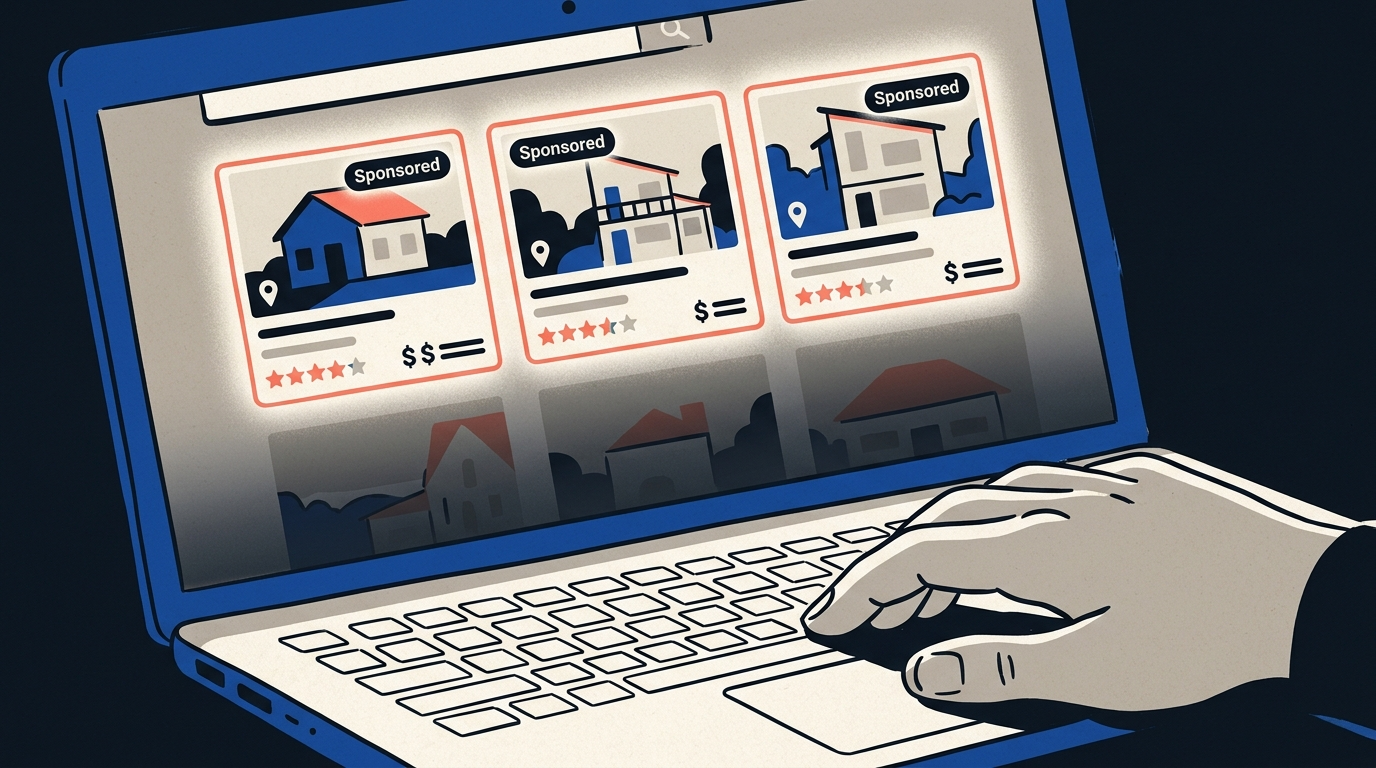
Vrbo's 'Sponsored Listings' program is straightforward in its mechanics, but devastating in its implications. Property managers and hosts can now pay for premium positions at the very top of relevant search results. This isn't some subtle tweak to an algorithm; this is a direct, undeniable monetization of the most valuable digital real estate on the platform. If a traveler searches for 'beach house in Miami' or 'cabin in the Smokies,' the listings they see first will increasingly be those that have paid for the privilege.
The model Vrbo has chosen is a 'pay-per-booked-night' system. This means partners only pay when a traveler clicks on a promoted property and then completes a booking. This is a crucial distinction. Unlike a pay-per-click (PPC) model, where you pay for every click regardless of conversion, or a pay-per-impression (CPM) model, where you pay just for views, Vrbo's system theoretically aligns with a host's ultimate goal: completed bookings. It sounds fair on the surface, a 'no booking, no fee' promise that might lull some into a false sense of security. But make no mistake, this is still a new, mandatory cost of doing business for anyone serious about maximizing their Vrbo income.
Campaigns are managed through the Expedia Group Advertising platform, a clear signal of Vrbo's deeper integration into its parent company's broader ecosystem. Hosts and managers select their target audience and submit a bid for each booked night. The minimum bid is set at $5, with no maximum. This 'no maximum' clause is where the real battle will be fought. Imagine a highly competitive market like Orlando or Scottsdale during peak season. What will a winning bid look like? $10? $20? $50 per booked night? We've seen these numbers escalate rapidly in other ad markets, and there's no reason to believe Vrbo will be different.
The system uses an 'advertising score' to determine which properties win the auction and are eligible to appear in those coveted premium positions. While the exact weighting of this score isn't fully transparent, it likely combines bid amount with other factors like listing quality, conversion history, traveler reviews, and perhaps even response times. This means it's not purely a money game, but money is now undeniably the primary ante. Partners cannot see competing bids, which introduces an element of strategic guesswork and favors those with the resources to test and optimize extensively. They can, however, monitor impressions, clicks, bookings, and return on advertising spend (ROAS) through a campaign dashboard, providing some level of data for performance analysis.
This isn't just 'another option' for marketing; it's a fundamental shift. When the top spots are consistently occupied by paid listings, the organic results get pushed further down the page, becoming less visible and less effective. For many hosts, especially those who have relied on Vrbo's historically strong organic reach, this is an existential threat. The days of simply having a great listing and waiting for the bookings to roll in are rapidly drawing to a close.
The Price of Prominence: A Deep Dive into the "Pilot" Numbers
Expedia Group, Vrbo's parent company, released some impressive figures from the six-month pilot program that preceded the global rollout. Participating partners, they reported, recorded average increases of 49% in bookings, 39% in revenue, and 30% in booked nights. These numbers, on their face, sound like a host's dream. A near 50% jump in bookings? Sign me up, right?
But here at STR NEWS, we've learned to read between the lines, especially when platforms release their own internal data. The report specified that these figures are 'based on Expedia Group internal data,' and 'further details about the sample and comparison period were not published.' This lack of transparency is a red flag the size of a king-sized duvet. Why no details on the sample size? We know only that 'nine property management companies' participated, including industry giants like AvantStay and Vacation Rental Collective. These are not your average independent hosts. These are well-capitalized, professionally managed operations with dedicated marketing teams, sophisticated revenue management software, and often, hundreds or thousands of properties.
The 'average' nature of the reported increases also masks a crucial reality. Did all nine companies see these gains? Or did a few perform exceptionally well, skewing the average, while others saw minimal or even negative returns? What was the baseline? Were these companies already struggling for bookings, making any boost look substantial? What was the comparison period? Was it against a period of low demand, making the pilot results look artificially inflated?
Furthermore, and critically, how much did these companies spend to achieve these gains? The reported increases in bookings and revenue are meaningless without understanding the corresponding increase in marketing spend. If a 49% increase in bookings came at the cost of a 60% increase in advertising spend, the net result for the host's bottom line could be negative, or at best, a wash. The 'pay-per-booked-night' model, while attractive, still adds a direct cost to every single booking generated through the sponsored channel. This cost eats directly into the host's margin.
For large property management companies, these pilot results might be genuinely achievable and even beneficial. They have the scale to absorb initial advertising costs, the data to optimize bids, and the capital to invest in a long-term strategy. They can run A/B tests, analyze ROAS across hundreds of listings, and fine-tune their campaigns with a precision that an individual host simply cannot match. For them, this might indeed be a powerful new tool to fill gaps during quieter periods or dominate competitive markets. For the smaller player, however, those rosy averages could be a mirage, leading them to pour money into a system designed to favor the big guns.
The pilot results, while encouraging for Expedia Group, should be viewed with extreme skepticism by the average host. They represent a best-case scenario for a select group of highly resourced players, not a universal promise of increased profitability for everyone.
Expedia's Grand Design: Integrating, Monetizing, Dominating
This move isn't happening in a vacuum. Tim Rosolio, vice president of vacation rental partnerships at Expedia Group, explicitly stated that Vrbo’s migration to the group’s ecommerce technology platform 'had enabled it to develop the advertising product.' This is a critical piece of the puzzle. Expedia isn't just running Vrbo as a separate entity anymore; it's integrating it deeply into its core technology and business strategy. This means shared infrastructure, shared data, and a unified approach to monetizing travel. It's a power play, plain and simple.
The 'Sponsored Listings' rollout is just one part of a much wider product blitz across Vrbo and property management software provider Escapia, which is also owned by Expedia Group. This is a comprehensive strategy to cement Expedia's dominance in the vacation rental space. Soon, Vrbo properties are expected to become bookable within Expedia travel packages. This is a game-changer for distribution. Imagine a traveler booking a flight and car rental through Expedia, and then being presented with Vrbo vacation rentals as part of a curated package. This moves vacation rentals from a niche 'alternative accommodation' category into the mainstream travel booking funnel, competing directly with hotels and resorts on Expedia's own turf.
Rosolio's comment that 'vacation rentals were no longer viewed solely as an alternative accommodation category, with guests increasingly expecting standards of cleanliness and service comparable with hotels,' further underscores this strategic pivot. Expedia Group is pushing Vrbo towards a 'hotelification' model. This means more standardized offerings, more predictable experiences, and, critically, more opportunities for Expedia to monetize every step of the traveler's journey, just as they do with hotels.
This integration also extends to the backend. Escapia, a key property management software, has updated its reservation grid and distribution tools, and Vrbo Payments is being piloted within the system. This creates a tighter, more controlled ecosystem. For property managers already using Escapia, this might streamline operations, but it also ties them more closely to Expedia's infrastructure and payment processing, giving the conglomerate even more leverage. It's a smart, calculated move by Expedia to capture more market share, control more of the transaction, and extract more value from every booking, regardless of whether it's a hotel room or a three-bedroom vacation home.
The Arms Race for Attention: Who Can Afford to Play?
The introduction of sponsored listings fundamentally alters the competitive landscape on Vrbo. In any pay-to-play system, capital becomes a primary determinant of success. This isn't just about having a better property or providing better service; it's about having the budget to ensure your property is seen first. This creates an immediate and undeniable advantage for large property management companies (PMCs) and institutional investors.
Consider the independent host: a single property owner, perhaps managing their rental part-time, relying on organic search and word-of-mouth. Their marketing budget is often minimal, if it exists at all. Now, they are forced to compete for visibility against companies like AvantStay, which manages thousands of high-value properties and has dedicated marketing departments with significant budgets. These PMCs can afford to bid aggressively, test different strategies, and absorb the costs of optimization. They can leverage their scale to achieve a lower cost per acquisition (CPA) even with higher individual bids, because their overall volume makes the investment worthwhile.
The opacity of the bidding system further exacerbates this imbalance. Since partners 'cannot see competing bids,' smaller players are forced to guess. They might overbid, wasting precious capital, or underbid, losing out on valuable prime placements. Large PMCs, with their trove of historical data and sophisticated analytics, can make more informed decisions, effectively gaming the system through sheer analytical power and financial muscle. They can use their ROAS dashboards to fine-tune bids across a portfolio, optimizing for maximum profitability in a way that's simply impossible for a single-listing owner.
This is not a level playing field. It's an arms race for attention, and the ammunition is money. While the ability to target specific audiences and fill gaps during quieter periods is touted as a benefit, the reality for many independent hosts will be increased pressure on their margins. They will be faced with a stark choice: pay up and potentially erode their profitability, or risk fading into obscurity on the Vrbo search results page. The promise of 'more control' over when and where properties are promoted rings hollow when the underlying mechanism is a forced expenditure for maintaining baseline visibility.
This trend mirrors what we've seen on other platforms. Google's search results are dominated by ads. Amazon's product pages are riddled with sponsored listings. It’s the natural evolution of any successful online marketplace: once a platform achieves critical mass and becomes a primary channel for discovery, it inevitably shifts from facilitating organic connections to monetizing those connections. Vrbo is simply following a well-worn path, but for the hosts who built the platform's inventory, it feels like a betrayal of the original promise.
The Shifting Sands of Online Travel: A History of Monetizing Search
To understand the full gravity of Vrbo's move, we need to look beyond the immediate announcement and place it within the broader history of online platforms. This isn't a novel concept; it's the inevitable lifecycle of any successful digital marketplace. From Google to Amazon, the trajectory is remarkably consistent: first, attract users and content through a promise of free discovery and utility; second, achieve critical mass and market dominance; third, begin to monetize that dominance by charging for visibility.
Think about Google. In its early days, search results were purely organic, ranked by relevance. Then came AdWords, and suddenly, the top spots were for sale. Today, the first page of many Google searches is dominated by paid advertisements, pushing organic results further down, often 'below the fold' where fewer users scroll. The same happened with Amazon. What started as a simple online bookstore evolved into a massive marketplace where product visibility is now heavily influenced by sponsored product ads. If you're a seller on Amazon, paying for ads is often a non-negotiable part of your strategy to get noticed amidst the millions of other products.
In the travel industry, Booking.com has long offered sponsored search placements to its accommodation partners. They pioneered many of these 'pay for visibility' models in the hotel space, and it was only a matter of time before the short-term rental platforms followed suit. Even Airbnb, often seen as the last holdout, has reportedly tested promoted listings with selected hosts. The writing has been on the wall for years: organic reach, while valuable, is a temporary gift from platforms. Once that gift is leveraged to build a dominant position, it's rescinded or, more accurately, converted into a revenue stream.
This evolution is driven by the platforms' own business imperatives. They are publicly traded companies, accountable to shareholders, and constantly under pressure to demonstrate growth and increased profitability. Monetizing search visibility is one of the most direct and effective ways to do this. It's a predictable revenue stream that leverages their most valuable asset: their user base and the data they collect. For Vrbo and Expedia Group, this isn't about being 'fair' to all hosts; it's about maximizing shareholder value. And in that calculus, charging for prime placement is an entirely logical, if painful, step.
Hosts who lament the loss of pure organic reach are right to feel frustrated. They were instrumental in building these platforms, contributing their properties and services, and creating the inventory that made these sites valuable. But the platforms have matured, and the rules of engagement are changing. The 'free lunch' of easy organic bookings is over. The new reality is that if you want to play on these platforms, you have to be prepared to pay their tolls, just as businesses in other sectors have learned to pay for advertising on Google, Facebook, or Amazon.
The 'free lunch' of easy organic bookings on Vrbo is over. If you want to play on this platform, you have to be prepared to pay their tolls.
Beyond the Bids: Vrbo's Full Product Blitz
While sponsored listings are the headline-grabbing change, it's crucial to remember that this is part of a much broader product rollout across Vrbo. This isn't a one-off feature; it's a comprehensive strategy to reshape the platform and, by extension, the host experience. Many of these additional features further solidify the 'hotelification' trend we've been tracking at STR NEWS, pushing vacation rentals closer to the operational models of traditional hotels.
New features include the introduction of same-day bookings and non-refundable rates. Same-day bookings cater to spontaneous travelers, often a segment hotels have long served, but it requires hosts to be exceptionally responsive and have robust operational readiness. Non-refundable rates, a staple in the hotel industry, offer travelers a lower price in exchange for booking certainty for the host. While this can be a valuable tool for revenue management, it also introduces a more rigid booking structure that some guests, accustomed to the flexibility of STRs, might find less appealing. For hosts, it means careful consideration of their cancellation policies and pricing tiers.
Vrbo is also rolling out tools for sending digital welcome guides, a small but significant step towards standardizing guest communication and enhancing the guest experience. This helps hosts provide consistent information and reduces manual effort, aligning with the expectation of professional service that Rosolio mentioned. Two additional cancellation policies are also now available, allowing operators to offer refunds until either five days or one day before check-in. This increased flexibility in cancellation options gives hosts more nuanced control over their booking terms, allowing them to tailor policies to different property types or market conditions.
Perhaps most importantly, a host protection program covering chargebacks, property damage, and income lost following guest-related damage is also planned. While details are still emerging, this is a critical development. Chargebacks can be a nightmare for hosts, and robust protection against property damage and lost income is something the industry has long demanded. If implemented effectively, this program could offer a significant layer of security, addressing some of the most pressing risks hosts face. However, the devil will be in the details of its coverage, exclusions, and claims process.
On the property management software front, Escapia has updated its reservation grid and distribution tools, and Vrbo Payments is being piloted within the system. These backend integrations are designed to create a more seamless experience for large PMCs and to further entrench Expedia's control over the entire booking and payment flow. For hosts using Escapia, this could mean more efficient management, but it also means deeper reliance on the Expedia ecosystem.
Taken together, this suite of features paints a clear picture: Vrbo is maturing, professionalizing, and converging with the broader online travel agency (OTA) model. It's moving away from its early roots as a purely peer-to-peer platform and embracing a more hotel-like operational framework. This means more tools for hosts, but also more rules, more complexity, and ultimately, more costs as the platform seeks to monetize every aspect of the transaction.
The Unseen Hand: How Platforms Shape Markets and Costs
Platforms like Vrbo are not neutral intermediaries. They are powerful market makers. By controlling the primary channels of discovery and booking, they exert immense influence over market dynamics, host behavior, and ultimately, the profitability of the short-term rental business. The introduction of sponsored listings is a stark reminder of this unseen hand, actively shaping the industry in ways that benefit the platform first and foremost.
When visibility becomes a purchasable commodity, the platform gains a new lever of control. It can effectively dictate who gets seen and who doesn't, creating a two-tiered system where organic excellence alone is no longer sufficient. This forces hosts into a continuous cycle of investment, not just in their properties and guest experience, but in their platform marketing budget. It's a form of rent-seeking, where the platform, as the 'landlord' of the digital space, extracts a fee for access to its 'tenants' (the travelers).
This dynamic also has broader implications for competition and market concentration. As discussed, larger PMCs are better positioned to leverage sponsored listings due to their financial resources and analytical capabilities. This could accelerate the consolidation of the STR market, making it harder for small, independent operators to compete effectively. If a traveler consistently sees properties from AvantStay or Vacation Rental Collective at the top of their search, those brands gain further market share, potentially leading to a less diverse and more homogenized inventory over time.
Moreover, the increased cost of customer acquisition through sponsored listings will inevitably be passed on. Hosts will either absorb these costs, shrinking their already tight margins, or they will raise their nightly rates to compensate. This could contribute to overall price inflation in the STR market, impacting travelers and potentially fueling further regulatory scrutiny from cities concerned about affordability. The chain reaction from a platform's monetization strategy can be far-reaching, affecting everyone from the host's bottom line to the guest's vacation budget and even the broader housing market.
The narrative from platforms often frames these changes as offering 'more control' or 'greater opportunities.' While technically true that hosts now have 'control' over their ad spend, this control comes at a price, and often, it's a forced choice rather than a genuine option. The 'opportunity' is often simply the opportunity to stay competitive in a market that the platform itself has made more challenging. It's a subtle but powerful shift in the power dynamic, further cementing the platform's role as the indispensable gatekeeper, and the host's role as a dependent supplier.
The bottom line for hosts
The launch of Vrbo's 'Sponsored Listings' is not just another feature; it's a fundamental shift in how you will operate on the platform. Here’s what you need to do, right now:
- Budget for Advertising: If you rely on Vrbo, you must now allocate a portion of your revenue to advertising. This is no longer optional for competitive markets. Factor it into your pricing and financial projections immediately.
- Start Small, Track Relentlessly: Don't throw all your money at it. Start with modest bids, perhaps targeting specific low-occupancy periods. Use the campaign dashboard to track impressions, clicks, bookings, and most importantly, your Return on Advertising Spend (ROAS). If you can't measure it, you can't manage it.
- Understand Your True Cost of Acquisition: Calculate the total cost of acquiring a guest through Vrbo, including commissions, payment processing fees, and now, advertising spend. Compare this to other channels, including direct bookings. This number is your new north star.
- Optimize Your Listing Quality: While money talks, the 'advertising score' means quality still matters. Ensure your photos are professional, descriptions are compelling, reviews are excellent, and response times are fast. A high-quality listing will convert better, making your ad spend more efficient.
- Diversify Your Distribution: This move underscores the risk of over-reliance on any single platform. Double down on building your direct booking website, cultivate repeat guests, and explore other channels. The more diversified your bookings, the less vulnerable you are to platform-dictated changes.
- Leverage Other New Features: Look into same-day bookings and non-refundable rates if they fit your operational model. Understand the new cancellation policies. And keep a close eye on the details of the upcoming host protection program – it could be a significant benefit if structured well.
The short-term rental industry is dynamic, and adaptation is the key to survival. Vrbo just raised the stakes. Those who understand the new rules and adjust their strategy swiftly will be the ones who continue to thrive. Those who don't, risk being left behind in the ever-deepening shadows of the search results page.
Source
STR NEWS analysis — reported September 3, 2026. Read and analyzed by the STR NEWS desk.




Read the desk every morning.
The day's crackdowns and platform moves, the money, the design and the stays going viral, plus the desk's verdict, in one short email every morning.