
Vrbo Just Lit the Fuse: The Great Pay-to-Play War for Listing Visibility Has Begun
The short-term rental giant's new 'Sponsored Listings' aren't just a feature; they're a tectonic shift, forcing hosts to buy their way to the top and irrevocably changing how guests find their next stay. Get ready for a
Strap in, hosts. The ground beneath your listings just shifted. Vrbo, long a steadfast pillar in the short-term rental landscape, has quietly, almost surgically, introduced a feature that isn't merely an update; it's a declaration of war on organic reach and a monumental redefinition of what it means to compete for guest eyeballs. We’re talking about Vrbo Sponsored Listings, and if you're not paying attention, you're already behind.
The news, first highlighted by RSU by PriceLabs, is simple on its face: Vrbo is now offering hosts the ability to pay for preferential placement in search results. This isn't a subtle tweak to an algorithm; it's a direct, unambiguous embrace of the 'pay-to-play' model that has consumed nearly every other digital marketplace from Google to Amazon. For years, the STR world largely operated on a meritocracy of reviews, response times, and competitive pricing. That era is officially over. A new, more expensive one has dawned.
What this means, in plain English, is that your pristine listing, your five-star reviews, your meticulously crafted description – all the things you worked so hard to optimize – will now be competing against listings whose primary advantage is a fatter marketing budget. The platforms are getting theirs, and you, the host, are about to feel the squeeze like never before. This isn't just about Vrbo; it's about the entire industry's trajectory, and it demands immediate, strategic recalibration from every single operator.
The New Gatekeepers: How Sponsored Listings Work
While the granular details of Vrbo's sponsored listings program are still being widely disseminated and understood across the host community, the core mechanism is clear: hosts can now pay to improve their listing's visibility in guest search results. This is a departure from the traditional ranking factors that have long governed how properties appear on platforms like Vrbo and Airbnb.
Historically, an STR listing's position on these platforms was largely determined by a complex interplay of factors: booking conversion rates, guest review scores, response times to inquiries, calendar availability, pricing competitiveness, amenities offered, and the quality of listing photos and descriptions. These 'organic' ranking factors rewarded operational excellence and guest satisfaction. Hosts who delivered consistent value and a great experience naturally rose in the ranks, leading to more bookings and a virtuous cycle of success.
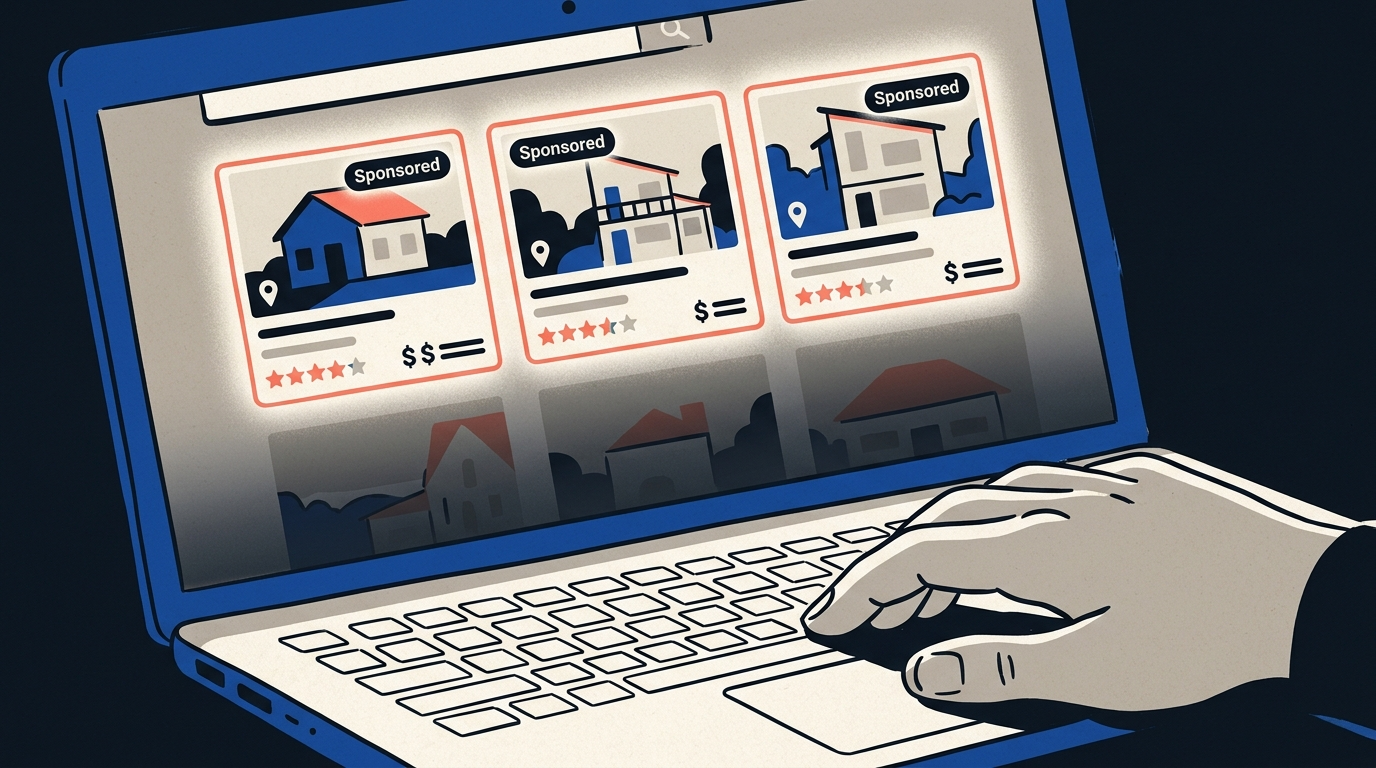
Sponsored listings fundamentally alter this dynamic. Instead of purely earning your way to the top through merit, you can now purchase that advantage. While Vrbo has not yet released exhaustive public documentation on the intricacies of its bidding system – whether it's a cost-per-click (CPC), cost-per-acquisition (CPA), or a fixed-fee model – the general principle is well-established in the digital advertising world. Hosts will likely bid against each other for prime ad slots, with higher bids securing more prominent placement. This could manifest as listings appearing at the very top of search results, interspersed within organic results with a 'sponsored' tag, or even in dedicated promotional carousels.
The immediate implication is that a listing with a lower organic rank, perhaps a newer property still building its review profile, or one in a highly competitive market, can now leapfrog established properties simply by outspending them. This changes the game not just for the properties that choose to participate, but for every single listing on the platform, as the competition for those coveted top spots intensifies.
This move isn't unique to Vrbo in the broader digital economy. Google pioneered the paid search model decades ago. Amazon transformed e-commerce by introducing sponsored product listings. Even traditional travel giants like Expedia and Booking.com have long offered preferred placement to hotels willing to pay higher commissions or direct advertising fees. Vrbo, under the Expedia Group umbrella, is simply bringing a proven revenue-generating strategy from its corporate parent's playbook directly into the STR domain. It’s a natural evolution, but one with seismic implications for hosts who have historically relied on a different set of rules.
The Long Shadow of Expedia Group: Why Now?
To understand why Vrbo is making this move now, you need to understand the beast it belongs to: Expedia Group. Expedia is a publicly traded company, beholden to shareholders. Its primary mandate is growth and profitability. While Vrbo has been a successful part of its portfolio, contributing significantly to its alternative accommodation segment, the market is maturing, and competition is fierce.
For years, Vrbo differentiated itself by focusing primarily on 'whole home' rentals, often catering to families and larger groups, positioning itself distinctly against Airbnb's broader 'any space' philosophy that included private rooms and shared accommodations. This niche served it well, building a loyal base of property managers and guests looking for traditional vacation homes.
However, growth rates for even the most dominant platforms eventually taper. Investor expectations don't. When organic growth slows, companies look for new revenue streams. Advertising, particularly 'search advertising' or 'performance marketing,' is a proven, highly lucrative avenue. Expedia Group, through its core hotel booking sites, has perfected this model over decades. Hotels regularly bid for placement, offer higher commission rates for better visibility, and participate in marketing programs to ensure they appear prominently to travelers.
It's not a coincidence that Vrbo is adopting this strategy. It's a strategic imperative. The platform has massive traffic and a captive audience of millions of potential guests. Monetizing that traffic beyond booking commissions is the next logical step in maximizing shareholder value. Furthermore, the STR market has become incredibly saturated. With more hosts entering the fray every year, and major institutional investors now pouring capital into professional property management companies, the competition for guest bookings has never been higher.
In such an environment, simply relying on an algorithm to surface the 'best' listings becomes less efficient for the platform's bottom line. By introducing sponsored listings, Vrbo creates a new revenue stream, but it also gives hosts a direct (albeit paid) lever to pull in a crowded market. This is particularly appealing to property managers with large portfolios who are constantly looking for ways to drive higher occupancy across their units. It also offers a potential lifeline to newer hosts or those struggling in highly competitive locales, provided they have the budget.
This isn't just about Vrbo's internal economics; it's also about competitive pressure. While Airbnb has historically been more subtle with its monetization of host visibility – focusing on 'Instant Book' preference, Superhost status, and algorithmic boosts for new listings – the industry watches every move. If sponsored listings prove wildly successful for Vrbo, generating significant new revenue and proving popular (or, more accurately, *necessary*) for hosts, it's only a matter of time before other platforms consider similar models.
The Host Dilemma: To Pay or Not to Pay?
This is the question that will be tearing through every host group chat and management meeting for the foreseeable future. The simple answer is: you almost certainly won't have a choice if you want to remain competitive. In any advertising-driven marketplace, once the 'paid' option becomes dominant, the 'organic' results invariably suffer.
Think about Google. When you search for something, the top results are almost always ads. You might scroll past them, but they get clicks. The organic results, while still valuable, are pushed down. The same will happen on Vrbo. If enough hosts pay for placement, those who don't will find their listings sinking further and further down the page, making them harder for guests to discover.
This forces hosts into a no-win situation: either pay to play and eat into your margins, or don't pay and risk significantly fewer bookings. For many, especially those operating on tighter margins or in less in-demand locations, this could be a crushing blow. The cost of doing business just went up. Significantly.
For large property management companies with hundreds or thousands of units, this might be viewed as a necessary, albeit unwelcome, marketing expense. They often have dedicated marketing budgets and can absorb the costs more easily, potentially even negotiating bulk deals or preferential terms with the platform. This further entrenches the power of professional operators, making it harder for independent hosts to compete on an even footing.
Smaller, independent hosts, particularly those with a single property, will feel this most acutely. Every dollar spent on sponsored listings is a dollar not going into property maintenance, guest amenities, or ultimately, their own pocket. They will have to make tough decisions about how much they are willing to bid, or if they can even afford to bid at all. This could lead to a two-tiered system: those who can afford visibility, and those who struggle to be seen.
Furthermore, the introduction of sponsored listings adds another layer of complexity to revenue management and marketing strategy. Hosts will now need to understand bidding mechanics, track conversion rates from paid placements, and calculate their return on ad spend (ROAS). This is a specialized skill set, often requiring dedicated software and expertise that many individual hosts simply don't possess. It moves the game away from pure hospitality and into sophisticated digital marketing.
The Guest Experience: What Does It Mean for Travelers?
While hosts are rightly focused on their bottom line, it's crucial to consider the guest experience. Platforms often justify these changes by claiming they improve relevance or choice for the traveler. But does paying for placement genuinely lead to better outcomes for guests?
The cynical view, often proven true in other advertising models, is that it can degrade the quality of search results. Guests searching for the 'best' or 'most relevant' property for their needs might instead be shown properties that have simply paid the most. This doesn't necessarily mean bad properties, but it means they might not be the *optimal* properties based on organic ranking factors like reviews, amenities, or location suitability.
Imagine searching for a specific type of vacation home – perhaps one with a hot tub and a pet-friendly policy in a quiet neighborhood. In an organically ranked system, the algorithm would prioritize listings that best match these criteria, alongside high review scores and consistent availability. In a sponsored listing environment, a property that checks most boxes but has paid for a top slot might appear above a property that perfectly matches all criteria but didn't pay.
This could lead to guest frustration, longer search times, and a feeling that the platform is prioritizing advertisers over user experience. Over time, if guests perceive that search results are less useful or less trustworthy, it could erode loyalty to the platform itself. However, the counter-argument from platforms is that sponsored listings offer more choice and can surface properties that might otherwise be overlooked, especially if the paid listings are still high-quality and relevant to the search query.
The key here is transparency. If sponsored listings are clearly marked as such, guests can make an informed decision. Most platforms that employ this model do label ads, albeit sometimes subtly. Vrbo will need to be careful not to alienate its core user base by making the guest experience overly commercialized or less effective. The delicate balance is to introduce new revenue streams without sacrificing the trust that powers the entire marketplace.
The Unseen Costs: The Platform Tax on Visibility
This isn't just about the direct cost of a sponsored listing campaign. This is about a fundamental shift in the economics of operating an STR. Every time a platform introduces a new monetization lever – be it higher commission rates, booking fees, or now, paid visibility – it effectively imposes a 'platform tax' on hosts. This tax isn't explicitly levied by a government; it's a cost of doing business within the platform's ecosystem, necessary to access its vast user base.
For years, hosts have debated the fairness of commission structures and guest service fees. Now, the discussion expands to include an advertising budget that was previously optional, or at least not as critical. This new cost will inevitably eat into profit margins, which for many hosts, are already under pressure from rising operating expenses, stricter regulations, and increased competition.
Consider the cumulative effect: a host pays commission on bookings, often a guest service fee is added, cleaning fees are applied, and now, to even *get* the booking, they might have to pay for advertising. Each layer chips away at the net revenue. For properties in highly desirable markets, this might be manageable, as demand can support higher nightly rates to offset increased costs. But for properties in more seasonal or competitive markets, raising rates might not be an option, forcing hosts to absorb the additional expense directly from their profit.
This 'platform tax' also creates an interesting dynamic for the platforms themselves. By controlling the visibility, they gain another powerful lever to incentivize or disincentivize certain behaviors. Want to push a new feature? Offer ad credits. Want to fill last-minute inventory? Allow hosts to bid aggressively for short-notice bookings. The power dynamic shifts further in favor of the platform, as it now controls not just the transaction, but also the very ability of a host to be discovered.
This move is also likely to accelerate the trend towards professionalization in the STR industry. Smaller, less sophisticated operators who struggle with dynamic pricing, channel management, and customer service will now also have to master digital advertising. This is a tall order. Property management companies, with their dedicated marketing teams and economies of scale, are far better equipped to navigate this new landscape. This could lead to further consolidation, with larger managers acquiring struggling independent properties, or independent hosts simply exiting the market.
This isn't just about Vrbo's internal economics; it's also about competitive pressure, and it demands immediate, strategic recalibration from every single operator.
The Airbnb Factor: Will They Follow Suit?
The elephant in the room, of course, is Airbnb. While Airbnb has experimented with various ways to promote listings and offers certain 'boosts' for new properties or those utilizing 'Instant Book,' it has largely resisted a full-blown, explicit sponsored listings model similar to Vrbo's or Google's.
Airbnb's brand identity has always been rooted in community, unique experiences, and a more 'authentic' travel vibe. A heavy-handed 'pay-to-play' advertising model could be perceived as undermining that ethos, making the platform feel more transactional and less personal. Their algorithm prioritizes factors like review scores, guest satisfaction, and host responsiveness, along with offering unique experiences and local insights.
However, no major tech platform can ignore a successful new revenue stream from a direct competitor. If Vrbo's sponsored listings prove to be a significant financial boon, generating substantial new income and becoming an indispensable tool for hosts, the pressure on Airbnb to introduce something similar will be immense. Publicly traded companies are always looking for new growth vectors, and advertising is a well-trodden path.
Airbnb might implement it differently, perhaps through a more integrated 'promotion' tool or by subtly weighting certain host behaviors (like offering discounts or last-minute availability) with higher visibility. They might also frame it as a 'marketing solution' for hosts rather than pure advertising. But the underlying principle – that hosts can pay to increase their visibility – is a powerful one that is hard to resist in a competitive, capital-driven market.
For now, Airbnb hosts might breathe a sigh of relief, but they should be watching Vrbo's experiment with extreme vigilance. The success or failure of sponsored listings on Vrbo will likely dictate the timeline and nature of similar features across the entire STR ecosystem. The industry moves as a whole, and what one dominant player does, others often emulate, adapt, or are forced to compete against.
What History Teaches Us: The Internet Always Gets Monetized
This isn't the first time an online platform has transitioned from a primarily 'organic' model to one incorporating paid placements. In fact, it's the default trajectory for almost every successful digital marketplace.
Consider the early internet: search engines like Altavista and Yahoo initially relied on human-curated directories and simple algorithms. Google changed the game with PageRank, emphasizing organic links. But even Google, the champion of organic search, quickly realized the immense revenue potential of selling ad space alongside its search results. Google Ads (formerly AdWords) became, and remains, its primary cash cow, dwarfing its other ventures.
E-commerce platforms tell a similar story. Amazon started by prioritizing 'best-selling' and 'most reviewed' products. Now, search for almost anything, and the top results are often 'sponsored products.' These are not necessarily the highest-rated or cheapest; they are the ones a vendor has paid to promote. Amazon's advertising business is now a multi-billion dollar enterprise, growing faster than its core retail business.
Even social media platforms, which started as free communication tools, have become advertising behemoths. Facebook, Instagram, X (formerly Twitter) – your feed is a constant stream of paid content, seamlessly blended with organic posts. Businesses pay to reach audiences that they once could reach for free.
The pattern is undeniable: as platforms grow, accumulate users, and become indispensable, they inevitably turn to monetizing that attention. Organic reach diminishes, and paid reach becomes a necessity. The short-term rental industry, despite its unique characteristics rooted in physical properties and human hospitality, is ultimately an online marketplace. It is not immune to these fundamental economic forces.
This historical context is crucial because it suggests that Vrbo's move is not an anomaly but a predictable phase in the maturation of the STR platform economy. It signals that the 'wild west' days of relatively inexpensive, organic visibility are drawing to a close. The industry is professionalizing, and part of that professionalization involves absorbing higher marketing costs as a standard part of doing business.
The bottom line for hosts
This is not a drill. Vrbo Sponsored Listings are here, and they represent a fundamental shift in the economics and competitive landscape of the short-term rental industry. Here’s what you need to do, right now:
- Accept the New Reality: The era of purely organic visibility is fading. Paid visibility is becoming a non-negotiable part of your marketing strategy. Resist this at your peril.
- Budget for Advertising: If you don't already have a dedicated marketing budget for platform advertising, create one. Start small, but start. This is now a cost of doing business, not an optional extra.
- Understand the Mechanics: Dive into whatever documentation Vrbo provides. Learn how their bidding system works. Is it CPC, CPA? What are the targeting options? Knowledge is power, especially when you're spending money.
- Experiment and Track: Don't throw all your money at it blindly. Allocate a small portion of your budget to test sponsored listings. Track your return on ad spend (ROAS) meticulously. Which listings benefit most? Which keywords or targeting options deliver the best conversions?
- Optimize Everything Else: While paid placement is crucial, it doesn't negate the importance of stellar organic factors. Maintain five-star reviews, rapid response times, competitive pricing, and high-quality photos. A paid listing with poor organic fundamentals is just a waste of money.
- Re-evaluate Your Pricing Strategy: With increased marketing costs, you may need to adjust your dynamic pricing strategy to ensure your profit margins remain healthy. Can your market support slightly higher rates to absorb this new expense?
- Diversify Your Channels: Reduce your over-reliance on any single platform. Explore direct booking websites, social media marketing, and other listing sites to hedge against future changes and maintain some control over your distribution.
- Join the Conversation: Talk to other hosts and property managers. Share insights, strategies, and best practices. The collective intelligence of the community will be vital in navigating this new frontier.
The STR industry is maturing, and with maturity comes increased commercialization. Vrbo's move is a stark reminder that platforms are businesses, and their primary loyalty is to their shareholders. For hosts, this means adapting, innovating, and getting smarter about your marketing. The short-term rental game just got a whole lot more expensive, and a whole lot more strategic. Those who understand that, and act on it, will be the ones left standing.
Source
RSU by PriceLabs — reported August 19, 2026. Read and analyzed by the STR NEWS desk.




Read the desk every morning.
The day's crackdowns and platform moves, the money, the design and the stays going viral, plus the desk's verdict, in one short email every morning.