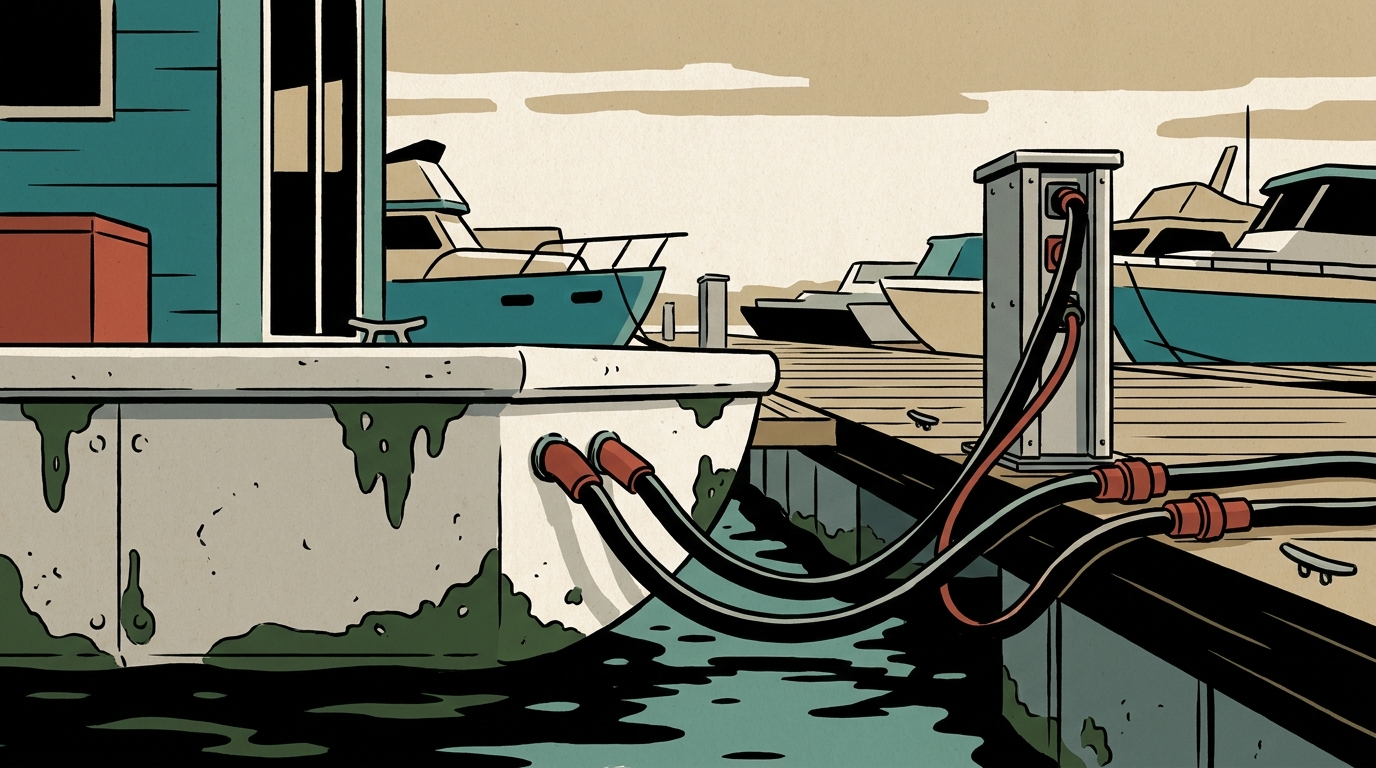
Why Floating Homes and Houseboat Rentals Squeeze Host Margins to the Breaking Point
The eye-popping ADRs of floating homes on Airbnb and Vrbo mask a financial reality of slip fees, specialized marine insurance, and relentless structural depreciation.
The listing photos of a floating home or a stationary houseboat on Airbnb or Vrbo are pure clickbait gold. They feature sun-washed decks, water reflecting off glass windows, and the romantic promise of waking up directly on the water. For the average traveler browsing for a weekend getaway, the visual appeal is irresistible. For the real estate investor looking at high click-through rates and premium average daily rates, the temptation to acquire a waterborne asset is immense. On paper, these listings seem to command a massive pricing premium compared to their land-based neighbors, often pulling in double or triple the average daily rate of a standard two-bedroom suburban home in the same general market.
But those high top-line figures are a financial mirage. The short-term rental industry has long been obsessed with top-line metrics like average daily rate and revenue per available room, yet these numbers tell only half the story when it comes to the marine environment. The physical reality of water is that it is a highly corrosive, chemically active solvent that is constantly trying to destroy, sink, or rot whatever is placed on top of it. When you move a hospitality business off solid ground and onto a floating platform, the standard rules of real estate economics dissolve. The operating margins that make traditional short-term rentals highly profitable are quickly eroded by a specialized ecosystem of marine overhead, slip lease restrictions, and astronomical maintenance costs.
To understand why so many operators lose their shirts on floating rentals, one must look past the guest reviews and study the underlying mechanics of marine operations. From the legal definitions of what constitutes a vessel to the daily realities of blackwater management and galvanic corrosion, running an accommodation on the water is not simply a variation of property management. It is a highly specialized, capital-intensive branch of marine operations masquerading as a hospitality business. Those who enter this market without a deep understanding of marine engineering and maritime law are almost guaranteed to watch their investment sink, both figuratively and literally.
How it actually works
To analyze the economics of floating rentals, one must first distinguish between the two primary categories of waterborne accommodations: floating homes and houseboats. While platforms like Airbnb often lump them into the same general search categories, they are fundamentally different assets from both an engineering and a legal perspective. A floating home is a non-vessel structure designed to be permanently moored. It is typically built on a massive concrete float, a log raft, or a steel pontoon system. It has no propulsion system, no steering mechanism, and is connected directly to municipal utilities, including water, sewer, and high-voltage shore power. These structures are essentially land-style houses built on floating foundations.
A houseboat, on the other hand, is a vessel. It is designed to navigate waters under its own power, featuring an engine, a hull shape designed to move through water, and onboard systems for fuel, fresh water, and waste holding. Because houseboats are vessels, they are governed by the United States Coast Guard and state maritime authorities rather than local municipal building codes. This distinction is critical because it dictates how the asset is taxed, how it is maintained, and how it can be legally operated as a short-term rental. If an asset is a vessel, it must comply with federal safety regulations, display registration numbers, and maintain seaworthiness, even if it never leaves its slip.
The core physical mechanism of any waterborne asset is buoyancy, which requires constant monitoring. Unlike a land-based foundation which remains static for decades, a floating foundation is dynamic and highly sensitive to weight distribution. If a host adds a heavy hot tub to the upper deck of a floating home or allows too many guests to gather on one side of a houseboat, the center of gravity shifts, creating a list that can stress plumbing connections, cause doors to stick, and in extreme cases, lead to capsize. Furthermore, the hull or float is constantly exposed to biofouling, wood-boring marine organisms, and electrochemical reaction. This physical reality requires a continuous schedule of underwater inspections, hull cleanings, and mechanical maintenance that simply do not exist in the vocabulary of a traditional land-based property manager.
The slip lease chokehold
The single greatest operational vulnerability for any floating short-term rental is the slip lease. Unlike traditional real estate where the property owner typically owns the land beneath the structure, the owner of a floating home or houseboat rarely owns the water or the seabed below. Instead, they must rent a slip from a marina or a port authority. These moorage agreements are not standard residential leases; they are commercial contracts governed by maritime and contract law, and they grant immense power to the marina operator. If a host loses their slip lease, they do not merely face an eviction; they face the catastrophic logistical challenge of towing a floating structure to another location, assuming another marina is willing to accept it.
The vast majority of marinas are private commercial enterprises or municipally managed facilities. Their primary revenue comes from long-term tenants, commercial fishermen, and recreational boaters. Marina operators are notoriously averse to short-term rental operations. Transient guests, unfamiliar with marine safety and dock etiquette, frequently create headaches for marina management. They leave dock carts in the middle of walkways, dump improper waste down marine heads, ignore quiet hours, and overload electrical circuits. Consequently, most marina contracts contain explicit clauses prohibiting subleasing, commercial activities, or transient rentals of any kind. A host who attempts to run a stealth short-term rental in a marina that bans them is playing a dangerous game of musical chairs; it takes only one disgruntled liveaboard neighbor to report the listing, leading to immediate lease termination and a thirty-day notice to vacate the slip.
For those rare marinas that do permit short-term rentals, the privilege comes at a steep price. Marina operators are well aware of the premium revenues generated by short-term rentals, and they demand their share of the pie. This often takes the form of a commercial liveaboard surcharge, which can easily double or triple the standard monthly moorage fee. In premier coastal markets, monthly slip fees can range from one thousand to over three thousand dollars. When a marina takes a direct percentage of the gross booking revenue as a condition of the commercial lease, the host is essentially paying an additional franchise tax before platform fees, cleaning costs, and occupancy taxes are even calculated. The marina holds all the cards; if they decide to renovate the docks, change their policy on transient rentals, or sell the facility to a private equity firm, the short-term rental operation can be wiped out overnight with zero legal recourse for the host.
The underwriting abyss
Insurance is the silent killer of waterborne short-term rental profitability. A standard commercial general liability policy or a homeowner policy with a short-term rental rider is completely useless when a structure floats on water. Traditional insurance carriers do not understand marine risks, and their policies contain sweeping exclusions for any damage caused by water intrusion, sinking, salvage operations, or accidents occurring on docks and gangways. Even platform-provided coverages like Airbnb AirCover feature extensive exclusions when it comes to watercraft and floating structures, leaving hosts exposed to catastrophic financial ruin if a major incident occurs.
To properly protect a floating rental, a host must navigate the specialized world of marine underwriting. This requires securing two distinct types of coverage: Hull & Machinery (H&M) and Protection & Indemnity (P&I). Hull & Machinery insurance covers physical damage to the floating home or houseboat itself, including damage from storms, collisions, and sinking. Protection & Indemnity is the marine equivalent of liability insurance, covering third-party bodily injury, property damage, and environmental liabilities. Because short-term rental guests are classified as commercial passengers or invitees, the host must obtain commercial-grade marine policies, which are priced for commercial charter boats and water taxis, not leisure homes.
The premiums for these policies are eye-watering, often costing four to six times more than an equivalent land-based commercial policy. Marine underwriters are highly conservative because the worst-case scenario on water is far more expensive than on land. If a land-based home catches fire, the damage is localized, and the land remains. If a floating home sinks, the owner faces not only the total loss of the asset but also the astronomical costs of marine salvage, hull recovery, and environmental cleanup. Under federal law, including the Clean Water Act, discharging fuel, oil, or graywater into a public waterway carries severe civil and criminal penalties. If a houseboat sinks and leaks fuel into a sensitive estuary, the host is strictly liable for the cleanup costs, which can easily reach six figures. Marine underwriters price this risk into their premiums, making commercial P&I insurance one of the largest fixed operating expenses on a floating rental profit and loss statement.
If a land-based home catches fire, the damage is localized and the land remains; if a floating home sinks, you face the total loss of the asset, astronomical marine salvage fees, and strict liability for environmental cleanup.
The cracked profit and loss sheet
To illustrate the stark divergence between land-based and waterborne short-term rental economics, it is useful to look at a typical operating model. Let us compare a standard two-bedroom land-based condo in a coastal market with a comparable two-bedroom floating home moored in a nearby marina. At first glance, the floating home appears to be the superior investment. Because of its novelty value, it commands an average daily rate of three hundred and fifty dollars, compared to two hundred and fifty dollars for the land-based condo. Assuming a sixty percent occupancy rate for both properties, the floating home generates seven thousand five hundred and sixty dollars in monthly gross revenue, while the condo generates five thousand four hundred dollars.
However, the illusion of profitability quickly shatters when we examine the operating expenses. The land-based condo owner pays standard homeowners association fees, property taxes, property insurance, and utilities, totaling roughly one thousand two hundred dollars per month. The floating home owner, meanwhile, is slammed by marine-specific expenses. The monthly slip fee, including the commercial short-term rental surcharge, consumes one thousand five hundred dollars. Commercial Hull & Machinery and Protection & Indemnity insurance costs another six hundred dollars per month. Because the floating home cannot connect directly to a municipal gravity sewer, it relies on a marine sanitation device or a holding tank that requires a commercial pump-out service twice a week, adding three hundred dollars to the monthly overhead.
The maintenance costs are equally asymmetrical. On land, a property manager can hire a local handyman for fifty dollars an hour to fix a running toilet or a sticky door. On the water, standard residential hardware and fixtures quickly fail due to salt air and high humidity. Every repair requires specialized marine-grade components and marine contractors who charge premium rates, often exceeding one hundred and fifty dollars an hour just to travel to the dock. When we factor in regular underwater hull cleanings by commercial divers to remove barnacles and algae, zinc anode replacements to prevent galvanic corrosion, and a capital expenditure reserve for the mandatory haul-out and dry-docking required by insurers every five years, the floating home's monthly operating expenses skyrocket to over four thousand five hundred dollars. The net operating income for the floating home drops below three thousand dollars, representing a net margin of under forty percent, compared to over sixty percent for the less flashy land-based condo.
Jurisdictional quagmires and municipal bans
The regulatory environment for floating rentals is a minefield of overlapping jurisdictions, conflicting laws, and aggressive municipal enforcement. On land, zoning laws are relatively straightforward; a property is either zoned for residential use, commercial use, or short-term rentals. On the water, a single listing can fall under the jurisdiction of the municipal city council, the county environmental health department, the state department of natural resources, the regional port authority, and the United States Coast Guard. Each of these entities has its own set of rules, and they frequently clash over who has the authority to regulate floating structures.
The legal status of floating structures was forever altered by the landmark United States Supreme Court case, Lozman v. City of Riviera Beach. In this case, the court was tasked with deciding whether a floating home that lacked its own propulsion, steering, or navigation lights was a vessel under federal maritime law. The Supreme Court ruled that because the structure was not practically capable of transportation over water, it was not a vessel. While this ruling was a victory for the homeowner in that specific tax dispute, it opened the floodgates for local municipalities to regulate floating homes as land-based structures. Cities like Seattle, Washington, and Sausalito, California, have used this precedent to apply strict municipal building codes, shoreline master programs, and zoning ordinances to floating structures, effectively banning new construction and heavily restricting short-term rental activity.
In Seattle, for example, the Shoreline Master Program under Seattle Municipal Code Title 23 strictly regulates floating homes and floating on-water residences. The city has capped the total number of floating homes allowed on Lake Union, making new permits virtually impossible to obtain. Furthermore, local ordinances require floating rentals to connect to municipal sewer lines via flexible high-pressure hoses, outlawing the use of older marine heads that discharge graywater or treated blackwater into the lake. In Florida, local municipalities have bypassed maritime preemption laws by targeting the land-based components of the rental operation; while they may not have the authority to police vessels anchored in federal waters, they can fine hosts for using public docks, boat ramps, or parking lots to transfer short-term rental guests to their waterborne accommodations.
The guest friction reality
Beyond the brutal economics and legal risks lies the operational reality of managing short-term guests in a marine environment. The average traveler is accustomed to the predictable, fool-proof systems of a modern suburban hotel or suburban home. They expect to flip a switch and have unlimited power, turn on a tap and have endless hot water, and flush a toilet without a second thought. When these guests are placed on a floating home or a houseboat, the psychological and mechanical gap between their expectations and the physical reality of a boat leads to a continuous cycle of guest friction, bad reviews, and costly maintenance emergencies.
Consider the electrical system. A typical houseboat moored at a marina is connected to the dock via a single 30-amp or 50-amp shore power cord. This is a fraction of the electrical capacity of a standard land-based home, which typically features a 150-amp or 200-amp service. If a guest attempts to run the air conditioning, a hair dryer, a microwave, and a coffee maker simultaneously, they will instantly trip the main breaker on the dock pedestal. Because dock pedestals are often locked by marina security for safety reasons, the host cannot simply instruct the guest to reset the breaker; they must dispatch an emergency maintenance technician or wait for marina staff to arrive, leaving the guests in the dark and the heat for hours.
The waste system is an even greater operational nightmare. Traditional marine toilets, commonly known as heads, are highly sensitive mechanical systems. They rely on manual pumps, vacuum seals, or electric macerators to move waste through narrow pipes into a holding tank. They are designed to handle only human waste and specialized single-ply marine toilet paper. If a guest flushes a single paper towel, wet wipe, or feminine hygiene product down a marine head, the system will clog instantly, often burning out the electric macerator motor in the process. Clearing a clogged marine head is a biohazardous, highly unpleasant task that traditional cleaning crews refuse to perform. The host must hire a specialized marine plumber, resulting in a minimum emergency dispatch fee of several hundred dollars and the immediate cancellation of the next guest's reservation due to a non-functioning bathroom.
The capital expenditure reckoning
While a land-based property owner faces capital expenditure cycles for roofing, HVAC systems, and paint, these assets do not carry the risk of total physical dissolution. A brick-and-mortar home built on a concrete slab will not sink into the earth if the owner neglects maintenance for a few years. On the water, capital expenditure is not a matter of aesthetic preservation; it is a battle for structural survival. The marine environment demands a level of preventative maintenance that is both relentless and incredibly expensive, culminating in the dreaded haul-out cycle that can decimate an operator's multi-year cash reserves.
The most critical maintenance task for any waterborne asset is the preservation of the hull or float. For steel and aluminum hulls, galvanic corrosion is a constant threat. When two different metals are submerged in an electrolyte like saltwater or freshwater, an electrical current flows between them, causing the weaker metal to dissolve. To prevent this, hosts must regularly replace sacrificial zinc or aluminum anodes attached to the hull, which corrode instead of the hull itself. If a host neglects to replace these anodes every twelve to eighteen months, the electrical currents present in any marina due to stray current from shore power systems will eat holes directly through the metal hull, leading to catastrophic leaks and sinking. This requires hiring a commercial diver to inspect the hull and replace the anodes underwater, a recurring expense that many novice hosts fail to budget for.
The ultimate capital expenditure event is the haul-out. Every three to five years, marine insurance underwriters require a comprehensive out-of-water marine survey to verify the structural integrity of the hull or float. This process is incredibly complex and costly. The vessel must be disconnected from all shore utilities, towed by a commercial tugboat to a specialized shipyard, and lifted out of the water using a massive travelift or crane. Once in dry dock, the hull must be pressure washed to remove marine growth, inspected for hull thickness, patched where metal thinning has occurred, and coated with expensive anti-fouling paint. The shipyard fees alone for hauling, blocking, and launching a medium-sized houseboat can easily exceed five thousand dollars, before any actual repairs, painting, or surveying fees are calculated. A typical haul-out can easily cost fifteen thousand to twenty-five thousand dollars, a massive capital expenditure hit that wipes out the profit margins of even the most successful short-term rental operations.
What hosts should do now
For those hosts who already own a floating asset or are committed to entering this highly specialized segment of the market, navigating these waters requires throwing out the standard short-term rental playbook and adopting a rigorous marine operations framework. To survive, you must treat your rental less like a condo and more like a commercial passenger vessel.
- Secure a ironclad moorage agreement: Never purchase a floating home or houseboat without a long-term, transferable slip lease that explicitly permits commercial transient rentals in writing. Verbal assurances from marina managers are worthless; you need a signed contract that outlines the commercial surcharge and protects you from arbitrary eviction.
- Establish a dedicated marine CapEx reserve: Set aside at least fifteen percent of your gross monthly revenue into a dedicated capital expenditure reserve account earmarked solely for marine maintenance, diver inspections, zinc replacements, and the inevitable five-year shipyard haul-out.
- Install guest-proof utility systems: Replace sensitive marine heads with heavy-duty commercial macerator systems or vacuum-flush toilets, and install highly visible signage in the bathrooms. Upgrade your electrical panel with smart load-shedding breakers that automatically shut off non-essential appliances before they trip the main dock pedestal.
- Vet your cleaning and maintenance crew for marine literacy: Standard residential cleaners will not know how to check a bilge pump, empty a greywater filter, or notice a slow hull leak. Hire specialized marine caretakers who understand dock safety, line handling, and basic marine engineering.
- Verify your insurance coverage under maritime law: Work with a specialized marine insurance broker to secure a commercial Protection & Indemnity policy that features specific riders for short-term commercial guests, environmental pollution liability, and vessel salvage.
The short-term rental industry will always be drawn to the exotic and the highly visual, but professional operators must look beyond the screen. Floating homes and houseboats represent the peak of operational complexity and financial risk. By treating these assets with the engineering respect and legal caution they demand, a select few hosts can successfully ride the waves of this unique market, while the unprepared will inevitably find themselves taking on water.
Checked by the standards desk (Eleanor Quist): every specific in this story was traced to its source material before publication.
About this piece
An original expert-analysis column by the Stay Gazette desk. Figures are illustrative of how the market behaves; confirm specifics for your own market before you act.




Read the desk every morning.
The day's crackdowns and platform moves, the money, the design and the stays going viral, plus the desk's verdict, in one short email every morning.