Bartech Targets Vacation Rentals With a Cheap No-Sensor Minibar App
A legacy hotel vendor wants a slice of the short-term rental market with a ten-dollar monthly subscription. But the real cost isn't the software.
For decades, the hotel minibar has functioned as both a luxury convenience and a psychological battlefield. Guests know the rules of the game: lift a container of cashews from its pressure-sensitive cradle, and a silent, automated signal instantly posts a double-digit charge to your folio at the front desk. It is a highly profitable, capital-intensive system designed for centralized properties with hundreds of rooms, dedicated corridors, and standardized housekeeping shifts. Now, one of the oldest names in the hotel minibar business wants to bring that transactional friction straight into the master bedroom of your local vacation rental.
Bartech, a company whose automated refrigeration systems are a staple of upscale hotel chains worldwide, has officially launched a product aimed squarely at the short-term rental market. Dubbed Bartech STR, the solution represents a radical departure from the company's traditional hardware-heavy, sensor-driven approach. Instead of expensive, hard-wired refrigerators that communicate directly with property management software, this new iteration relies entirely on the ubiquitous QR code and the willingness of the guest to self-report their late-night cravings. It is a software-first approach to an old physical problem, priced at a modest monthly fee designed to lower the barrier to entry for individual hosts and independent property managers alike.
But as any experienced short-term rental operator knows, there is a vast gulf between hotel-style convenience and the operational reality of managing decentralized properties. What looks like an effortless stream of passive, high-margin ancillary revenue on a corporate presentation slide can quickly devolve into an operational nightmare on the ground. When you strip away the automated sensors, the physical security, and the centralized staff of a full-service hotel, you are left with a fundamental question: does a vacation rental guest actually want to buy a six-dollar can of soda from a host, and is that host prepared to do the physical work required to sell it to them?
What happened
According to a report by Hospitality Net, Bartech has officially launched Bartech STR, a smart minibar solution designed specifically for vacation rentals and short-term properties. The offering is built around a software-as-a-service model, charging hosts a flat subscription fee of $9.99 per month per property. Rather than requiring operators to purchase proprietary, sensor-equipped refrigerators or undertake complex integrations with property management systems like Guesty or Hostaway, the system utilizes a simplified, low-tech hardware footprint combined with a web-based payment portal.
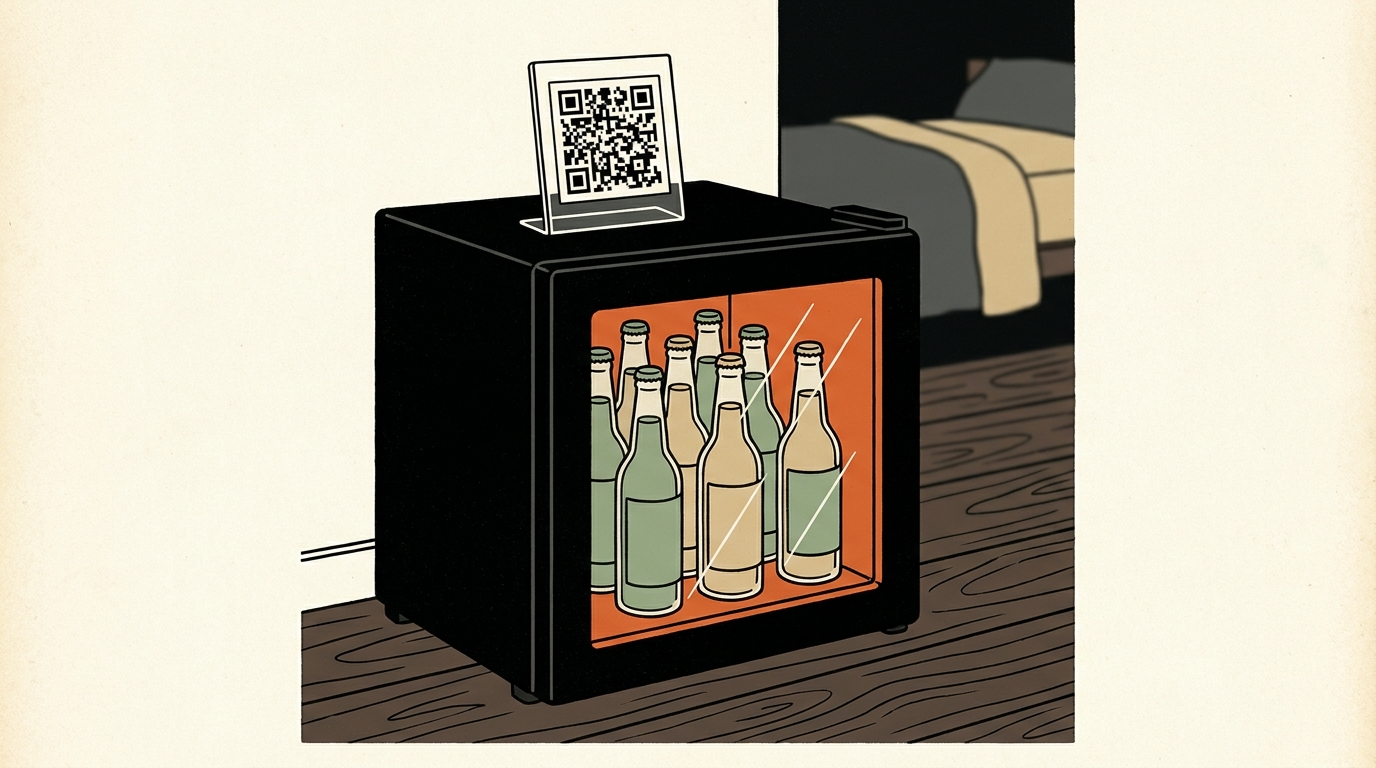
The mechanics of the transaction are straightforward. Hosts set up a designated minibar area, which can be a standard mini-fridge, a countertop basket, or a cabinet. They then place a Bartech-provided QR code in the room. When a guest wants to purchase an item, they scan the QR code with their mobile phone, which directs them to a secure checkout page. From there, the guest selects the items they wish to consume, inputs their payment details, and completes the transaction. The host is notified of the purchase, and the revenue is deposited directly into the operator's account, minus any standard payment processing fees.
Crucially, the system does not feature any physical item-level tracking or weight sensors. If a guest consumes a bottle of water without scanning the QR code, the system has no automated way of detecting the theft or charging the guest's credit card. The entire model relies on the guest's honesty at the point of consumption, or, more realistically, the host's ability to manually audit the inventory during the post-checkout cleaning window and file a claim against the guest through the booking platform's resolution center. It is an approach that strips away the complex infrastructure that made Bartech famous in the hotel world, replacing it with a light, consumer-facing payment layer.
The legacy of the hotel pressure sensor
To understand why Bartech is taking this approach, one must look at the history of the hotel minibar itself. For thirty years, Bartech built its reputation on precision engineering and automation. In a traditional hotel setup, every single slot in the minibar fridge is equipped with a micro-switch, an infrared sensor, or a magnetic weight detector. These sensors are hard-wired or wirelessly connected to the hotel's property management system. If a guest lifts a bottle of vodka for more than sixty seconds, the system assumes it has been consumed. The charge is automatically added to the guest's bill before they even walk down to the lobby to check out.
This level of automation was born out of operational necessity. In a three-hundred-room hotel, checking every single minibar manually every morning requires an army of staff. Guests frequently dispute minibar charges at checkout, claiming they never touched the items, or worse, that they replaced the premium gin with tap water. Automated sensors reduced these disputes by providing a clear, timestamped log of exactly when an item was removed. However, the hardware required to achieve this level of precision is incredibly expensive, often costing upwards of a thousand dollars per room to install, plus ongoing maintenance and software licensing fees.
That hardware cost is a non-starter for the short-term rental industry. The vast majority of vacation rental hosts operate only a handful of properties, and even large-scale property management companies manage portfolios that are geographically scattered rather than stacked vertically in a single tower. Running dedicated ethernet lines or maintaining a proprietary local wireless network to connect sensor-filled refrigerators is physically and financially impossible in a decentralized portfolio. By ditching the sensors and embracing the QR code, Bartech is acknowledging that the hardware-heavy hotel model cannot scale in the residential vacation rental space.
The desperate hunt for the next dollar
The launch of Bartech STR comes at a highly specific moment in the macroeconomic cycle of the short-term rental industry. The post-pandemic travel boom, which drove unprecedented occupancy rates and average daily rates throughout 2021 and 2022, has cooled significantly. According to data from AirDNA, supply growth has caught up with guest demand in many mature markets, leading to increased competition, softening occupancy, and compressing profit margins for hosts who bought properties at the top of the real estate market.
In this environment, hosts and property managers are desperately searching for new ways to monetize their existing guest flow. The industry has seen a surge in ancillary service offerings: early check-in fees, late checkout surcharges, mid-stay cleaning upsells, and partnerships with local tour operators. The home itself is increasingly being treated as a retail showroom, with companies offering platforms that allow guests to purchase the mattress they slept on, the art on the walls, or the coffee in the kitchen. A smart minibar app fits perfectly into this trend of micro-monetization.
However, there is a fine line between professional hospitality and cash-grabbing opportunism. While a guest might appreciate the option to buy a late-night snack, they are also increasingly sensitive to being nickel-and-dimed. In an era where guests are already vocal in their complaints about high cleaning fees, complex checkout chore lists, and platform service charges, the introduction of a paid minibar can alter the psychological dynamic of the stay. It shifts the host-guest relationship from one of warm hospitality to one of transactional commerce, potentially impacting the guest's overall satisfaction and their subsequent review score.
What looks like an effortless stream of passive, high-margin ancillary revenue on a corporate presentation slide can quickly devolve into an operational nightmare on the ground.
The housekeeping bottleneck
The single greatest obstacle to any retail operation in a short-term rental is not the software or the payment gateway; it is the physical labor of supply chain management and quality control. In a hotel, a dedicated minibar attendant pushes a cart from room to room, restocking items, checking expiration dates, and dusting the shelves. The cost of this labor is absorbed into the hotel's overall payroll, and the proximity of the rooms makes the process highly efficient.
In a decentralized short-term rental, that efficiency vanishes. The person responsible for restocking your smart minibar is almost certainly going to be your independent housekeeper or a third-party turnover service. Housekeepers are already under immense time pressure to clean, sanitize, laundry-prep, and stage a property within a narrow four-hour window between checkout and check-in. Asking them to conduct a detailed inventory audit, check expiration dates on perishable snacks, restock a mini-fridge from a locked supply closet, and report discrepancies is a significant expansion of their duties.
If a host does not pay their cleaners extra for this inventory management, the task will inevitably be rushed or ignored. If they do pay them extra, that labor cost can quickly wipe out the modest profit margins generated by selling three-dollar cans of soda and five-dollar bags of chips. Furthermore, the host must manage the logistics of supply storage. Where are the extra minibar items kept? If they are stored in an owner's closet on-site, the cleaner must have access. If the cleaner has to transport the inventory themselves, the logistics become even more complicated and expensive.
The regulatory buzzsaw of residential alcohol
There is a reason why hotel minibars are heavily stocked with small bottles of whiskey, gin, and wine: alcohol is where the real profit margins are. A guest might hesitate to pay four dollars for a bottle of water, but they will happily pay twelve dollars for a gin and tonic at midnight. However, selling alcohol in a short-term rental is a legal and regulatory minefield that most hosts are entirely unprepared to navigate.
In almost every major jurisdiction across North America and Europe, selling retail alcohol requires a commercial liquor license. These licenses are expensive, limited in number, and strictly tied to specific commercial zoning districts. Operating an unlicensed retail alcohol business out of a residential home is a serious offense that can result in heavy fines, the revocation of short-term rental permits, and even criminal charges. While some hosts attempt to bypass this by leaving free beer or wine as a hospitality gesture, the moment a QR code is introduced to charge money for those drinks, it becomes a commercial sale under the law.
Beyond licensing, there is the massive issue of liability. If a host sells alcohol to a guest through a self-service QR code system, how do they verify the buyer's age? A simple digital checkbox asking "Are you over 21?" is unlikely to protect a host from liability if a minor consumes alcohol on the property. Furthermore, many jurisdictions have strict dram shop laws that hold sellers of alcohol liable for damages caused by intoxicated individuals. If a guest purchases multiple drinks from your minibar, drives, and causes an accident, the host's insurance policy is highly unlikely to cover the resulting claims if the sale was conducted without a commercial liquor license.
The problem of shrinkage and the water-in-the-vodka trick
In retail terms, "shrinkage" is the loss of inventory due to theft, damage, or administrative error. In a hotel, automated sensors and front-desk credit card holds keep shrinkage to a minimum. In a vacation rental using Bartech STR's no-sensor model, the host is entirely exposed to the whims of guest behavior. Without physical locks or sensors, there is absolutely nothing stopping a guest from consuming the entire contents of the minibar and simply refusing to scan the QR code.
When this happens, the host's only recourse is to charge the guest after the fact. This requires the housekeeper to notice the missing items, document them with photos, and report them to the host, who must then open a dispute on Airbnb or Vrbo. This process is tedious, time-consuming, and highly damaging to the guest relationship. A guest who gets hit with a twenty-dollar charge for missing snacks after they have checked out is far more likely to leave a retaliatory four-star review, which can cost the host thousands of dollars in lost future bookings.
Then there is the classic problem of guest ingenuity. Every hotelier has stories of guests drinking the miniature bottle of vodka, filling it with tap water, and carefully screwing the cap back on to avoid detection. Without physical weight sensors or a highly trained housekeeping eye, these tricks are incredibly difficult to spot. A host running a remote operation might not realize for weeks that the premium liquors in their minibar have been replaced with water, leading to an incredibly embarrassing experience when a subsequent paying guest opens a bottle only to find it diluted or tampered with.
The platform policy gray area
Another critical factor to consider is how the major booking platforms view off-platform financial transactions. Both Airbnb and Vrbo have strict policies designed to keep financial transactions within their own ecosystems. This is partly to protect their service fee revenue, but also to protect guests from fraud, scams, and unexpected charges. While platforms generally allow hosts to charge for genuine additional services like pet fees or pool heating, these are typically handled through the platform's own payment resolution tools.
Using an external, third-party payment portal like Bartech STR to sell physical goods directly to guests during their stay operates in a distinct gray area. While it is common for hosts to sell merchandise or local goods, directing guests to scan external QR codes and input their credit card details into a non-platform website can raise red flags. If a guest complains to Airbnb that they felt pressured to use an external payment processor, or if a dispute arises over a minibar charge, the platform's default stance is often to side with the guest and penalize the host's account.
Furthermore, guests are increasingly wary of cybersecurity risks. In an era of rampant phishing scams and data breaches, asking a traveler to scan a random QR code in a rental home and enter their credit card information on an unfamiliar website is a significant security ask. Many tech-savvy travelers will simply decline to use the system out of caution, limiting the actual adoption rate of the minibar and reducing the host's return on their investment.
The psychology of the modern guest
Ultimately, the success or failure of any minibar solution comes down to the psychology of the guest. When a traveler books a short-term rental rather than a traditional hotel room, they are usually doing so because they want a different kind of experience. They want a space that feels like a home, not a commercial enterprise. They want a full kitchen where they can cook their own meals, a living room where they can gather, and a sense of local authenticity.
Placing a commercial minibar with a QR code and a price list in that space can disrupt that entire aesthetic. It serves as a constant, subtle reminder that they are paying customers in a commercial transaction, rather than welcome guests in a local home. It introduces a corporate feel to a space that is valued precisely for its non-corporate character. While a late-night arrival will always appreciate a cold bottle of water, many hosts find that leaving a few complimentary local snacks and beverages is far more effective at generating goodwill, securing five-star reviews, and driving repeat bookings than trying to squeeze a few extra dollars out of a retail sale.
In the hospitality business, goodwill is a highly valuable currency. A guest who feels welcomed by a thoughtful, free basket of local coffee and treats is far more likely to overlook minor issues during their stay, communicate politely with the host, and leave a glowing review that helps the property rank higher in search algorithms. Conversely, a guest who feels nickel-and-dimed by a host charging four dollars for a bottle of sparkling water is far more likely to scrutinize every dusty corner and leave a critical review that can damage the property's long-term earning potential.
What hosts should do now
Before you run out and sign up for a monthly minibar subscription, take a hard look at your current operations and guest demographics to determine if this model makes financial and logistical sense for your business.
- Analyze your guest demographics: If your properties primarily host families, business travelers, or long-term guests who utilize the full kitchen, they are unlikely to use a minibar. If you host weekend couples or event-goers who arrive late and do not cook, the demand may be higher.
- Calculate the true operational cost: Do not just look at the $9.99 monthly software fee. Factor in the cost of your housekeeper's time to audit and restock the inventory, the cost of storing extra inventory, and the inevitable cost of guest theft or damage.
- Consult your local zoning and liquor laws: If you plan to sell any form of alcohol, consult with a local attorney or regulatory expert to ensure you have the proper commercial licensing and liability insurance to do so legally.
- Keep it simple and complimentary first: Before investing in a paid retail system, try offering a small selection of complimentary snacks and beverages. Monitor how this impacts your guest reviews and overall occupancy rates; the indirect revenue from better reviews often far outweighs direct retail sales.
- If you do sell, focus on high-margin, non-perishable local goods: If you decide to go ahead with a retail model, avoid easily tampered-with items or perishables. Focus on high-margin, locally branded items like custom coffee blends, local honey, or branded merchandise that guests can take home as souvenirs.
The short-term rental industry will continue to professionalize, and the line between vacation rentals and boutique hotels will continue to blur. But professionalization should not mean blindly copying the most transactional, outdated aspects of the traditional hotel model. Focus on what makes vacation rentals great: space, hospitality, and a genuine connection to the local community.
Checked by the standards desk (Eleanor Quist): 1 specific was removed or attributed as unverified before publication.



Read the desk every morning.
The day's crackdowns and platform moves, the money, the design and the stays going viral, plus the desk's verdict, in one short email every morning.