The Nostalgia Stay Sells a Whole Decade
Time-capsule rentals crush the beige box on feed clicks and off-season bookings, but half-hearted kitsch and fragile appliances will destroy review scores.
Every real estate market across North America and Western Europe has at least one neighborhood where the housing stock looks like it froze in 1978, 1986, or 1994. For years, the immediate reaction of every property flipper and short-term rental investor was pure demolition: rip out the knotty pine paneling, hammer down the mustard-yellow linoleum, strip the avocado green cast-iron tubs, spray three coats of contractor white across every surface, and lay down thousands of square feet of gray vinyl plank flooring. Then came the identical furniture orders from warehouse websites, the identical black-framed wire barstools, and the identical framed prints of highland cows or abstract geometric brushstrokes. The resulting commodity rentals now sit in an oversupplied swamp, slashing their average daily rates by five dollars a week while begging dynamic pricing algorithms to notice their existence.
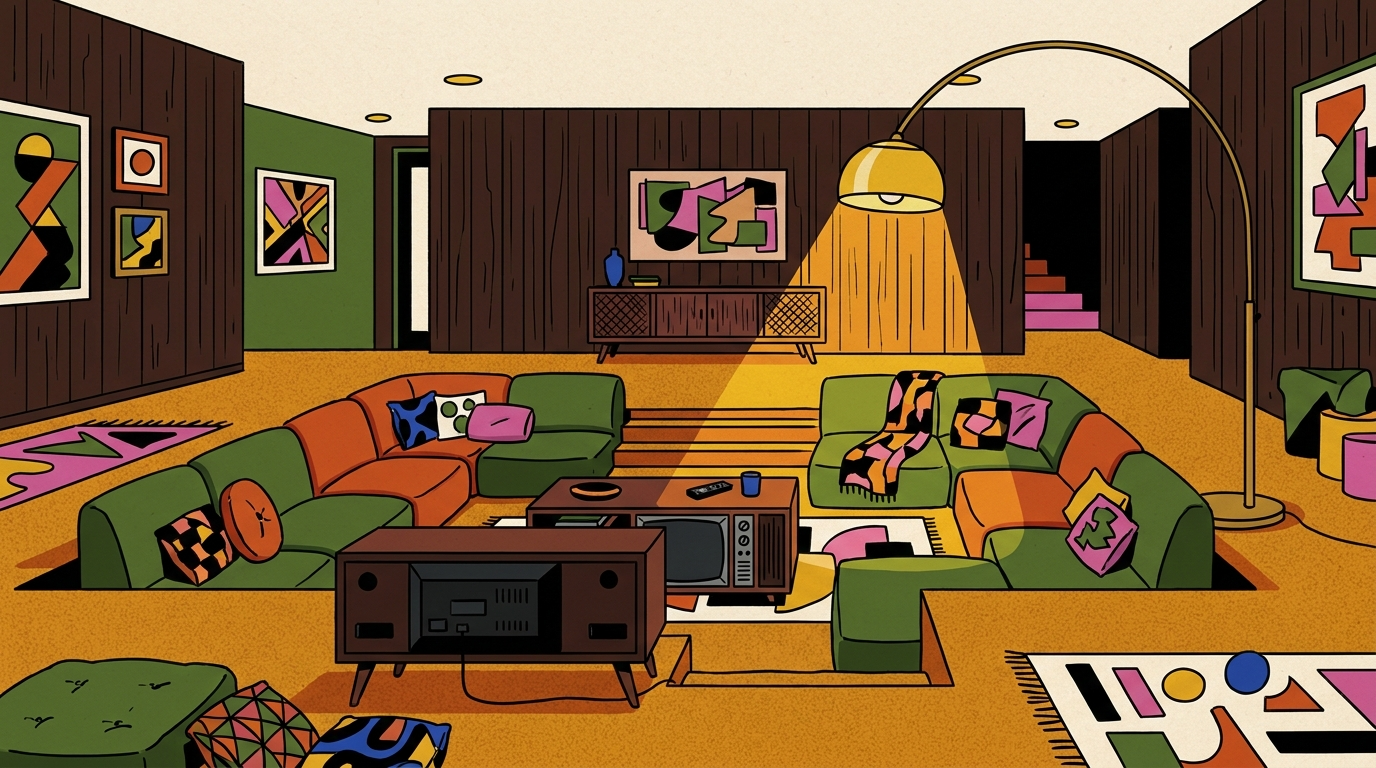
Down the street, an operator who bought an untouched ranch house from an estate sale decided against the white paint. Instead of throwing out the sunken conversation pit, they deep-cleaned the velour cushions. Instead of drywalling over the cedar planking, they conditioned the timber. They hunted down brass arc lamps, tracked down a working tube-cabinet shell to house a hidden flat screen, picked up rotary phones wired to Bluetooth receivers, and filled a walnut credenza with board games printed before the collapse of the Berlin Wall. That listing does not fight in the gutter of local rate cuts. It does not wait for summer weekend overflow. It generates six-figure impressions on video platforms without paying a cent in ad spend, books out three months in advance at a forty percent rate premium, and converts idle browsers into committed guests who treat the stay as an interactive museum exhibit.
Nostalgia is the single most underpriced asset class in the vacation rental industry today, but it is also the sharpest double-edged razor an operator can swing. When an owner commits totally to an era, the property ceases to be a bed and becomes a retail time machine. Guests do not book it to sleep near a convention center; they book it to photograph themselves inside their own childhood memories or a decade they only know through streaming television. Yet the line separating a brilliant time-capsule stay from an unhygienic junk pile is paper-thin. Operators who miss that distinction end up holding a house full of broken yard-sale electronics, stained textiles that impossible-to-please housekeepers refuse to touch, and an influx of bad reviews from travelers who wanted a clean shower rather than an ironic tribute to the Carter administration.
How it actually works
The operational engine behind a nostalgia property operates on a conversion sequence entirely different from that of standard accommodations. In a conventional rental, discovery starts with geography and dates: a guest needs to be in Nashville or Manchester on a specific Friday, filters by bedroom count, sorts by price or review rating, and scans a gallery of nearly identical modern interiors to find the least offensive option. The transaction is utilitarian. The platform algorithm ranks listings based on pricing competitiveness, historical booking frequency, and click-through rates on the primary photo. Because contemporary units look virtually identical in search thumbnails, click-through rates remain brutally flat, forcing hosts into price wars to capture market share.
The time-capsule property breaks that entire discovery paradigm. When a listing features a primary photo showing a 1980s neon-lit arcade lounge, an authentic 1970s sunken living room with a hanging orb fireplace, or a 1990s bedroom complete with inflatable furniture and pop-music cassettes, user interaction patterns spike instantly. Click-through rates jump because the thumbnail stops the thumb mid-scroll. More crucially, the listing triggers extreme save-to-wishlist rates. On major platforms, internal search ranking engines treat a high wishlist-to-view ratio as a primary signal of consumer desire. The platform begins serving the property on regional landing pages, off-beat destination hubs, and category carousels such as the Airbnb historical or creative spaces collections, exposing the home to thousands of potential guests who never entered the town name into a search box.
From there, external organic traffic takes over the heavy lifting. Guests who book a nostalgia rental do not treat the interior as passive infrastructure. They photograph every corner, film walkthrough videos for short-form social feeds, and tag the location in posts that accumulate hundreds of thousands of views. In vacation rental marketing, earned media is extraordinarily rare; standard apartments receive zero organic social reach because nobody posts a photograph of a gray flat-pack sofa against a generic white wall. The nostalgia property turns every guest into an unpaid content production team. This dynamic creates direct booking power, insulating the operator from total platform dependence and allowing the property to command high rates during dead mid-week windows when corporate and leisure travel typically dries up.
The collapse of the commodity box
To understand why decade-specific design commands such intense consumer attention, one must study the rapid decay of the modern minimalist aesthetic. Between 2015 and 2021, an entire industry of interior designers and turnover specialists emerged to preach a single gospel: neutralize everything. The logic was simple and defensive. If an interior has no strong personality, it can offend no one. If the walls are off-white, the rugs are low-pile cream wool, and the dining chairs are molded plastic replicas of mid-century classics, the property can appeal equally to a business traveler on a laptop, a family with toddlers, and an elderly couple attending a wedding.
That defensive design philosophy worked when supply was restricted and demand was surging. Today, it is an economic death sentence. AirDNA data from across competitive North American vacation rental markets reveals that as supply outpaced leisure demand following the post-pandemic boom, listings offering zero design differentiation experienced the steepest drops in occupancy and average daily rate. When thirty properties in a five-mile radius offer the exact same aesthetic, guests treat them as completely fungible commodities. They will book the one that costs five dollars less per night, and they will cancel without hesitation if a competitor runs a flash promotion.
Commodity design creates operational fragility. When an operator competes purely on utility and price, margins evaporate under the weight of rising software subscriptions, professional laundry costs, municipal licensing hikes, and elevated utility bills. The neutral property cannot raise its rates because it possesses zero pricing power. It cannot inspire guests to travel specifically to stay within its walls. It lives or dies on local event calendars—a sports tournament, a medical conference, a university graduation. When those events conclude, occupancy craters to single digits.
The nostalgia stay rejects the defensive consensus entirely. It embraces polarization as an economic asset. An interior styled after a 1980s VHS rental store or a 1970s California bohemian retreat will actively repel certain travelers. An executive on a business trip will look at orange floral wallpaper, brass record players, and wood-paneled walls and immediately click away. The operator does not care. By trading the passive acceptance of ten thousand uninterested searchers for the fanatic loyalty of five hundred design enthusiasts, the property achieves an emotional monopoly over a dedicated demographic subset. Those five hundred guests do not shop on price. They shop on sentiment, memory, and narrative.
The economics of estate sale arbitrage
The most misunderstood aspect of building a nostalgia property lies in the capital expenditure equation. Conventional wisdom among short-term rental consultants dictates that creating a distinctive, high-end theme requires massive capital outlays. Operators routinely drop fifty to seventy-five thousand dollars on commercial furniture packages, custom millwork, and professional staging to manufacture a feeling of upscale modernity. Yet that expensive modern furniture is built from pressed particleboard, paper veneers, and low-density foam designed to disintegrate after twenty-four months of aggressive guest turnover.
A true vintage interior flips this capital expenditure structure on its head. Solid wood furniture from the mid-to-late twentieth century—walnut sideboards, oak dining tables, cast-iron patio sets, hand-tied upholstery frames—sells at estate sales, suburban clearance auctions, and digital secondhand marketplaces for pennies on the dollar. While suburban heirs practically pay junk haulers to remove heavy, dark-toned furniture from their late relatives' houses, a savvy operator recognizes those pieces as indestructible commercial-grade inventory. Solid wood can be sanded, re-oiled, polished, or repaired hundreds of times without structural failure, unlike modern veneer which delaminates the moment a guest spills a glass of wine.
Consider the procurement balance sheet for outfitting a three-bedroom single-family home. Sourcing contemporary pieces through mid-tier retail brands easily totals thirty to forty thousand dollars for a complete living, dining, and sleeping package that loses seventy percent of its resale value the moment the boxes are flattened. By contrast, an operator committing to an authentic late-1970s or early-1980s layout can acquire high-end period furnishings—solid brass lamps, hand-carved coffee tables, heavy credenzas, original bar carts, and genuine era wall art—for twelve to eighteen thousand dollars through aggressive local thrift and estate arbitrage.
The financial advantage compounds over time through depreciation dynamics. A modern flat-pack sofa purchased for eighteen hundred dollars is an operating expense that amortizes to zero within three years as cushions sag and fabric pills under weekly turnover cycles. A pair of authentic 1970s velvet swivel club chairs bought at an estate auction for three hundred dollars does not depreciate at all. If cared for, that vintage inventory maintains its liquidation value indefinitely or appreciates as period antiques gain historical cultural standing. The host transforms an operational consumable into an asset class that holds residual capital value.
The danger zone between immersion and kitsch
The principal pitfall of nostalgia hospitality is the descent into cartoonish kitsch. There is a profound operational difference between an authentic time capsule that evokes emotional immersion and a tacky costume party that feels like a novelty restaurant. Guests will pay premium rates to feel transported into an alternate era; they will leave scathing reviews if they realize they spent three hundred dollars a night to sleep in a warehouse of discarded suburban trash.
Kitsch happens when an operator attempts to build a retro theme on a foundation of cheap props rather than genuine architecture, lighting, and materials. Sticking a plastic neon sign on a freshly painted white wall, throwing a cheap record player on an MDF console, and hanging reproductions of 1980s movie posters is not immersive design. It is cheap decor. Guests spot the phoniness immediately. The tactile feedback is wrong: the fake plastic switches feel flimsy, the low-end faux-leather smells chemical, and the synthetic printed rugs feel rough against bare feet. When an interior feels half-hearted, the charm vanishes, leaving behind nothing but functional inconvenience.
Guests will pay premium rates to feel transported into an alternate era; they will leave scathing reviews if they realize they spent three hundred dollars a night to sleep in a warehouse of discarded suburban trash.
True immersion requires an unrelenting commitment to spatial coherence. The materials must match the claimed era. If a home is marketed around 1970s earth-toned tranquility, the tactile experience must validate that promise: heavy woven macramé, rough slate entry tiles, deep walnut wood grains, thick linen drapes, and ambient lighting that mimics the warm, amber color temperatures of incandescent bulbs. Lighting is where most amateur hosts fail disastrously. Screwing cold-white 5000K LED bulbs into retro sconces ruins the illusion instantly, giving the room the sterile ambiance of an autopsy suite rather than the cozy glow of a vinyl-spinning evening.
The cardinal rule of the nostalgia stay is simple: the aesthetic belongs to the past, but the utility belongs to the present. The bed must not be an authentic fifty-year-old lumpy inner-spring mattress; it must be a top-of-the-line hybrid mattress concealed inside a vintage headboard and frame. The bed linens must not be scratchy polyester floral sheets salvaged from a thrift store bin; they must be high-thread-count washed cotton in an era-appropriate color palette. Guests want the visual and psychological escapism of a prior decade, but they demand the hot water pressure, wireless internet speed, and mattress support of a modern boutique hotel. Violating that boundary guarantees sub-four-star operational failure.
The demographic trap and the age curve
Every era carries a precise demographic expiration date that operators must map against their target guest profile. Nostalgia is not universal; it is generational. What sparks a wave of sentimental longing in a thirty-eight-year-old traveler may register as repulsive antiquity to a sixty-five-year-old, or as completely incomprehensible novelty to an eighteen-year-old. Before investing capital into an era-specific conversion, the host must know precisely whose memories they are monetizing.
The most lucrative target in current short-term rental demographics is the millennial cohort, now aged roughly between thirty and forty-five. These travelers possess substantial disposable income, travel frequently in groups or with young families, and are experiencing the first heavy onset of cultural nostalgia for their childhoods in the late 1980s and 1990s. When an operator recreates the visual language of the 1990s—chunky CRT televisions housing hidden modern game emulation systems, cassette decks with curated mixtapes, bright primary color blocking, Memphis-Milano patterns, and pop-culture ephemera—millennials respond with immediate booking enthusiasm. They are not renting a room; they are buying back their Saturday mornings in 1993.
Meanwhile, the 1970s aesthetic commands massive authority among Gen Z and younger millennials, who romanticize the decade not through lived memory, but as an antidote to digital exhaustion. For this audience, the 1970s represents analog authenticity: high-fidelity vinyl sound systems, conversation pits that encourage eye-to-eye human interaction over smartphone scrolling, earthy plant-filled spaces, and warm, low-contrast environments. The marketing positioning here shifts away from kitschy references toward therapeutic, tactile slowness. A property outfitted with a curated collection of classic folk and funk records, an acoustic guitar, and zero visible touchscreens converts on wellness and mental reset promises.
The grave danger lies in misreading the local market's dominant guest traffic. If a property is located adjacent to a major regional hospital, a financial center, or a conservative retirement community, deploying an aggressive 1980s synth-wave or neon-drenched retro theme is financial suicide. Traveling nurses, visiting doctors, corporate consultants, and older vacationers will actively avoid a home that appears visually loud or physically challenging. Nostalgia stays thrive almost exclusively in drive-to leisure destinations, mountain getaways, artistic secondary cities, and resort corridors where guests travel specifically for leisure, celebration, and escapism rather than professional obligations.
Operational nightmares of the vintage grid
Behind the soft amber lighting and the Instagram-worthy vintage photography lies a harsh operational reality: running a house packed with historical objects is an ongoing logistical trial. The standard modern vacation rental benefits from standardized parts, industrial-grade plumbing, wipe-down synthetic surfaces, and appliances covered by active commercial warranties. When an operator fills a home with authentic retro hardware, maintenance switches from automated dispatching to bespoke problem-solving.
Consider the electrical and mechanical systems. Original mid-century and late-century appliances are massive liabilities. An authentic 1974 harvest-gold refrigerator may look spectacular in listing photographs, but its compressor consumes electricity at three times the rate of a modern unit, runs loud enough to disturb light sleepers in nearby bedrooms, and cannot be repaired by a standard appliance technician when it fails on a Saturday evening before a holiday booking. Worse still, vintage electrical cords lack modern grounding wires and thermal cutoff switches, creating catastrophic fire hazards that can void commercial short-term rental insurance policies if not verified by Underwriters Laboratories safety standards.
The professional solution is extensive mechanical concealment. The harvest-gold refrigerator shell should be carefully retrofitted with modern cooling components, or replaced entirely with a brand-new retro-styled modern appliance from manufacturers who build contemporary, energy-efficient compressors into vintage aesthetic housings. The wood-encased television on the credenza should house a 4K panel with hidden streaming capabilities, wired through vintage speakers using modern, low-voltage digital amplifiers. Every electrical outlet must be upgraded to modern grounded, tamper-resistant GFCI circuits, even if the faceplates are swapped for period-accurate brass or colored switch covers. Guests must never be placed in physical proximity to ungrounded sixty-year-old wiring.
Cleaning operations also require a complete rethink. Minimalist contemporary rentals can be turned by a two-person cleaning crew in ninety minutes because flat surfaces, vinyl floors, and simple furniture lines are easy to disinfect and mop. A nostalgia property is a landmine of high-friction turnover labor. Real textured wood paneling collects dust in its grooves. Authentic shag or high-pile rugs trap dirt, sand, and pet hair that regular commercial upright vacuums cannot lift without specialized rakes and deep suction cycles. Antique velvet and corduroy fabrics cannot be wiped down with bleach-based sanitizers; they require professional upholstery steamers and delicate spot treatments. If an operator fails to budget twenty to thirty percent more for turnover labor and supplies, the property will steadily decline into a musty, grimy condition that shows up instantly in cleanliness review ratings.
Measuring the viral RevPAR lift
When executed with structural discipline and mechanical modernism, the return on investment of a time-capsule property outpaces almost every other themed hospitality concept. The true economic benefit does not merely reveal itself in the peak-season average daily rate, when even substandard properties can find bookings during high-demand surges. The real magic shows up in RevPAR (Revenue Per Available Room) during the dead off-peak months between November and March, when regional demand drops off a cliff.
In seasonal drive-to markets—whether the Catskills, the Smoky Mountains, Lake Michigan, or coastal New England—generic three-bedroom homes routinely drop their rates by fifty percent in winter while their occupancy limps along at twenty-five to thirty-five percent. They have nothing to sell other than cheap shelter in a cold town. The nostalgia stay, however, is a self-contained destination. It does not matter if it is raining, snowing, or freezing outside; in fact, bad weather actively enhances the appeal of being locked inside a warm, nostalgic playground loaded with classic board games, vintage video game consoles, curated movie collections, and cozy analog aesthetics.
Consequently, fully committed vintage properties maintain off-peak occupancy rates well above market averages while holding their baseline pricing steady. Furthermore, these properties open alternative revenue channels that vanilla rentals can never touch. Commercial production crews, fashion brands, wedding parties looking for unique preparation backdrops, and independent filmmakers actively seek out structurally accurate vintage interiors. By establishing daytime production buyout rates—often matching or exceeding the standard overnight rate for six to eight hours of house access—an operator can monetize unoccupied mid-week calendar slots without incurring overnight guest wear-and-tear.
The sourcing and curation playbook
Building a successful nostalgia rental requires a procurement strategy that resembles museum accessioning more than a trip to a suburban shopping center. The goal is complete aesthetic coherence across every visible square inch. The most successful operators follow a strict fifty-mile sourcing radius, utilizing local estate liquidation auctions, specialty garage sales, architectural salvage yards, and secondary digital marketplaces where older generations are shedding high-grade mid-to-late-century household goods.
To avoid the appearance of random clutter, a host must establish a precise five-year historical window and an ironclad color script before purchasing a single item. If the property is anchored in the mid-1970s, the palette should strictly honor harvest gold, burnt orange, avocado green, chocolate brown, and raw brass, complemented by textured woods like cedar, walnut, and teak. Introducing a Memphis-style pastel geometric chair from 1988 into that 1975 living room destroys the narrative spell instantly. The brain recognizes the anachronism even if the guest cannot articulate why the room feels wrong.
Tactile engagement is the secret weapon of retention. A museum allows visitors to look but not touch; a nostalgia short-term rental achieves greatness by inviting aggressive tactile interaction. That means every piece of vintage entertainment must function effortlessly:
- Audio systems: An authentic vintage receiver shell, modified with modern internal Bluetooth components and wired to original restored floor speakers, alongside a working turntable with a heavy, easy-to-use tone arm and a crate of cleaned, playable records.
- Analog gaming: A dedicated corner featuring classic board games from the target era in pristine condition, housed in clear protective sleeves to prevent missing pieces, alongside arcade cabinets running genuine vintage hardware or reliable modern boards.
- Print media: Original magazines from the specific month and year the property celebrates—such as copies of Life, Rolling Stone, or architectural journals—placed casually on coffee tables to encourage casual reading.
- Kitchenware: Heavy, colorful enameled cookware, retro-styled percolators, and authentic thick ceramic diner mugs that give morning coffee a distinct, heavy physical presence.
By shifting the guest's environment from passive viewing to active physical play, the home disconnects the traveler from their screen-bound reality. That disconnection creates intense psychological gratitude, which translates directly into five-star reviews and word-of-mouth recommendations that no paid marketing campaign can duplicate.
Navigating the regulatory and insurance minefield
Before launching an aggressive vintage transformation, an operator must scrutinize their local municipal code and insurance policy documents. Many jurisdictions enforce strict short-term rental safety ordinances that can trigger immediate regulatory shutdown if vintage styling conflicts with safety compliance. Fire marshals and building inspectors do not care about your mid-century visual aesthetic; they care about smoke egress, clear pathway widths, and UL-listed electrical devices.
Textiles represent the primary compliance hurdle. Authentic vintage drapes, wall tapestries, and upholstered furniture manufactured prior to modern fire-safety standards often lack flame-retardant treatments. In the event of an electrical failure or an unattended candle, untreated vintage fabrics can ignite and spread flame with terrifying speed. Professional operators solve this by treating all decorative vintage textiles with commercial spray-on fire retardants that meet national fire protection standards, keeping full documentation and safety certificates on file for municipal inspections.
Smoke and carbon monoxide detectors present a secondary design challenge. Nothing shatters a carefully built 1970s illusion faster than a bright white, plastic smoke alarm flashing an obnoxious green LED from the center of a rich cedar ceiling. However, painting over safety sensors, concealing them inside cabinets, or moving them away from code-mandated ceiling placements is strictly illegal and wildly dangerous. The host must embrace the intrusion of modern safety equipment, selecting black or low-profile smoke detector housings where appropriate, or accepting the clean placement of necessary safety monitors as a non-negotiable layer of protection for their guests and their investment.
What hosts should do now
Transitioning away from commodity short-term rental design toward an immersive, profitable nostalgia stay requires disciplined planning, ruthless editing, and a clear operational budget. Take these concrete actions before spending money on vintage decor:
- Lock down a single tight era: Choose a specific decade—or better yet, a five-year cultural window—based on the architectural bones of the property. Do not try to blend 1960s mod, 1970s funk, and 1990s grunge under one roof. Pick one lane and commit to it across every room.
- Upgrade the mechanical core first: Before buying vintage art or furniture, ensure your plumbing, electrical grounding, circuit breakers, and HVAC systems are thoroughly modern. Replace questionable antique wiring immediately and utilize modern retro-look appliances rather than risking original fifty-year-old compressor units.
- Invest forty percent of the decor budget in commercial-grade comfort: Spend heavily on premium mattresses, high-end pillows, durable hotel-grade linens, modern shower valves, and enterprise-grade Wi-Fi routers. Hide the modern hardware behind era-appropriate screens or custom wood paneling.
- Audit your local demographic demand: Verify that your market attracts leisure, celebration, or weekend road-trip traffic. If your listing relies primarily on business conventions, medical travelers, or corporate relocations, keep your design clean, neutral, and conventional.
- Train turnover staff on high-friction maintenance: Build detailed cleaning checklists that address the specific vulnerabilities of vintage goods. Supply the cleaning crew with wood oils, specialized carpet rakes, velvet steamers, and non-destructive sanitizers to prevent the property from aging into musty disrepair.
The short-term rental market has permanently outgrown the era of passive profits and thoughtless beige furnishings. In a platform ecosystem choked with carbon-copy apartments, the operator who knows how to package memory, texture, and genuine historical drama will always capture the booking while the commodity box cuts its rate into oblivion.
About this piece
An original expert-analysis column by the Stay Gazette desk. Figures are illustrative of how the market behaves; confirm specifics for your own market before you act.


Read the desk every morning.
The day's crackdowns and platform moves, the money, the design and the stays going viral, plus the desk's verdict, in one short email every morning.