Airbnb Promotes Agritourism as a Financial Lifeline for Maine Farmers
As coastal short-term rental markets tighten under heavy regulation, the platform is looking inland—and wrapping its corporate lobbying in a flannel shirt.
The ground in central Maine does not thaw until late May, and by November, the mud has hardened back into iron. For generations, the families working this soil measured survival in bushels of potatoes, pounds of wild blueberries, or the price of raw milk at the regional cooperative. It is a life lived at the mercy of unpredictable weather, rising diesel prices, and global supply chains that do not care about the mortgage on a tractor. But lately, a new crop has begun sprouting in the pastures of the Pine Tree State, one that does not require fertilizer, irrigation, or crop insurance. It requires only a reliable Wi-Fi connection, a clean set of sheets, and a keypad lock bolted to the door of a renovated tool shed.
The tech platforms call it agritourism, a polished term for a gritty economic reality. Across Maine, working farms are opening their gates to tourists who want to collect their own eggs, watch a goat milking demonstration, and sleep under exposed hemlock beams. To the tech executives in San Francisco, this is a beautiful story of economic diversification and rural revitalization. To the farmers, it is a complicated bargain. It is the realization that the most profitable thing their land can yield is no longer food, but the urban traveler's desire to feel, if only for forty-eight hours, a connection to the soil.
This shift is not happening in a vacuum. As coastal cities lock down their short-term rental markets with caps, bans, and registration fees, the short-term rental industry is looking inland for its next growth phase. Airbnb is actively courting the agricultural community, positioning itself as the ultimate partner for the modern farmer. But behind the heartwarming press releases and the stories of saved family farms lies a high-stakes calculation. For the short-term rental operator, the investor, and the rural town manager, the rise of farm-based rentals is reshaping the economics of rural land, testing the limits of local zoning, and redefining what it means to be a host in a changing world.
What happened
According to a report by Mainebiz, Airbnb has launched a concerted effort to promote agritourism as a vital, growing income stream for farmers across Maine. The short-term rental giant is highlighting the financial benefits of farm stays, arguing that hosting allows agricultural landowners to supplement their seasonal incomes and preserve their historic properties. By pointing to the success of existing hosts who offer everything from rustic cabins in the woods to loft apartments above working barns, the platform is pitching short-term rentals not as a luxury amenity, but as a critical tool for agricultural preservation.
The timing of the platform's push is highly strategic. Maine's agricultural sector has faced compounding challenges in recent years, from extreme weather events to skyrocketing input costs. At the same time, traveler demand for rural, outdoor-focused experiences has remained strong even as the post-pandemic travel boom normalizes. By framing short-term rentals as an essential lifeline for the working farm, Airbnb is attempting to build a powerful coalition of rural hosts who can serve as a political shield against the growing wave of local regulation.
The Mainebiz report underscores a broader trend within the platform's business model: the aggressive expansion of specialized categories. Over the past several years, Airbnb has redesigned its search interface to highlight unique stays, with cabins, farms, and off-grid properties receiving prominent placement. This structural change has redirected millions of search queries away from saturated urban centers and toward rural counties. For Maine's agricultural landowners, this algorithmic shift has turned isolated fields into valuable digital storefronts, attracting visitors who would have otherwise booked a standard hotel room in Portland or a coastal cottage in Bar Harbor.
However, the transition from traditional agriculture to hospitality is rarely simple. While the extra income is real, it comes with significant operational friction, regulatory gray areas, and the potential to distort rural real estate markets. As more farmers turn to the platform to keep their operations afloat, they are discovering that managing guests is a world away from managing crops, and that the long-term consequences of this trend may reach far beyond their own property lines.
The financial math of the modern acre
To understand why Maine farmers are listening to the platform's pitch, one must look at the brutal balance sheet of modern agriculture. The United States Department of Agriculture reports that the vast majority of small farms across the country rely on off-farm income to stay afloat. A single bad harvest, an outbreak of crop disease, or a sudden drop in wholesale commodity prices can wipe out a year's profit. In this context, a steady stream of booking revenue from a short-term rental is not just extra pocket money; it is the capital that pays the property tax bill, funds the purchase of new seed, or covers the cost of repairing a broken baler.
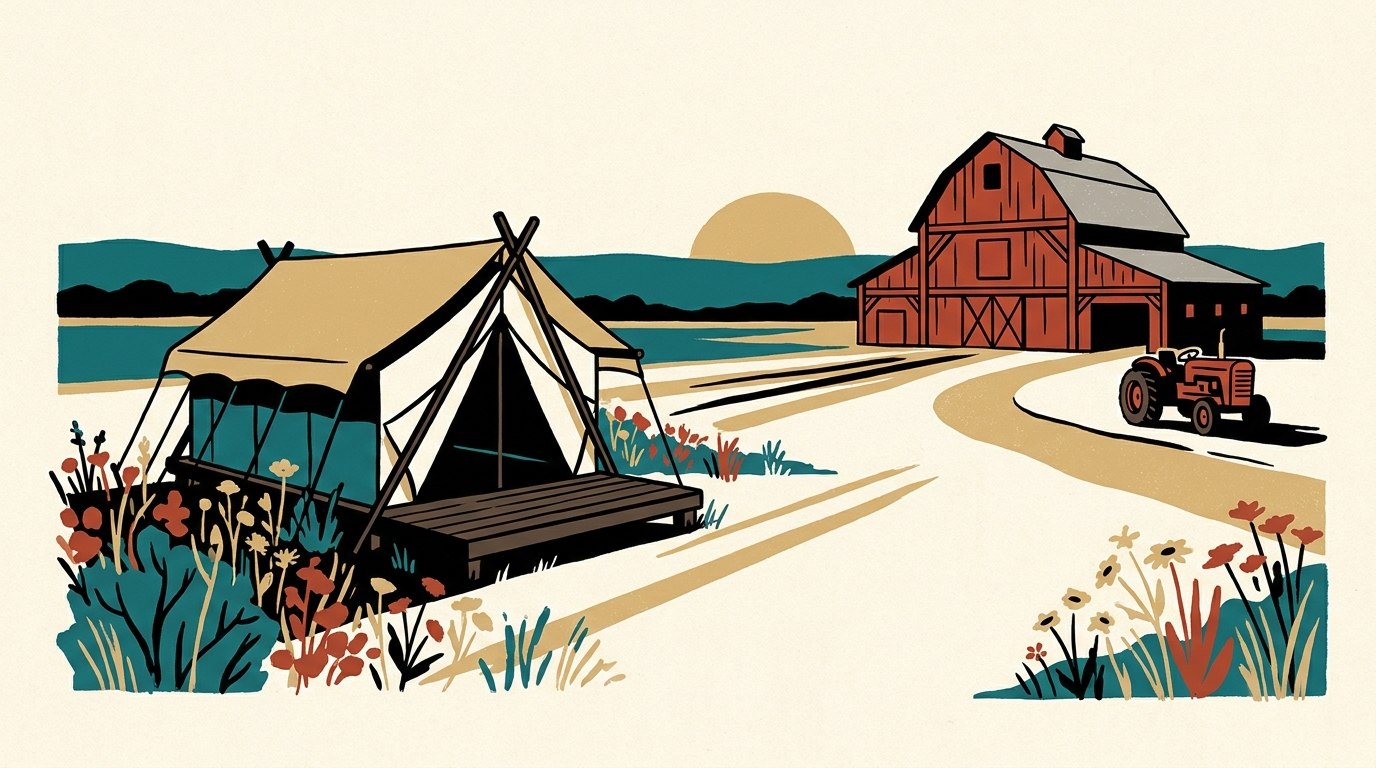
Consider the math of a typical small-scale Maine farm. A vegetable grower might work eighty hours a week through the summer to clear fifteen thousand dollars in net profit after expenses. That same grower can erect a high-quality safari tent on a wooden platform in an unused pasture, list it on a booking platform for one hundred and fifty dollars a night, and generate that same fifteen thousand dollars in a single season with a fraction of the physical labor. The return on investment for lodging space far exceeds the return on investment for agricultural yield per square foot.
This economic reality is driving a quiet transformation of farm design. Farmers are no longer just planning their crop rotations; they are planning their scenic vistas. A field of sunflowers is no longer valued solely for its seed oil, but for how it looks in the background of a listing photo. A historic timber-frame barn is no longer evaluated by how many tons of hay it can store, but by whether its loft can be converted into a multi-unit rental with a modern bathroom. The financial incentives of the hospitality economy are actively rewriting the physical layout of the rural landscape.
But this financial lifeline comes with a hidden catch. In Maine, many working farms benefit from the Farmland Tax Law, a current-use program that significantly reduces property taxes for land dedicated to agricultural production. To qualify, landowners must meet strict requirements regarding acreage and agricultural income. When a farmer builds short-term rental units on their property, they risk violating these requirements, potentially triggering hefty tax penalties and clawbacks if the town determines that the primary use of the land has shifted from farming to commercial lodging.
The escape hatch of rural zoning
While coastal Maine towns have spent the last five years drafting restrictive short-term rental ordinances, rural inland counties have largely remained an unregulated frontier. In cities like Portland, hosts face strict caps on non-owner-occupied listings, registration fees, and aggressive enforcement. In Bar Harbor, the gateway to Acadia National Park, voters approved a measure that limits the transfer of short-term rental permits, effectively putting a ceiling on the commercial market. These policies have made it increasingly difficult and expensive for traditional real estate investors to operate on the coast.
Inland, however, the regulatory environment is vastly different. Many rural Maine towns have no local zoning ordinances at all, relying instead on state-level environmental regulations. Even in towns with basic zoning, agricultural districts are typically designed to encourage diverse economic activities to keep farms viable. Local select boards, eager to maintain their tax bases and support local business owners, are highly hesitant to pass restrictions that would prevent a multigenerational farming family from earning a living.
This regulatory disparity has turned agricultural land into a highly attractive escape hatch for short-term rental operators. By partnering with local landowners or purchasing agricultural parcels themselves, operators can build high-yielding lodging portfolios without the fear of sudden municipal bans. The challenge, however, lies in maintaining the delicate balance between authentic agricultural use and commercial hospitality. When a farm stay becomes more profitable than the farm itself, the regulatory definitions of what constitutes an agricultural enterprise begin to blur, forcing local planners to grapple with difficult questions about the future of their communities.
The tension is already surfacing in town halls across the state. Neighbors who moved to rural areas for peace and quiet are finding themselves next door to de facto campgrounds and event venues. Dust from increased traffic on unpaved town roads, noise from late-night outdoor gatherings, and concerns over septic system capacity are driving demand for rural short-term rental regulations. For the farmer-host, this means the regulatory battles they thought they left behind on the coast may soon arrive at their own farm gates.
The European precedent and the American wild west
The concept of using tourism to support farming is not new. In 1985, Italy formalized this practice by passing the national agriturismo law. The Italian model was designed to halt the abandonment of rural land by allowing farmers to offer lodging and meals, provided that these activities remained secondary to actual agricultural production. To qualify as an agriturismo in Italy, a property must prove that its primary income and labor are still dedicated to farming, and the food served to guests must largely be produced on-site. The system is highly regulated, heavily subsidized, and deeply integrated into the country's cultural identity.
In the United States, however, the agriturismo movement has developed without a cohesive national framework. Instead, it has been driven almost entirely by market forces and tech platforms. This lack of centralized regulation has created a wild west scenario. In Maine, there is no single legal standard for what qualifies as a farm stay. A host can place a plastic dome on a half-acre lot with two chickens and market it as an authentic agricultural experience. This lack of clear definitions creates a significant risk of greenwashing, where commercial lodging developers exploit the romantic appeal of the farm to bypass local regulations and charge premium rates.
Without the strict guardrails of the European model, the American version of agriturismo risks cannibalizing the very communities it claims to support. If any vacant lot can be marketed as a farm stay, the genuine working farms that actually need the supplementary income are forced to compete with polished, investor-owned glamping operations that have no connection to local agriculture. To protect the integrity of the market, some industry advocates are calling for clearer state-level guidelines that distinguish between true working farms and purely commercial hospitality ventures disguised as rural retreats.
Some states have already begun to address this issue. In Oregon, strict land-use laws protect agricultural land from commercial development, requiring farm-stay operators to prove that their lodging activities are accessory to a working farm. In Vermont, state agricultural agencies provide clear definitions and support for agritourism enterprises while ensuring that lodging remains secondary to food production. Maine, with its strong tradition of local home rule, has yet to adopt a unified approach, leaving each town to figure out how to police the line between a working farm and a commercial hotel.
The labor paradox: From plow to pillow
For the working farmer, entering the short-term rental business introduces a profound operational paradox. Farming is a grueling, physical occupation characterized by long hours, unpredictable schedules, and a high tolerance for dirt, noise, and odors. Hospitality, by contrast, is a service industry that demands prompt communication, meticulous cleanliness, and a constant focus on guest comfort. Merging these two worlds is a recipe for operational friction that many agricultural hosts are unprepared to manage.
The daily reality of a farm stay host is a logistical juggling act. A farmer cannot easily answer an urgent platform message about a malfunctioning Wi-Fi router while in the middle of assisting a difficult livestock birth. A guest who paid three hundred dollars a night for a rustic getaway may not appreciate the sound of a diesel tractor warming up outside their window at five in the morning, or the inevitable smell of manure during fertilizer season. The very elements that make a farm authentic are often the same elements that lead to four-star reviews from disappointed city dwellers.
Moreover, the labor requirements of managing a high-turnover rental can quickly overwhelm a small farm crew. Cleaning a cabin, washing linens, and preparing guest amenities require hours of attention during the peak summer season, which is precisely when agricultural labor demands are at their highest. Many farmers who jump into the short-term rental market with visions of easy passive income quickly find themselves working a second full-time job as a housekeeper and concierge. Those who succeed are the ones who treat the rental not as a sideline, but as a distinct business unit that requires dedicated staff and professional systems.
There is also the significant issue of liability. Standard farm insurance policies are designed to cover agricultural risks, not commercial hospitality. If a guest is injured while wandering through a barn, kicked by an animal, or falls ill after consuming unpasteurized products, a standard policy will likely deny coverage. Farm hosts must secure specialized commercial liability insurance, which can be expensive and difficult to find for active, working agricultural properties. The cost of this specialized coverage can quickly eat into the profit margins that made the rental attractive in the first place.
The speculative squat: When investors buy the barn
The most significant long-term threat posed by the rise of farm-based short-term rentals is the potential distortion of rural real estate values. When agricultural land is valued solely for its crop yield, it remains relatively affordable for the next generation of farmers. But when that same land is valued for its potential short-term rental income, the price per acre can skyrocket beyond the reach of anyone who actually intends to grow food.
This phenomenon, which some housing advocates refer to as speculative agricultural squatting, occurs when well-capitalized investors purchase historic farmsteads with the primary goal of developing lodging. To maintain tax advantages or satisfy basic local zoning requirements, these investors may lease a few acres back to a local farmer or keep a small herd of livestock on the property. The agricultural activity becomes a performative backdrop, a tax write-off, and a marketing tool for a lucrative lodging business.
For young and first-generation farmers in Maine, who already face immense challenges securing land, this trend is alarming. When historic barns and fertile pastures are bought up by out-of-state LLCs to be turned into event venues and short-term rental compounds, the local agricultural infrastructure begins to erode. The feed stores, tractor dealerships, and processing facilities that rely on a dense network of working farms cannot survive on a handful of hobby farms and luxury glamping sites. The commodification of rural land risks turning active farming communities into sterile, agricultural-themed amusement parks for wealthy tourists.
This trend also accelerates the loss of productive farmland. While a farmer-host might use rental income to invest in their agricultural operations, an investor-host has no such incentive. Over time, the actual agricultural output of the property declines, and the land is effectively retired from food production. As prime agricultural soils are converted into cabin sites, gravel driveways, and septic fields, the long-term food security and economic resilience of the region are compromised for short-term lodging profits.
The PR shield: Corporate lobbying in a flannel shirt
It is impossible to analyze Airbnb's promotion of agritourism without looking at the platform's global regulatory challenges. In cities across the world, from New York to Florence, local governments are blaming short-term rentals for rising rents, housing shortages, and the hollowing out of historic neighborhoods. In response, Airbnb has spent millions of dollars on lobbying, public relations campaigns, and legal battles to defend its business model.
In this ongoing political struggle, the rural farm host is a priceless asset. When Airbnb executives testify before state legislatures or meet with regulatory agencies, they do not lead with stories of professional property managers operating fifty apartments in a downtown core. Instead, they present the image of the struggling multigenerational farmer who was able to keep the family land thanks to a yurt listed on the platform. It is a highly effective, emotionally resonant narrative that makes it incredibly difficult for lawmakers to pass sweeping state-level restrictions.
By aggressively promoting agritourism in states like Maine, Airbnb is building a powerful, highly sympathetic grassroots lobbying army. When local towns propose short-term rental bans, it is the local farmers, deeply respected in their communities, who show up to select board meetings to argue that such regulations will destroy their livelihoods. Airbnb's support for the agricultural community is not merely a philanthropic endeavor; it is a sophisticated, long-term regulatory strategy designed to protect its marketplace by wrapping its corporate interests in a flannel shirt.
This strategy also allows the platform to open up new, untapped markets. As urban growth slows due to regulatory caps, rural agritourism represents a major expansion opportunity. By convincing farmers to list their land, Airbnb can continue to show inventory growth to its shareholders while positioning itself as a champion of the rural working class. It is a brilliant corporate maneuver that aligns the platform's financial goals with the survival instincts of struggling agricultural landowners, leaving local regulators with the unenviable task of trying to police the line between economic survival and speculative development.
The financial incentives of the hospitality economy are actively rewriting the physical layout of the rural landscape.
What hosts should do now
If you are a farmer considering adding a short-term rental to your property, or an operator looking to partner with an agricultural landowner, you must approach this market with a clear operational strategy. The transition from agricultural production to hospitality is full of hidden pitfalls that can ruin both your balance sheet and your reputation.
- Establish clear operational boundaries: Create physical barriers and clear signage that separate the guest areas from the working zones of the farm to ensure visitor safety and prevent interference with daily agricultural operations.
- Set realistic expectations in your listing: Be entirely honest about the noise, smells, and early morning activity on your farm; guests who understand they are booking a working enterprise are far more likely to leave five-star reviews.
- Automate your hospitality systems: Implement keyless entry, automated messaging templates, and professional cleaning schedules so that your lodging business does not consume the valuable hours you need to dedicate to your crops and livestock.
- Consult with your local planning board early: Before investing capital in a new cabin or yurt, review your town's zoning ordinances and agricultural tax programs to ensure your rental will not jeopardize your farm's tax status or violate local land-use laws.
The future of rural hosting belongs to those who can master the balance of authentic farm life and professional hospitality management. By treating your short-term rental as a serious, separate business unit rather than a casual side project, you can protect your land, diversify your income, and build a sustainable enterprise that will last for generations.
Checked by the standards desk (Eleanor Quist): every specific in this story was traced to its source material before publication.



Read the desk every morning.
The day's crackdowns and platform moves, the money, the design and the stays going viral, plus the desk's verdict, in one short email every morning.