Airbnb Funds Rural Pivot with Ten Thousand Dollar Grants for Arkansas Farmers
A tech giant hands out cash to small agriculturalists in the Ozarks, chasing unregulated inventory and a shield against city crackdowns. Here is the real cost of the dirt.
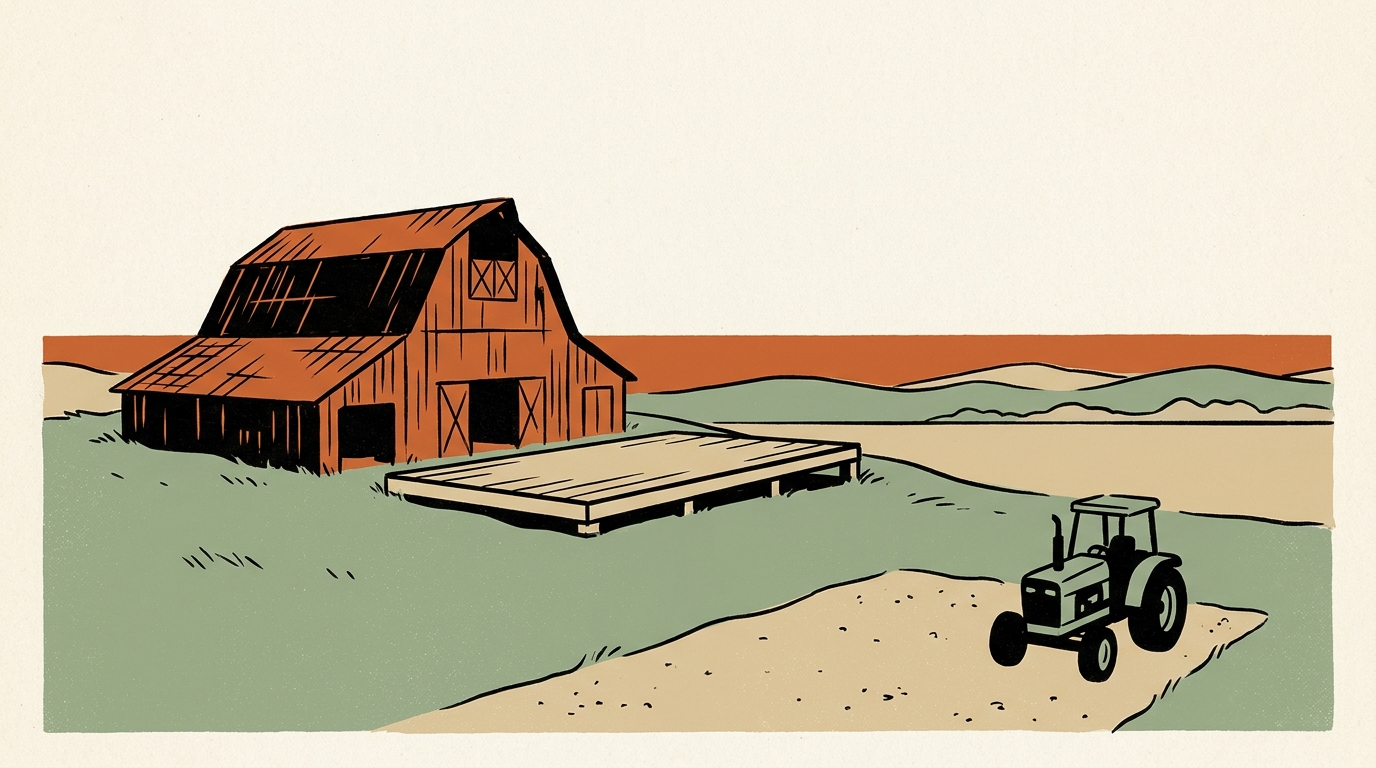
Silicon Valley is looking for dirt under its fingernails. In a move that highlights the ongoing shift from hyper-regulated urban centers to the wide-open spaces of middle America, Airbnb is backing a program that hands cash directly to agricultural landowners. The platform is partnering with an unnamed regional non-profit organization to distribute grants of up to $10,000 to participants in the Farm to Stay program in Arkansas, according to a report by the Arkansas Democrat-Gazette. The goal is simple on its face: convince working farmers to clear out their old tool sheds, renovate their unused milk barns, or pitch high-end yurts next to their hay bales, and then list them exclusively for travelers seeking an escape from the concrete.
To the average observer, this looks like a quaint corporate social responsibility project. It has all the hallmarks of a feel-good press release: supporting the family farm, promoting sustainable rural tourism, and helping city dwellers connect with the land. But for anyone who has watched the short-term rental industry mature over the last decade, this is a calculated chess move. It is a direct response to the regulatory strangulation occurring in major metropolitan markets across the globe. As cities like New York, Florence, and London tighten the screws on urban hosts, the world's dominant booking platform is looking to cultivate a new, highly defensible frontier where zoning boards are weak, neighbors are miles away, and the local government is more likely to hand out a tax break than a cease-and-desist letter.
For the professional host, the property manager, and the rural landowner, this program raises a series of critical questions. Is ten thousand dollars actually enough to build a viable hospitality business in the middle of a working pasture? What are the operational realities of hosting urban guests who want the aesthetic of a farm but cannot stand the smell of manure or the sound of a rooster at dawn? And most importantly, who actually wins when a multi-billion-dollar tech company starts subsidizing the construction of lodging on agricultural land? To find the answers, we have to look past the pastoral marketing and examine the hard numbers, the regulatory landscape, and the cold economic incentives driving this rural gold rush.
What happened
According to the reporting by the Arkansas Democrat-Gazette, Airbnb has aligned itself with a non-profit entity to roll out the Farm to Stay initiative within the state of Arkansas. Under the terms of this program, qualifying farmers and agricultural landowners can apply for financial assistance of up to $10,000. These funds are specifically earmarked to offset the costs of developing, renovating, or upgrading physical structures on their property to make them suitable for short-term rental occupancy. The program aims to lower the barrier to entry for rural hosts who may possess the land and the unique setting required for a rustic escape but lack the liquid capital to bring their structures up to modern hospitality standards.
The mechanics of the grant process require applicants to demonstrate that they are actively engaged in agricultural operations and that the proposed lodging will be integrated into a working farm environment. Once the renovations or constructions are completed using the grant money, the resulting property must be listed on the Airbnb platform, thereby expanding the company's proprietary inventory of unique, rural accommodations. Neither Airbnb nor its non-profit partner has publicly disclosed the total funding pool allocated for this initiative, but the individual grant cap of $10,000 suggests a targeted approach designed to seed dozens of new listings across the state's diverse agricultural zones, from the Ozark plateau to the delta lowlands.
This initiative represents a localized execution of a much broader corporate strategy. Over the past three years, Airbnb has heavily promoted its specialized search categories, with the Farm category receiving prominent placement on the platform's homepage. By directly funding the creation of these listings through localized grant programs, the platform is attempting to solve a classic supply-side problem: unique, high-quality rural inventory is incredibly difficult to acquire organically. Farmers are busy farming; they are not typically scouring the internet for short-term rental management strategies. A ten-thousand-dollar check is the perfect catalyst to turn a busy landowner into an active participant in the gig economy.
The urban exodus and regulatory refuge
To understand why Airbnb is writing checks to farmers in Arkansas, one must first look at what is happening to the platform's traditional bread-and-butter inventory in major cities. For the first decade of its existence, the short-term rental industry grew by converting urban apartments and suburban homes into de facto hotel rooms. It was a highly lucrative model, but it was built on a regulatory vacuum. Today, that vacuum has been filled with concrete. New York City's enforcement of Local Law 18 has effectively wiped out tens of thousands of listings, requiring hosts to register with the city and live in the unit they are renting. San Francisco, Los Angeles, Chicago, and Miami have implemented similarly restrictive registration systems, caps on rental nights, and steep occupancy taxes. Across the Atlantic, European capitals are moving toward outright bans on non-primary residence short-term rentals.
In this hostile climate, rural areas look like a regulatory paradise. In states like Arkansas, county governments rarely have the administrative infrastructure or the political desire to enforce strict short-term rental ordinances. Agricultural zoning is notoriously flexible when it comes to accessory structures and farm-related enterprises. Many state legislatures, dominated by rural lawmakers, have actively blocked municipal attempts to restrict short-term rentals, viewing them as vital engines of economic development for depressed rural economies. By steering capital and traveler demand into these jurisdictions, the platform is building a buffer against its urban losses. If a platform cannot grow its inventory in Manhattan, it must grow it in the Ozarks.
Furthermore, rural hosting offers a level of community insulation that urban hosting simply cannot match. In a crowded apartment building, a single noisy guest can trigger a condo association fine, a police visit, and a permanent ban from the building. On a fifty-acre cattle ranch, the nearest neighbor is a quarter-mile away. The friction points that make urban short-term rentals so politically toxic—housing affordability, neighborhood disruption, parking shortages—are largely absent in rural counties. Airbnb is not just buying inventory with these grants; it is buying peace of mind and political goodwill in states where agricultural lobbies carry immense legislative weight.
The harsh math of ten thousand dollars
For a farmer struggling with high fertilizer costs, rising diesel prices, and erratic crop yields, a $10,000 grant sounds like a massive windfall. But anyone who has ever swung a hammer or hired a plumber knows that ten grand does not go very far in the modern construction market. If a landowner is starting with a bare field or a dilapidated barn, $10,000 is not a budget; it is a down payment. The reality of converting a structure to meet the expectations of a modern traveler is a lesson in escalating costs.
Consider the basic infrastructure required for a habitable short-term rental. First and foremost is waste management. A working farm might run on a simple septic system designed for a single-family home, but adding an additional dwelling unit often requires a septic inspection, a tank pump, or a completely new lateral field to comply with state health department regulations. In many rural counties, a new septic installation alone can easily swallow $6,000 to $12,000. Then there is the issue of water. If the farm relies on well water, the host must ensure the system can handle the increased demand and that the water is potably safe, often requiring filtration systems that cost upwards of $1,500.
Even if the plumbing is already in place, the cost of interior finishing is steep. To achieve the aesthetic that drives high occupancy rates on the platform, a host cannot simply throw a cot into a plywood shed. Guests expect insulated walls, reliable climate control (especially during humid Arkansas summers), comfortable bedding, and a functional bathroom. A ductless mini-split HVAC system, which is the industry standard for small off-grid cabins, costs roughly $3,000 to $4,000 installed. High-quality foam insulation, drywall, electrical wiring, and a basic shower-and-toilet package will quickly consume the remaining balance of the grant. The following breakdown illustrates where a typical $10,000 grant actually goes when attempting a basic barn conversion:
- Electrical & Climate Control: $4,500 (Mini-split installation, sub-panel upgrade, and basic outlet wiring)
- Plumbing & Waste: $3,500 (Connecting to existing septic lines, installing a basic shower, toilet, and sink)
- Insulation & Drywall: $1,500 (Basic fiberglass batts and moisture-resistant drywall for a 200-square-foot space)
- Fixtures & Furnishings: $1,500 (Bed frame, mattress, lighting, and basic decor—resulting in a $1,000 budget overrun before any structural work even begins)
The takeaway here is clear: the grant is a hook, not a complete solution. Landowners who enter this program assuming they can build a luxury cabin for zero out-of-pocket dollars will find themselves stranded halfway through a renovation, forced to either abandon the project or dip into their own savings to finish it. For the grant to make financial sense, the recipient must already possess a structurally sound building with existing utility hookups, or they must be prepared to match the grant dollar-for-dollar with their own capital.
The culture clash of the working farm
There is a wide, dangerous gulf between the curated fantasy of farm life and the gritty reality of agricultural production. City dwellers who book a farm stay are often chasing an idealized aesthetic: mist rising over quiet fields, a gentle horse nuzzling their hand, and a glass of wine on a porch at sunset. What they are not expecting is the smell of fresh manure spread on a neighboring field, the relentless drone of a diesel generator at 3:00 AM, or the swarms of flies and mosquitoes that are an inevitable part of living near livestock.
This expectation gap is the single greatest operational challenge for rural hosts. On a working farm, chores do not stop because a guest wants to sleep in. Tractors move early. Roosters crow before dawn. Livestock guard dogs bark at coyotes throughout the night. If a host does not aggressively manage these expectations in their listing description, they are setting themselves up for a parade of two-star reviews that will quickly bury their listing in the platform's search algorithm. A single bad review complaining about agricultural odors or morning noise can destroy a property's booking momentum before it even gets off the ground.
Furthermore, farms are inherently dangerous places for unsupervised city dwellers. Heavy machinery, electric fences, deep stock ponds, and unpredictable farm animals present significant liability risks. Unlike a standard suburban home, a farm stay requires a robust liability waiver and clear, physical boundaries. Hosts must invest in fencing, warning signage, and secure locks to keep guests out of working barns, chemical storage areas, and pastures containing bulls or protective mother cows. The $10,000 grant does not cover the legal fees required to draft a bulletproof liability waiver, nor does it cover the commercial general liability insurance policy that every smart host must carry to protect their land from a catastrophic lawsuit.
A ten-thousand-dollar check is a powerful incentive, but it is also a binding contract that locks a working farm into the volatile machinery of the global tourism economy.
The economics of agritourism as a survival strategy
Despite the operational hurdles and the construction cost overruns, the economic argument for agritourism is incredibly compelling. Small-scale farming in the United States is in a state of perpetual crisis. According to data from the United States Department of Agriculture (USDA), the vast majority of small farms operate on razor-thin profit margins, with many relying entirely on off-farm income to stay afloat. Volatile commodity prices, corporate consolidation, and climate-induced weather extremes have made traditional agriculture an increasingly risky proposition. In this context, diversifying into hospitality is not a luxury; it is a survival strategy.
The math of a successful rural rental can completely transform a farm's balance sheet. Consider a small livestock operation in Arkansas generating a net profit of $15,000 a year from cattle sales. If that same farm can build a single rustic cabin and rent it out for an average of $150 a night at a modest 40% occupancy rate, the numbers are eye-opening. That single cabin will generate roughly $21,900 in gross annual revenue. After factoring in cleaning costs, platform fees, utilities, and insurance, the net profit from that single rental unit can easily match or exceed the entire annual profit of the agricultural operation. The yield per square foot of a short-term rental is astronomically higher than the yield of any crop or livestock a farmer can raise.
This cash flow is also counter-cyclical. Agricultural revenue is highly seasonal, with cash flowing in only after harvest or cattle sales. A short-term rental provides a steady, weekly stream of cash throughout the year, helping to smooth out the farm's operating capital and reduce reliance on high-interest agricultural operating loans. This is why state agencies, agricultural extension offices, and rural development non-profits are so eager to support programs like Farm to Stay. They see agritourism as a viable path to keeping family farms in operation and preserving rural heritage. But while the macroeconomic benefits are clear, the individual host must remain clear-eyed about the trade-offs involved in inviting paying strangers onto their private land.
The non-profit shield and corporate goodwill
It is worth examining the structure of this initiative, specifically the involvement of a non-profit partner to distribute the funds. Airbnb is a publicly traded corporation with a market capitalization in the tens of billions of dollars. Why does it need a non-profit intermediary to hand out ten-thousand-dollar grants to farmers? The answer lies in the complex world of corporate public relations, tax strategy, and local political lobbying. By channeling these funds through a non-profit, the platform achieves several key strategic objectives simultaneously.
First, it softens the corporate image of a Silicon Valley tech giant entering conservative, rural communities. In many parts of the American South and Midwest, coastal technology companies are viewed with deep suspicion. They are often seen as coastal elites who extract wealth from local economies while contributing little to the community fabric. By partnering with a respected regional non-profit that has deep roots in the local agricultural community, Airbnb immediately gains credibility and trust that money alone cannot buy. The non-profit acts as a cultural translator, validating the program to skeptical farmers who would otherwise toss an email from a tech company directly into the spam folder.
Second, this structure provides a powerful shield against regulatory pushback. When Airbnb lobbies state legislatures or county quorum courts to protect short-term rentals from local restrictions, it rarely leads with its own corporate interests. Instead, it points to the small farmer whose livelihood is being supported by the platform. The narrative shifts from "protecting a tech company's bottom line" to "protecting the multi-generational family farm in the Arkansas hills." It is an incredibly potent political argument that rural lawmakers find almost impossible to vote against. The $10,000 grants, therefore, serve as highly effective lobbying assets, creating a grassroots army of rural hosts who will fight tooth and nail to protect their right to rent their properties on the short-term market.
The logistics of rural property management
For professional property managers looking to expand their portfolios, the rural land grab presents a unique set of operational challenges that do not exist in the city. In an urban condo building, finding a reliable cleaner, a quick plumber, or an emergency locksmith is a matter of making a few phone calls. In a rural county, the labor market is thin, and drive times can make standard property management models completely unprofitable. Managing a farm stay requires a fundamental redesign of the operational playbook.
The first major bottleneck is turnovers. A standard short-term rental relies on a tight four-hour window between guest checkout and check-in. In rural areas, finding cleaners who are willing to drive forty minutes out into the country for a single two-hour clean is incredibly difficult. If they do agree to the job, they will charge a premium to cover their travel time and fuel costs. This drives up the cleaning fee, which can make the listing less competitive on the platform. Smart rural managers often look for neighboring landowners or farmhands' spouses to handle turnovers, building a hyper-local labor pool that is already familiar with the property.
Then there is the issue of maintenance. When an air conditioning unit fails in the middle of a ninety-five-degree Arkansas July, an urban host can usually find an HVAC technician to resolve the issue within hours. In a remote rural area, a technician might not be available for days, or they may charge a hefty trip fee just to diagnose the problem. Rural hosts must become highly self-reliant, mastering basic plumbing, electrical, and appliance repair themselves. They must also maintain an inventory of critical spare parts—extra water pumps, backup internet routers, spare linens, and basic tools—on-site to resolve issues immediately before they escalate into guest refund demands.
Finally, connectivity is a constant struggle. While satellite internet providers have improved significantly in recent years, many rural areas in Arkansas still suffer from slow, unstable, or non-existent internet access. Yet, even guests who book a "rustic retreat" still expect to stream their favorite shows and check their emails without interruption. A host must invest in high-quality satellite hardware, such as Starlink, and be prepared to troubleshoot connectivity issues on a regular basis. If reliable internet is simply not possible on the property, this limitation must be highlighted in bold letters at the very top of the listing description to prevent disappointed guests from tanking the property's ratings.
What hosts should do now
If you are a landowner or a property manager in Arkansas considering applying for the Farm to Stay program, you must approach this opportunity with a clear business plan rather than a romanticized vision of farm hospitality. Do not let the promise of a grant blind you to the long-term operational and financial commitments required to run a successful short-term rental on agricultural land.
- Audit your existing infrastructure first: Before applying for the grant, hire a licensed contractor to inspect your target structure. Determine the exact location of water, electrical, and waste connections to establish a realistic construction budget that accounts for the inevitable cost overruns beyond the $10,000 grant cap.
- Check your local agricultural liabilities: Consult with an attorney to draft a comprehensive liability waiver that clearly outlines the inherent dangers of a working farm. Ensure your property is protected under Arkansas agritourism liability laws, and secure a commercial general liability insurance policy that specifically covers short-term rental activity on agricultural land.
- Set brutal expectations in your listing: Do not try to hide the realities of your farm. Use your listing description to warn guests about potential noises, smells, wildlife, and early morning operations. By filtering out guests who are looking for a sterile hotel experience, you will protect your review scores and attract travelers who genuinely appreciate the rural environment.
- Secure reliable local backup labor: Establish a relationship with at least two local cleaning and maintenance providers who are willing to service your remote location. Having a backup plan for turnovers and emergency repairs is critical to maintaining a high level of guest satisfaction when you cannot be on-site yourself.
The Farm to Stay program is a powerful reminder that the short-term rental industry is no longer confined to the city streets. For those who can navigate the construction costs, the operational logistics, and the culture clash of rural hosting, the rewards are substantial. Just remember that the tech platforms are writing these checks to serve their own strategic goals. As a host, your job is to make sure that the dirt under your fingernails remains a source of profit, not a sinkhole of debt.
Checked by the standards desk (Eleanor Quist): every specific in this story was traced to its source material before publication.
Sources
- The Arkansas Democrat-Gazette - reported September 25, 2026.
Read and analysed by the Stay Gazette desk.

Related from the desk



Read the desk every morning.
The day's crackdowns and platform moves, the money, the design and the stays going viral, plus the desk's verdict, in one short email every morning.