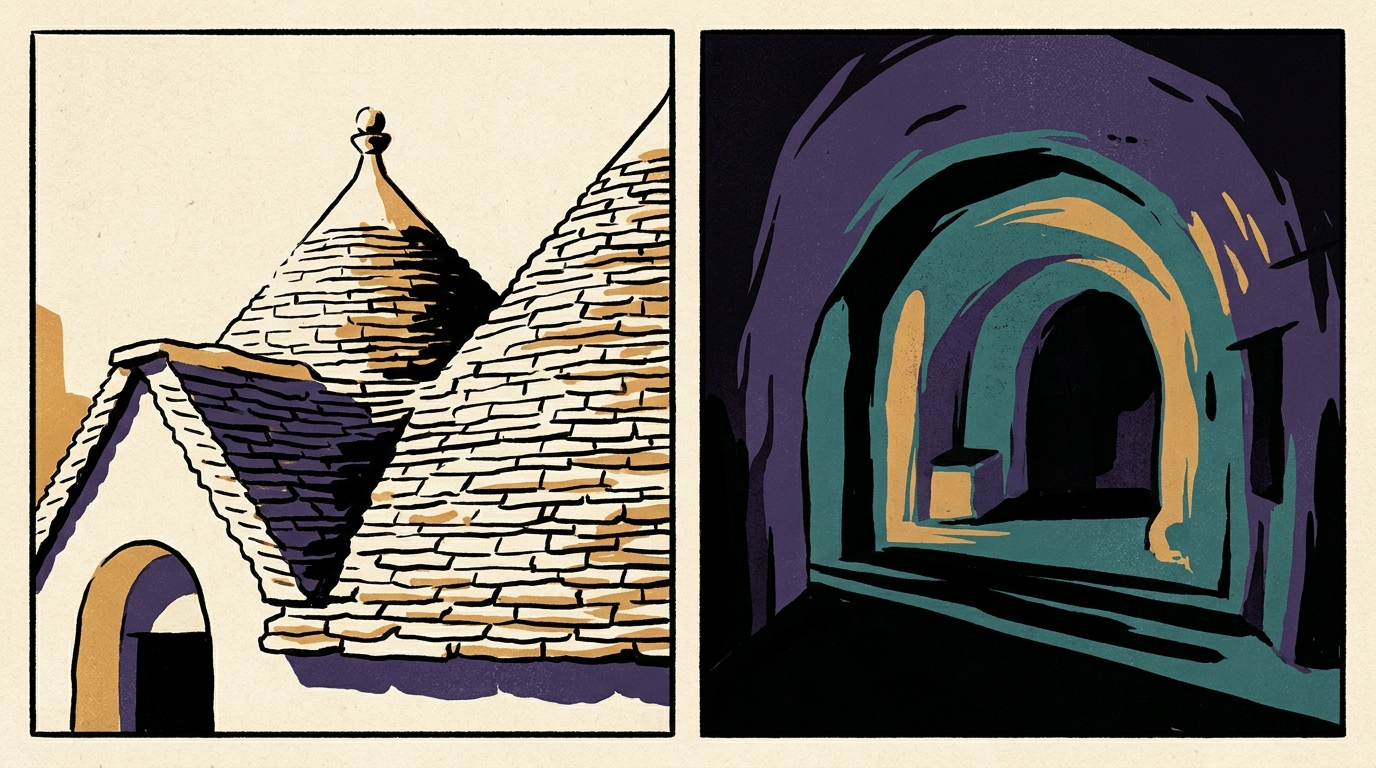
The Brutal Economics of Italy Ancient Stone Rentals
Ancient thermal mass keeps Puglia's trulli and Matera's cave dwellings cool without high utility bills. But the regulatory and maintenance costs are astronomical.
When the mid-August sun pins the southern Italian landscape under a forty-degree heat wave, the modern vacation villas of Puglia and Basilicata begin eating their own profits. Split-system air conditioners rattle continuously against thin brick walls, spinning utility meters at rates that turn a high-occupancy season into a direct transfer of wealth to regional energy monopolies. For the owners of these conventional properties, the summer peak is a battle of thermal attrition. But three miles away, inside a drystone trullo or deep within a hollowed-out limestone cave in Matera, the air remains a silent, steady twenty-one degrees. No compressors hum. No vents rattle. The physics of the ancient world is quietly doing the work of a modern climate-control system, and doing it for free.
This is the thermal-mass premium, a structural advantage that has quietly turned some of the oldest housing stock in Europe into the most resilient assets in the short-term rental market. Once dismissed as the architecture of poverty, the conical trulli of the Valle d'Itria and the subterranean Sassi of Matera are now high-performing assets on global booking platforms. They are not merely photogenic structures that stand out on a five-inch smartphone screen; they are highly efficient thermal machines. In an era where operating margins are squeezed by inflation and rising energy costs, these ancient building styles offer a structural moat that modern construction cannot replicate.
Yet, the amateur investors who buy into this stone-built market on a wave of romanticism almost always underestimate the friction. To operate a centuries-old structure as a high-yield hospitality asset is to enter a complex web of cultural heritage laws, specialized labor shortages, and unique structural liabilities. The very properties that require little energy to cool can easily bankrupt an owner through regulatory delays, specialized restoration costs, and the relentless reality of subterranean moisture. Understanding the mechanics of this market requires looking past the pastoral fantasy and analyzing the cold, hard numbers behind the stone.
How it actually works
The operational magic of both the trullo and the cave dwelling lies in the physics of thermal inertia. In modern construction, insulation is designed to resist the flow of heat. In ancient stone architecture, thermal mass is used to delay it. Puglia's trulli are constructed using a double-skinned wall system. The inner and outer layers are built of local limestone blocks, while the massive cavity between them is packed with loose stone rubble and soil, known locally as the sacco. This results in walls that are frequently between one and two meters thick. The conical roof is formed by overlapping flat limestone slabs, called chiancarelle, laid dry without mortar to allow the structure to breathe while remaining completely watertight.
Matera's cave dwellings, carved directly into the calcarenite rock, take this concept even further. Instead of standing in the air, they are enveloped by the earth itself. The thermal conductivity of limestone is relatively low, and its specific heat capacity is high. This creates a phenomenon known as the decrement factor: the time lag between the peak temperature on the outside of a wall and the peak temperature on the inside. In a structure with walls over a meter thick, this time lag is approximately twelve hours. The intense heat of the midday sun does not penetrate the interior until the middle of the night, when the outside air has already cooled, allowing the heat to radiate back outward. By the time the next day's sun rises, the stone has shed its heat and is cool once more.
For a short-term rental operator, this translates directly to the bottom line. In standard southern European rentals, heating and cooling can account for up to thirty-five percent of total seasonal operating expenses. During the peak booking months of July and August, a typical three-bedroom modern villa in Puglia can run up hundreds of Euros in monthly electricity bills. A restored trullo or cave dwelling operating under the same weather conditions can reduce its cooling load by over seventy percent, requiring only a small, low-voltage ventilation system to maintain comfort. The saving is not just financial; it is operational. It eliminates the frequent guest complaints about inadequate air conditioning performance, broken remotes, and noisy outdoor compressors that drag down review scores on Booking.com and Airbnb.
The heritage straightjacket
The financial savings on utilities are not free; they are pre-paid through massive, front-loaded capital expenditure and ongoing regulatory compliance. In Italy, any structure of historical significance is overseen by the Soprintendenza Archeologia, Belle Arti e Paesaggio. This regional arm of the Ministry of Culture has absolute veto power over any modification, restoration, or infrastructural upgrade. If an investor purchases a dilapidated trullo with the intention of converting it into a rental, they cannot simply hire a standard general contractor. The law requires that any structural work on a trullo be executed by a certified maestro trullaro, a master mason trained in the ancient art of drystone construction.
These craftsmen are a dwindling resource, and their labor commands a significant premium. Re-pointing a sagging trullo cone or rebuilding a collapsed wall must be done stone by stone, selecting and shaping each piece of limestone by hand without the use of modern cement, which can trap moisture and cause the limestone to decay. A restoration that would take two weeks on a modern brick home can easily stretch to six months of painstaking hand labor. The cost per square meter for restoring a historic stone structure in Puglia can easily run double or triple that of a standard residential renovation. Every pipe, wire, and drainage line must be threaded through the massive stone walls without altering the exterior appearance, leading to complex engineering workarounds that inflate labor costs.
In Matera, the regulatory environment is even tighter. Because the Sassi are a UNESCO World Heritage site, any excavation or modification of a cave interior requires extensive archaeological surveys. A host looking to add a second bathroom to accommodate higher-paying families may find their project halted for months if the drilling reveals an unmapped ancient water cistern or a historical burial niche. No modern materials are permitted on the visible surfaces; walls must be finished with traditional lime-based plasters, and floors must use local stone. The installation of essential modern infrastructure, such as high-speed internet cables or mechanical ventilation ducts, requires creative concealment strategies that must be approved individually by local heritage boards. For the operator, this means that the pre-opening phase of the business is a high-risk cash drain where timelines are routinely measured in years rather than months.
The visual funnel
While the construction phase is a logistical minefield, the marketing phase of a stone rental is where the asset class shines. On modern booking platforms, the first image a potential guest sees is the ultimate gatekeeper of conversion rates. In a sea of identical white plaster apartments and generic modern villas, the conical silhouette of a trullo or the raw, candle-lit stone arch of a Matera cave acts as an immediate visual hook. According to data trends observed across unique listing categories, properties with distinct architectural identities enjoy significantly higher click-through rates (CTR) than adjacent standard listings.
This visual appeal was supercharged when Airbnb restructured its search algorithm to emphasize categories like Historical Homes. This change transformed how travelers discover properties. Instead of searching specifically for a destination and a set of dates, users are now guided to browse by architectural style. A traveler who had no initial intention of visiting Basilicata or the Valle d'Itria can be drawn into the booking funnel simply by clicking on the historical categories. This organic discovery mechanism reduces the host's reliance on paid marketing, social media ad spend, and aggressive price discounting to fill their calendar.
The raw stone of a Matera cave or the drystone cone of a trullo is not just shelter; it is a proprietary marketing channel that pays dividends with every search algorithm update.
This organic visibility creates a pricing power that resists market downturns. In many saturated European markets, standard apartments are locked in a race to the bottom, competing purely on price and proximity to transit hubs. A historical stone property, however, operates on a different demand curve. It is sold as an experience, allowing hosts to charge a significant premium on their Average Daily Rate (ADR). The booking window for these properties is also remarkably long, with guests often reserving their stays six to nine months in advance to secure specific, highly photographed rooms. This early cash flow provides operational predictability that standard operators can only envy.
The operational toll
But once the guest arrives, the operational reality of managing an ancient structure asserts itself. The most significant operational challenge in both trulli and cave dwellings is moisture management. Limestone is a highly porous material that acts like a sponge. In Matera's cave homes, capillary action draws water from the surrounding rock bed directly into the walls of the dwelling. Without constant intervention, the relative humidity inside a cave can quickly soar above eighty percent, leading to damp linens, peeling finishes, and a distinct, musty odor that will ruin a property's review scores within a single season.
To combat this, successful operators must install continuous, high-capacity dehumidification systems. These cannot be cheap, noisy portable units sitting in the corner of a room; they must be integrated, silent systems hidden within the cabinetry or floors, running twenty-four hours a day. This necessity partially offsets the energy savings achieved by not running traditional air conditioning. Furthermore, the constant presence of moisture means that metal fixtures, light switches, and electronic appliances degrade at an accelerated rate. Salt efflorescence, where dissolved minerals are carried to the surface of the stone and crystallize into a white powder, requires regular scrubbing and specialized chemical treatments to maintain the clean, rustic look that guests expect.
Cleaning fees for these properties are also structurally higher. A standard modern apartment with flat, painted plaster walls can be cleaned quickly between guests. A historical stone dwelling features thousands of uneven stone joints, rough surfaces, and high, vaulted ceilings that trap dust and cobwebs. Every nook and cranny must be vacuumed and dusted by hand. The porous stone floors cannot be cleaned with harsh modern chemicals, which can stain or erode the historic limestone; they require specialized, pH-neutral cleaners and meticulous care. This increases the turnaround time between check-out and check-in, often forcing operators to set a minimum stay of two or three nights to absorb the high cleaning costs and maintain operational efficiency.
The seasonality trap
While the peak summer months are highly lucrative, southern Italy is notorious for its steep seasonality curve. In Puglia and Basilicata, the active tourism season has traditionally been concentrated between June and September. Outside of these months, municipal services slow down, local restaurants close for the winter, and flight frequencies to regional airports in Bari and Brindisi drop dramatically. For a standard rental, this off-season is a dead loss. For a historical stone rental, it is a period of high vulnerability.
During the cold, wet winter months, an unheated, unventilated stone structure is highly susceptible to deep structural dampness. If an operator shuts down the property and turns off the utilities to save money, they will return in the spring to find a mold-infested interior that requires thousands of Euros in remediation. Therefore, the property must be heated and dehumidified throughout the winter, even when empty. Because limestone has high thermal mass, heating a cold stone structure back up to a comfortable temperature takes days of continuous energy input. It is not a matter of turning on a smart thermostat two hours before a guest arrives; the stone itself must be warmed to prevent condensation from forming on the cold walls when the indoor air is heated.
To mitigate this winter cash drain, smart operators are shifting their marketing strategies to target remote workers, writers, and retirees seeking quiet, off-season retreats. The very isolation and raw aesthetic that makes these properties popular in the summer can be packaged as a cozy, wood-fired sanctuary in January. However, this requires a different infrastructure, including high-speed fiber internet, reliable underfloor heating systems, and well-equipped kitchens that allow guests to cook when local restaurants are closed. Operators who fail to adapt to this year-round operational model often find that their summer profits are entirely consumed by winter maintenance costs.
Comparable global cases
The economic dynamics of Puglia's trulli and Matera's cave dwellings are not unique to southern Italy; they represent a global pattern where vernacular architecture has been repositioned as premium hospitality real estate. A prime parallel can be found in the yposkafa, or traditional cave houses, of Santorini, Greece. Originally carved into the volcanic ash cliffs by local mariners as cheap housing protected from the wind and sea, these whitewashed caves now command some of the highest ADRs in the Mediterranean. Like the Sassi of Matera, they rely on subterranean thermal mass to remain cool in the brutal Aegean summer, and like Matera, they suffer from extreme humidity and intense regulatory oversight from Greek archaeological authorities.
In Andalusia, southern Spain, the historic cave dwellings of Granada and Guadix offer another comparable case. These cuevas, carved into clay hillsides, have transitioned from marginalized dwellings to highly sought-after ecological rentals. Operators there face the same balance of low cooling bills and high moisture-mitigation costs. In the United States, the historic adobe structures of Taos and Santa Fe, New Mexico, utilize thick mud-brick walls to achieve the same thermal lag effect, protecting guests from the extreme diurnal temperature swings of the high desert. In every case, the lesson is identical: vernacular architecture built from local materials to suit local climates creates a highly defensible, high-margin asset class that modern, stick-built construction cannot replicate.
What these global markets share is a reliance on a highly specific cultural identity. A guest booking an adobe home in New Mexico or a cave in Santorini is not just buying a place to sleep; they are purchasing a temporary connection to the history of a landscape. This emotional connection creates a powerful buffer against the commoditization of the short-term rental market. When a market becomes oversupplied with inventory, the first properties to suffer are the generic condos and suburban tract homes that look the same in any country. The historical stone rentals, tied to the geography and history of their specific regions, maintain their occupancy levels because their supply is physically limited by history itself.
What hosts should do now
If you are currently operating or plan to acquire a historical stone rental in southern Italy or a similar heritage market, your success depends on transitioning from an amateur landlord to a preservation-minded asset manager.
- Secure a dedicated preservation mason before you buy, establishing a long-term maintenance contract for annual stone inspections and re-pointing.
- Install hidden, continuous mechanical ventilation with heat recovery (MVHR) to manage relative humidity without ruining the historic visual aesthetic.
- Position your listing directly within the specialized historical categories on major booking channels, optimizing your photos to highlight the unique architectural features in the first five images.
- Design an off-season occupancy strategy targeting long-term remote workers, ensuring the property is heated consistently through the winter to prevent deep structural dampness.
- Audit your compliance with the new national identification code system (CIN) to avoid heavy fines as Italian authorities crack down on unregistered rentals.
The ancient stone dwellings of southern Italy have survived wars, plagues, and economic collapses because they were built in harmony with the physical realities of their environment. In a modern short-term rental market defined by rising costs and intense competition, that same physical harmony remains their greatest asset. Treat these properties with the architectural respect they demand, and they will reward you with a high-yield, inflation-resistant business that modern buildings simply cannot match.
Checked by the standards desk (Eleanor Quist): every specific in this story was traced to its source material before publication.
About this piece
An original expert-analysis column by the Stay Gazette desk. Figures are illustrative of how the market behaves; confirm specifics for your own market before you act.


Read the desk every morning.
The day's crackdowns and platform moves, the money, the design and the stays going viral, plus the desk's verdict, in one short email every morning.