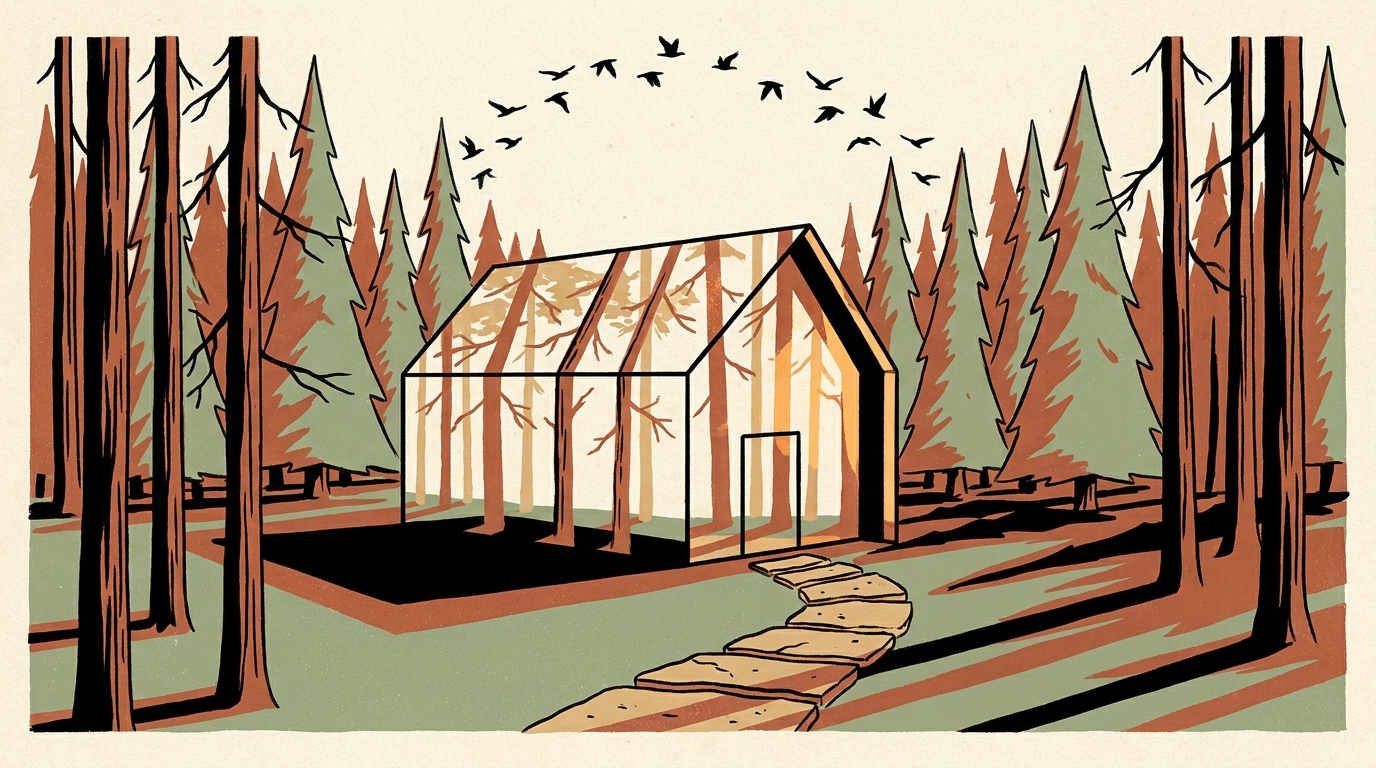
The Mirror Cabin Disappears Into the Treeline and the Balance Sheet
Mirrored glass structures generate massive social media saves and high average daily rates, but operational realities like bird strikes and thermal load threaten returns.
The modern traveler does not buy a location; they buy a photograph. The short-term-rental marketplace has evolved into an economy of visual signals, where the primary asset is no longer shelter, but rather the digital projection of shelter. In this visual landscape, nothing captures the imagination quite like a building that refuses to exist. The mirrored cabin—a structure wrapped completely in reflective, high-performance glass—has transitioned from an avant-garde architectural experiment to one of the most profitable design trends in the premium short-term-rental market. It is a visual vanishing act engineered specifically to perform on social media feeds and booking platforms.
The premise is simple: construct a minimalist box, clad it in mirrored glass, and place it in a remote forest or an arid desert. To the lens of a smartphone, the building dissolves into its surroundings, leaving only a floating reflection of the trees, sky, or sand. On platforms like Airbnb and Vrbo, this visual illusion acts as an immediate thumb-stop. It converts passive browsers into active saves, signaling the platform’s ranking algorithms to elevate the listing. In a highly competitive marketplace where standard cabins and timber frames are common, the mirrored box commands a significant premium, driving up average daily rates and sustaining high occupancy rates even during shoulder seasons.
Yet, beneath the clean reflection lies a complex web of structural compromises, operational headaches, and ecological hazards. The very feature that makes these cabins go viral—their total visual integration with the environment—is also the source of their greatest vulnerabilities. From the thermal reality of living in a glass greenhouse to the grim chore of clearing dead birds from the base of the walls, the mirrored cabin is a masterclass in the tension between digital marketing and physical operations. For the hosts who operate them, these structures are either highly lucrative assets or bottomless capital sinks, depending entirely on how they manage the engineering trade-offs hidden behind the glass.
How it actually works
The optical illusion of the mirrored cabin is not magic; it is a straightforward application of light physics and glass chemistry. These structures rely on one-way mirror technology, which is achieved by applying a microscopically thin, semi-reflective coating of metal or metallic oxides to the glass surface. This coating reflects a portion of the incoming light while allowing the rest to pass through. The direction of the reflection is entirely dependent on the ratio of light levels between the outside and the inside of the structure.
During the daylight hours, the outdoor environment is flooded with natural sunlight, while the interior of the cabin remains relatively dim. Because the exterior light level is vastly higher than the interior level, the glass acts as a mirror to anyone standing outside, reflecting the trees, sky, and ground with crisp accuracy. For the guest inside, however, the lower interior light level allows them to look directly through the glass, experiencing an unobstructed view of the forest. The cabin disappears to the outside world while offering its occupants an intimate connection to the surrounding wilderness.
This optical contrast is the engine that drives the property’s digital marketing. On modern booking platforms, listings live or die by their click-through rates and their save-to-booking ratios. Airbnb’s search algorithm rewards listings that keep users engaged on the page. A mirrored cabin, captured in the golden hour light when the reflection is most dramatic, creates an immediate cognitive dissonance that forces the user to pause. It does not look like a place to sleep; it looks like a sculpture. This visual novelty drives users to save the listing to their wish lists, a metric that Airbnb uses to gauge high-intent interest.
According to industry data and platform mechanics, listings with high wish-list counts receive preferential search placement, creating a compounding loop of organic visibility. This organic reach dramatically lowers the host’s customer acquisition cost. Instead of spending thousands of dollars on paid social media campaigns or local tourism directories, the property sells itself through user-generated content and platform positioning. The disappearing aesthetic becomes a self-sustaining marketing engine, allowing hosts to charge premium rates that far exceed those of neighboring, conventionally built properties of the same square footage.
However, maintaining this visual engine requires a precise understanding of its physical limits. The optical illusion is fragile. It depends on a clean surface, a high light differential, and a specific angle of approach. When these elements are out of balance, the illusion breaks down, leaving the property looking less like an architectural marvel and more like an industrial office park dropped into the woods. The transition from digital render to physical reality is where many developers make their first, and most expensive, mistakes.
The privacy paradox at twilight
The most immediate operational challenge of the mirrored cabin is the privacy paradox. The optical physics that create the exterior mirror effect during the day do not remain static. As the sun sets and the outdoor light levels drop below the interior light levels, the mirror effect completely reverses. The semi-reflective coating now reflects the interior lights back into the cabin, turning the glass walls into giant mirrors for the guests inside. Meanwhile, the exterior glass becomes completely transparent to anyone standing outside.
This reversal is a shock to guests who have paid a premium for what they believed was absolute isolation. A guest sitting in a brightly lit cabin at nine o’clock at night is entirely visible to anyone in the surrounding woods, yet they cannot see out past their own reflection. They are effectively living on a brightly lit stage in the middle of the dark. To resolve this, hosts must install comprehensive interior window treatments. The standard solution is motorized, heavy-duty blackout shades that can be deployed at the touch of a button or programmed to lower automatically at sunset.
The inclusion of these shades, however, introduces a structural and financial compromise. When the blackout shades are lowered, the primary selling point of the cabin—the feeling of being immersed in nature—is completely obscured. The guest is no longer looking at the forest; they are looking at a wall of synthetic fabric. The architectural experience is reduced to a standard, enclosed room, defeating the purpose of the expensive glass envelope. Furthermore, motorized shading systems are highly complex mechanical units that are prone to failure, particularly in remote, unconditioned environments.
In a short-term-rental context, mechanical reliability is paramount. Guests are notoriously hard on remote-control systems, and a jammed motorized shade in a remote cabin is not just a minor annoyance; it is an immediate privacy emergency. If a shade fails to lower, the guest’s privacy is compromised, leading to immediate demands for refunds and negative reviews. If a shade fails to raise, the guest is trapped in a dark box, unable to enjoy the views they paid for. Fixing these issues in remote areas requires dispatching specialized technicians, resulting in high trip charges and potential booking downtime.
To mitigate this privacy trap without relying entirely on mechanical shades, smart operators must employ rigorous siting strategies. The cabin cannot simply be dropped onto any parcel of land. It must be positioned on a topography that naturally blocks external sightlines. This means placing the cabin on steep ridges, elevated platforms, or deep within private acreage where public trails, service roads, and neighboring structures have zero line of sight. Siting a mirrored cabin requires a detailed survey of sightlines at all times of day and night, adding significant soft costs to the pre-construction phase of the project.
The thermal tax on structural glass
Beyond the visual and operational challenges, the mirrored cabin presents a massive thermodynamic problem. Glass is a notoriously poor insulator compared to traditional building materials. In a standard timber-frame or structural insulated panel construction, walls can easily achieve thermal resistance values of R-20 to R-30, blocking the transfer of heat into or out of the building. By contrast, even high-performance double-pane, low-emissivity insulated glazing units struggle to reach an R-value of R-4.
This low thermal resistance means that a mirrored-glass cabin is highly sensitive to external temperature fluctuations. In the summer, solar radiation hits the glass, and despite the reflective coating, a substantial amount of infrared heat penetrates the interior. This is known as solar heat gain, measured by the Solar Heat Gain Coefficient. In the winter, the reverse occurs: the interior heat rapidly escapes through the glass surface, forcing the heating system to work overtime to maintain a comfortable temperature. The cabin behaves less like a home and more like a high-tech greenhouse.
To combat this thermal instability, hosts must invest in oversized, high-efficiency heating, ventilation, and air conditioning systems. Standard sizing calculations for HVAC units do not apply to glass structures. A mirrored cabin requires significantly more British Thermal Units of cooling capacity per square foot than a traditional building of the same size. Typically, operators must install variable-refrigerant-flow multi-split heat pumps that can constantly modulate their output to handle the rapid temperature swings that occur when clouds pass over the sun.
These oversized HVAC systems are not only expensive to purchase and install; they are incredibly costly to operate. In remote locations, electricity rates are often higher than in urban centers, and many off-grid cabins rely on solar arrays paired with battery storage or propane generators. Running high-BTU heat pumps continuously can easily overwhelm a remote solar system, forcing the developer to install larger solar arrays, massive battery banks, and backup generators. This escalates the initial capital expenditure of the project, stretching the amortization period and lowering the overall return on investment.
Additionally, the constant operation of high-velocity air conditioning systems can create comfort issues inside the cabin. Air conditioning units dry out the air, and the rapid cycling of the system can create hot and cold spots, particularly near the glass surface. Guests sitting close to the windows may feel intense radiant heat during the day and cold drafts at night, regardless of what the thermostat reads. To address this, some high-end developers install radiant floor heating and cooling systems, which provide a more stable thermal envelope but add tens of thousands of dollars to the construction budget.
The avian toll of the invisible wall
One of the most sensitive and frequently ignored issues surrounding the mirrored cabin trend is its ecological impact, specifically regarding bird strikes. Birds do not navigate the world the way humans do; they rely on visual cues that do not translate well to large mirrored surfaces. When a bird looks at a mirrored cabin, it does not see a physical barrier. It sees a perfect, uninterrupted reflection of the sky, the clouds, and the surrounding tree canopy. It believes it is flying into open airspace, often with fatal results.
Avian mortality from glass collisions is a massive ecological problem, with research indicating that hundreds of millions of birds die annually in North America alone from window strikes. Mirrored cabins, placed directly in undisturbed forest environments or migration corridors, represent a highly concentrated hazard. A bird flying at full speed into a mirrored wall has almost no chance of survival. Finding dead or injured birds around the perimeter of a cabin is a common experience for housekeepers, and it is a jarring, unpleasant reality for guests who have booked the cabin to connect with nature.
This ecological conflict has led to a growing wave of regulatory intervention. Municipalities and county planning departments, particularly in environmentally sensitive areas, are increasingly adopting bird-safe building ordinances. These regulations often require the use of glass that incorporates visual patterns, UV-reflective coatings, or external screens to make the glass visible to birds. The American Bird Conservancy champions the 2x4 rule, which states that any pattern on the glass must be spaced no more than two inches apart vertically or four inches horizontally to prevent birds from attempting to fly through the gaps.
For the developer of a mirrored cabin, these regulations present a significant aesthetic dilemma. The entire value proposition of the mirrored cabin relies on its absolute, seamless invisibility. Applying visible patterns, dots, or fritted designs to the exterior glass breaks the mirror illusion, making the structure look like a patterned commercial storefront rather than a disappearing art piece. UV-reflective coatings, which are visible to birds but largely invisible to humans, offer a partial solution, but they are highly expensive, have a limited lifespan, and can alter the clean, neutral reflection of the glass under certain lighting conditions.
Failing to address this issue is not just an ecological failure; it is a brand risk. In the age of social media, a single guest posting a video of a dead bird outside a high-end mirrored cabin can trigger a public relations disaster. Guests who seek out remote, nature-focused rentals are often highly environmentally conscious. Discovering that their luxury retreat is actively harming the local wildlife can lead to immediate negative reviews, cancellations, and a permanent stain on the property’s reputation. Responsible hosts must integrate bird-safe design principles from the beginning, even if it means modifying the pure mirror aesthetic.
The relentless maintenance of a giant mirror
The operational economics of short-term rentals are heavily dependent on turn times and cleaning fees. A standard cabin with timber siding or painted panels requires minimal exterior maintenance; a gentle wash once or twice a year is typically sufficient to keep it looking presentable. A mirrored cabin, however, demands an entirely different level of upkeep. Every single fingerprint, water spot, pollen layer, dust storm, bird dropping, and insect splat is immediately visible on a mirrored surface.
If the exterior glass is dirty, the illusion of invisibility is ruined. Instead of a disappearing cabin, guests arrive to find a dusty, streaked glass box that looks neglected and industrial. To maintain the visual premium that justifies the high ADR, the exterior of the cabin must be cleaned thoroughly and frequently—often between every single guest stay. This represents a massive operational challenge, particularly in remote wooded or desert locations where wind, rain, and pollen are constant factors.
Standard housekeepers are rarely equipped or trained to clean large expanses of exterior glass to a streak-free finish, especially on multi-story structures. This forces hosts to hire professional window washing services, which are difficult to source and highly expensive in remote rural areas. A single professional window cleaning run can cost hundreds of dollars, rapidly eating into the property’s operating margins. If a host attempts to pass these high costs onto the guest via elevated cleaning fees, they risk driving away bookings, as guests are increasingly sensitive to high, non-refundable fees at checkout.
Water quality is another hidden operational hurdle. Remote cabins often rely on well water, which is frequently high in mineral content. If hard water is used to clean the exterior glass, it leaves behind stubborn calcium and magnesium deposits when it evaporates. Over time, these mineral deposits can etch the glass surface, permanently clouding the reflection and requiring expensive professional restoration or complete glass replacement. Operators must invest in commercial-grade water filtration and deionization systems specifically to supply water for window washing, adding further complexity to the property’s utility infrastructure.
The seasonality of maintenance must also be factored into the business plan. In northern climates, winter weather can make exterior glass cleaning virtually impossible. Freezing temperatures, snow accumulation, and ice storms can coat the mirrored surfaces, while the cold makes wet cleaning hazardous or ineffective. During these months, the cabin’s exterior visual appeal will naturally degrade, which can lead to a drop in guest satisfaction if the physical reality of the property does not match the pristine, summer-time photos displayed on the booking platforms.
The capital expenditure equation
To understand whether a mirrored cabin is a viable investment, one must analyze the capital expenditure relative to the projected Revenue per Available Room. Building a mirrored cabin is not a budget-friendly endeavor. The structural requirements alone are significantly higher than those of a traditional stick-built or modular cabin. Large expanses of glass are heavy, requiring robust structural steel framing, reinforced concrete foundations, and specialized engineering to handle wind loads, seismic activity, and soil shifting.
The procurement of the glass itself is a major cost driver. High-performance, insulated, low-E, mirrored glass panels must be custom-manufactured to precise tolerances. These panels are incredibly delicate and difficult to transport to remote, off-grid locations. The logistics of delivering multi-ton glass panels down narrow, unpaved forest roads, followed by the rental of heavy cranes and specialized vacuum lifting equipment to install them, can easily double the logistics budget of the project. If a single glass pane breaks during transport or installation, the project can suffer weeks of delays and thousands of dollars in replacement costs.
In contrast, a traditional timber-frame cabin or a high-end prefabricated modular unit can be delivered and assembled with standard construction equipment at a fraction of the cost. A typical high-spec timber cabin might cost between $250 and $350 per square foot to construct in a rural market. A custom mirrored cabin, when factoring in the steel frame, specialized glazing, crane rentals, and advanced HVAC systems, can easily exceed $600 to $800 per square foot. The initial investment is substantially higher, requiring a clear path to premium pricing to justify the spend.
To achieve a satisfactory return on investment, the mirrored cabin must sustain an ADR and occupancy rate that far outpaces the local market average. For example, if a standard cabin in a given market commands an ADR of $250 with a 60% occupancy rate, resulting in a monthly RevPAR of $4,500, the mirrored cabin must leverage its unique aesthetic to command an ADR of $500 or more with a 75% occupancy rate, generating a monthly RevPAR of $11,250, to amortize the high construction costs within a reasonable timeframe.
While this premium is highly achievable during the first two to three years of operation—when the property is new, viral, and faces little local competition—the long-term viability is less certain. As more mirrored cabins enter the market, the novelty factor naturally declines. What was once a unique architectural marvel becomes a recognizable trend, and the premium ADR begins to compress. If the ADR drops toward the market average while the operational costs remain high, the asset’s profitability can quickly deteriorate, leaving the host with a high-debt, low-yield property.
The zoning, wildfire, and regulatory traps
The regulatory landscape for unique short-term rentals is notoriously complex, and mirrored cabins face unique hurdles that standard structures do not. Rural county planning departments and municipal zoning boards are often deeply skeptical of unconventional designs. Their primary concerns center around structural safety, environmental integration, and local impact. A building that is designed to be invisible can, ironically, draw intense regulatory scrutiny.
One major safety concern is the potential for wildfire hazard, particularly in dry, arid regions. Mirrored glass reflects solar radiation. If the glass panels are slightly curved, warped, or installed at an improper angle, they can act as a parabolic mirror, focusing intense beams of sunlight onto surrounding dry vegetation or neighboring properties. This phenomenon, known as solar convergence, has been documented in urban environments where curved glass skyscrapers have concentrated light to melt plastics and ignite fires on the street below. In a dry forest or desert environment, a poorly engineered mirror cabin could easily spark a wildfire, creating a catastrophic liability risk for the host and the community.
Siting and orientation are critical to mitigating this fire risk. Structural engineers must perform solar path analyses to ensure that the reflected light is safely dispersed rather than concentrated onto combustible materials. This analysis adds another layer of professional fees to the development process. Furthermore, many rural counties have strict dark-sky ordinances designed to preserve natural nighttime views. While a mirrored cabin is dark during the day, the light bleed from its expansive glass walls at night can violate these ordinances, requiring the use of specialized low-transmission glass or strict curfew rules for interior lighting.
Building codes also present a hurdle regarding energy efficiency and wind-load ratings. Many rural areas have adopted modern International Energy Conservation Codes or state-specific equivalents, which place strict limits on the percentage of glazing allowed on a building’s envelope. A structure that is nearly 100% glass requires highly complex engineering trade-offs, such as ultra-high-efficiency roof insulation, thermal breaks in the structural steel, and high-performance HVAC systems to pass compliance. If the local building department is unfamiliar with these advanced engineering techniques, the approval process can drag on for months, costing the developer valuable time and money.
The very feature that makes these cabins go viral—their total visual integration with the environment—is also the source of their greatest vulnerabilities.
What hosts should do now
If you are planning to develop or acquire a mirrored-glass short-term rental, you must move beyond the visual fantasy and focus on the cold realities of construction and operations. A successful project requires a systematic approach to mitigating the inherent risks of glass architecture.
- Perform a solar path analysis: Work with an experienced architect or structural engineer to analyze how solar reflections will behave throughout the year. Ensure the reflective surface does not concentrate light onto dry brush, neighboring structures, or public walkways.
- Budget for professional exterior cleaning: Do not assume your standard cleaning crew can handle massive exterior glass surfaces. Factor in the cost of a professional window washing service, and install a commercial-grade deionization water system on-site to prevent mineral scaling.
- Install redundant, high-efficiency HVAC: Oversize your heating and cooling systems to handle the extreme thermal swings of a glass envelope. Use variable-refrigerant-flow heat pumps and consider radiant floor heating to maintain a stable interior climate.
- Integrate bird-safe design early: Work with glass manufacturers to select glazing that incorporates UV patterns or micro-fritting. This protects the local avian population and shields your business from negative guest reviews and regulatory penalties.
- Secure physical privacy through siting: Place the structure on a topography that naturally blocks sightlines from roads, trails, and utility paths, ensuring that guests do not feel exposed when the mirror effect reverses at night.
By treating the mirrored cabin as a high-performance engineering project rather than a simple visual novelty, hosts can capitalize on the massive demand for photogenic retreats while avoiding the operational traps that threaten long-term profitability.
About this piece
An original expert-analysis column by the Stay Gazette desk. Figures are illustrative of how the market behaves; confirm specifics for your own market before you act.

Read the desk every morning.
The day's crackdowns and platform moves, the money, the design and the stays going viral, plus the desk's verdict, in one short email every morning.