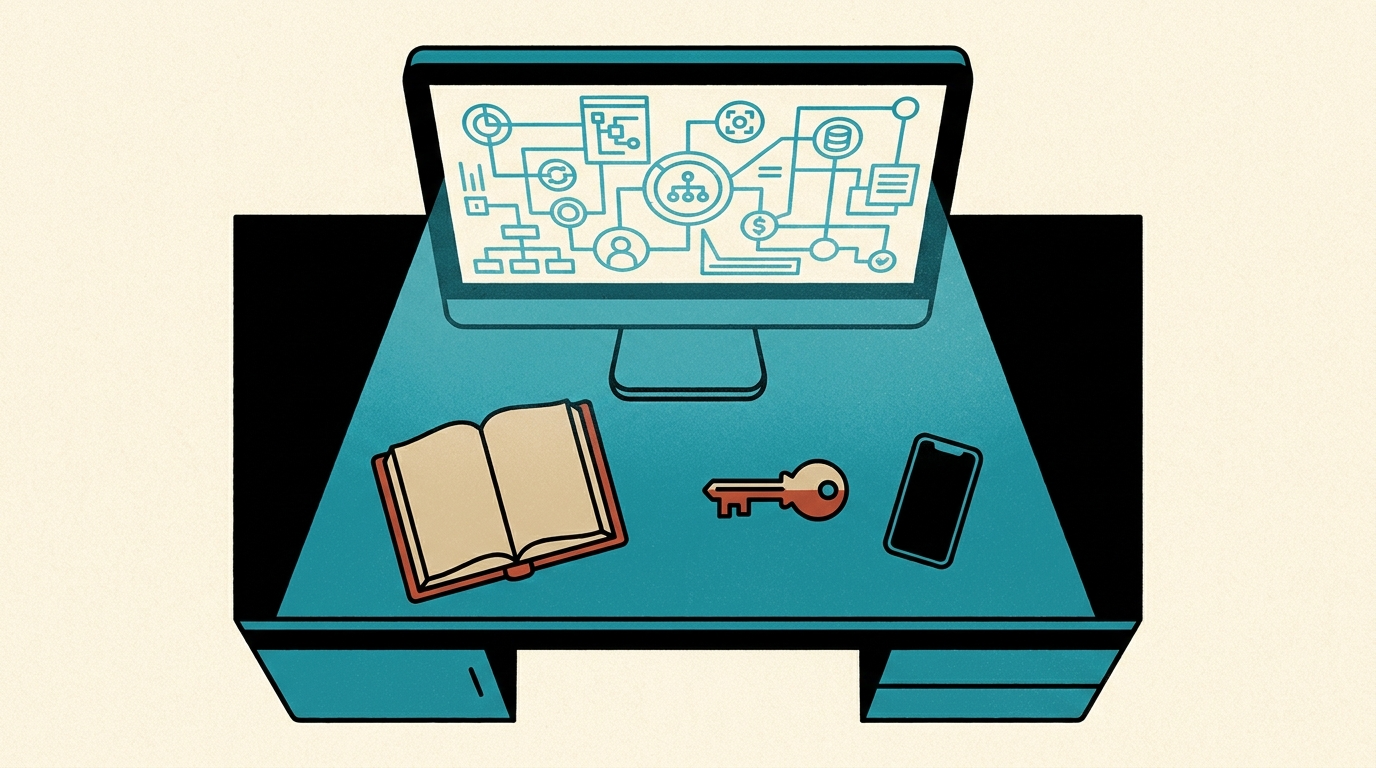
The End of the Web-Based PMS: Why AI Will Redefine Vacation Rental Technology
The traditional property management system has become an operational bottleneck. As autonomous AI agents take over, the centralized dashboard is about to go obsolete.
For more than twenty years, the vacation rental industry has operated on a single, unchallenged assumption: that to run a hospitality business, a human being must sit in front of a web browser and click buttons. We built empires on these clicks. We hired armies of guest coordinators, revenue managers, and maintenance dispatchers whose entire professional existence consists of copy-pasting text from one software tab to another, reconciling mismatched reservation calendars, and babysitting APIs that break whenever Airbnb or Vrbo updates their platform architecture. The dashboard was our cockpit, and we assumed that as the industry grew, we would simply need bigger dashboards with more buttons.
This manual era is coming to a sudden, unceremonious end. The traditional web-based property management system, or PMS, is no longer the cutting-edge asset it was during the software-as-a-service boom of the last decade. It has become an operational bottleneck. As artificial intelligence transitions from an experimental chatbot feature to an autonomous operating layer, the centralized dashboard is about to go the way of the physical ledger book and the desktop server. The platforms we rely on to run our businesses are structurally incapable of surviving this transition in their current form.
What happened
On October 2, 2026, John Suzuki, a veteran industry advocate and former software evangelist for HomeAway, published an analysis on VRM Intel detailing a structural shift that is already underway. Suzuki argued that the transition away from web-based PMS platforms like Guesty, Hostaway, Track, Streamline, and Escapia will not be a gradual curve. Instead, he warned that AI-native architectures are poised to bypass these traditional systems entirely, turning them from operational nerve centers into simple, passive databases.
This warning comes at a moment of broader consolidation and technological shifts across the short-term rental sector. On the exact same day, vacation rental management giant Casago announced its leadership transition with Joe Riley stepping in as CEO, as reported in a business update on October 2, 2026. Meanwhile, major data moves are shaking the space, including TowneBank's massive 250 million dollar sale of Towne Vacations to Belcrest Vacations, as reported by Amy Hinote, and Key Data's double-header announcements promoting Scott McLeod to President and appointing Dustin Downing to lead product innovation. Key Data also recently launched Dex AI, which it calls the industry's first AI-powered data experience engine. The message from the market is loud: the old ways of managing data, inventory, and operations are too slow, too expensive, and too dependent on human clicks to survive the coming margin squeeze. The tech stack that got us here is not the tech stack that will take us forward.
The legacy of the relational database
To understand why the web-based PMS is dying, one must understand how it was born. In the late 1990s and early 2000s, property management software was a localized affair. Desktop programs ran on dedicated office servers, backed up nightly to physical tapes. If a manager wanted to update a listing, they walked over to the terminal. The transition to the cloud in the 2010s was hailed as a revolution, but it was fundamentally an architectural compromise. Legacy systems migrated their relational databases to cloud-hosting environments like Amazon Web Services. Newer, cloud-native entrants like Guesty and Hostaway built beautiful, browser-accessible interfaces from day one. But under the hood, the fundamental design remained unchanged. They are systems of record.
Their primary purpose is to store structured data in neat tables: guest names, check-in dates, nightly rates, door codes, and clean-up schedules. They present this data on visual dashboards, relying on the human brain to act as the processing unit. If a guest asks for an early check-in, the PMS does not solve the problem; it displays the message, shows the housekeeping status, and waits for a human operator to click "approve" and send a template. This human-centric dependency was acceptable when margins were wide and average daily rates were soaring. But in a mature, consolidated market where every dollar of operational cost matters, relying on manual labor to bridge the gaps between software databases is a massive financial liability. The web-based PMS did not eliminate labor; it simply moved the labor from the clipboard to the keyboard.
The historical shift from iCal to API and beyond
To truly understand the technological shift we are entering, we must look back at the history of calendar synchronization in the vacation rental space. In the early days of online listings, before Airbnb existed and when Vrbo was still a simple classifieds website, calendar management was entirely manual. If a guest booked a week on one platform, the property owner had to log into every other website they used and manually block out those dates. The introduction of the iCal standard in the mid-2000s was hailed as a major step forward for basic automation.
For all its usefulness, iCal was an incredibly primitive technology. An iCal feed is simply a text file containing a list of blocked dates that is hosted on a server and refreshed periodically. It contains no guest information, no pricing data, no check-in instructions, and no operational details. Worse, iCal feeds do not sync in real time. They rely on the receiving platform to periodically fetch the file, a process that can take anywhere from fifteen minutes to several hours. In the early days of low-demand, long-term vacation rentals, this lag was acceptable. But as the market grew and instant booking became the standard, the iCal sync delay became a primary cause of double-bookings, leading to stressful guest cancellations and severe platform penalties.
The transition to direct API integrations in the 2010s was designed to solve the double-booking problem. APIs allowed the PMS to push reservation data directly to the booking channels in near-real-time. But this transition also shifted the burden of technology maintenance onto the PMS vendors and the property managers. APIs are not static; they are constantly changing. Every time Airbnb, Vrbo, or Booking.com updates their API architecture, PMS vendors must write new code to keep up. When an API breaks, the connection drops, and the property manager is left in the dark. We traded the simple, slow reliability of iCal for a complex, fragile network of APIs that requires continuous monitoring and human intervention to maintain.
The integration tax and the API bottleneck
Over the past five years, PMS vendors tried to solve their inherent limitations by copying the Apple App Store model. They built integration marketplaces. If a property manager wanted dynamic pricing, they integrated PriceLabs, Wheelhouse, or Beyond. If they wanted guest screening, they added third-party security tools. If they wanted operations management, they plugged in Breezeway or BeHome247. This app-stack strategy created a lucrative ecosystem, but it also introduced immense operational fragility.
Every integration relies on an API connection. Data must travel from the booking platform to the PMS, then to the pricing engine, back to the PMS, down to the smart lock manager, and out to the messaging tool. A single delayed webhook or mismatched field mapping can cause a reservation to drop, a door code to fail, or a double-booking to occur. Property managers now spend thousands of dollars a month on software subscriptions only to spend thousands more on administrative staff whose sole job is to monitor these integrations and fix the data breaks. The modern PMS is no longer an efficient tool; it is a complex web of digital duct tape. When a channel manager takes fifteen minutes to sync a rate update to Booking.com, or when an iCal feed lags by an hour, the property manager pays the price in double-bookings and lost revenue. This latency is a structural limitation of web-based systems that cannot process real-time events concurrently at scale.
The fragmentation tax and SaaS fatigue
Historically, SaaS was sold as a cost-saving measure. By moving from desktop servers to cloud-based subscriptions, property managers eliminated the need for on-site IT technicians, hardware upgrades, and physical backups. But over the last decade, the SaaS model has mutated. Instead of a single, comprehensive software suite that handles everything, property managers are forced to navigate an increasingly fragmented ecosystem. The modern PMS has effectively hollowed out its core product, relying on third-party integrations to handle everything from dynamic pricing to smart home hardware, guest screening, and operations management.
This fragmentation has introduced what industry veterans call the integration tax. A property manager does not just pay twenty dollars per unit per month to their PMS. They pay an additional seven dollars per unit to a dynamic pricing engine, five dollars to a guest-messaging assistant, eight dollars to an operations management platform, four dollars to a keyless entry provider, and three dollars to a guest vetting service. By the time the tech stack is complete, the manager is paying forty-seven dollars per unit per month. For a mid-sized operator, these stacked software fees can quickly translate to tens of thousands of dollars a year in software fees alone.
Worse, this model does not scale cleanly. As the portfolio grows, the complexity of managing these subscriptions and their associated data syncs increases exponentially. If the pricing engine has a database error, it pushes incorrect rates to the PMS, which then pushes those rates to the channels. By the time the human operator notices the mistake, five properties have been booked for peak holidays at off-season rates. The financial damage of a single integration failure can easily wipe out a year's worth of software cost savings. This SaaS fatigue is driving operators to look for consolidated, unified systems that run on a single intelligence layer rather than a fragile network of disconnected software subscriptions.
The rise of the autonomous digital operator
The shift from systems of record to systems of action is not just a technological upgrade; it is a conceptual revolution. An AI-native PMS does not wait for a human to log in and look at a dashboard. It operates as an autonomous agent that continuously monitors the state of the business. When a guest sends a message at 2:00 AM asking if the property has a high chair, the legacy PMS displays the message and sends a notification to an exhausted overnight agent. An AI-native system, however, reads the message, queries the property's database, checks the housekeeping notes to verify the physical location of the high chair, confirms its availability, drafts an immediate response, and updates the reservation notes—all in less than ten seconds.
This is the world described by McKinsey & Company in their 2024 report on generative AI, which highlighted how enterprise software is rapidly moving away from static user interfaces toward agentic workflows. In the vacation rental space, this means the software itself becomes the operator. It handles the channel distribution, the dynamic pricing adjustments, the guest vetting, and the maintenance dispatching without requiring a human to act as the intermediary. The human's role shifts from executing tasks to supervising the system. You no longer manage the properties by clicking buttons on a screen; you manage the AI agent that manages the properties.
“This transition is not incremental—it is structural. Just as cloud computing rendered server-based systems obsolete, AI-native platforms are poised to redefine—and potentially replace—the traditional web-based PMS model.”
The labor economics of the margin squeeze
At the same time that software costs are rising, the labor market for vacation rental operations has become increasingly difficult to navigate. For decades, property management was a highly localized, labor-intensive business. You needed local office staff to answer phones, dispatch housekeepers, and coordinate maintenance calls. During the post-pandemic travel boom, as booking volume exploded, many property managers turned to remote virtual assistants in countries like the Philippines or South Africa to handle customer service, guest communications, and administrative tasks.
This remote labor strategy was a temporary fix, not a long-term solution. Today, the cost of high-quality remote labor is rising, and the administrative burden of managing, training, and retaining a distributed team is substantial. More importantly, human communication is limited by human speed. A virtual assistant, no matter how well-trained, can only handle one guest chat at a time. During peak check-in windows on a Friday afternoon, a manager with two hundred properties might receive fifty messages in the span of thirty minutes. Guests are standing in the rain at lockboxes, searching for the trash bins, or asking why the air conditioning is not turning on.
When response times stretch from minutes to hours, guest satisfaction scores plummet. On modern booking platforms, a drop in guest ratings directly correlates with a drop in search visibility, leading to fewer bookings and lower revenue. The labor-centric model of property management has hit its structural limit. There are not enough hours in the day, or enough cheap virtual assistants in the world, to deliver the instantaneous, highly personalized communication that modern consumers expect. An autonomous digital operator does not experience fatigue, does not require training, and can handle one thousand concurrent guest conversations without a single second of latency.
The modern PMS is no longer an efficient tool; it is a complex web of digital duct tape.
The shifting economics of the software stack
The economic incentives driving this transition are absolute. Software-as-a-service companies typically charge property managers a flat monthly fee per unit, or a percentage of gross booking revenue, often ranging from 1% to 3%. For a property manager overseeing a large portfolio, this percentage-based model can translate to paying hundreds of thousands of dollars annually just for the software license. Yet, despite this high cost, the manager must still maintain an in-house team of reservationists, guest relations agents, and coordinators to run the software.
An AI-native platform flips this entire financial equation. Instead of acting as an expensive database that requires human operators, an AI-native system functions as an autonomous digital employee. It does not just store the clean-up schedule; it looks at the housekeeper's location via GPS, assesses traffic, evaluates the guest's check-out time, and automatically re-routes the cleaning crew without human intervention. By shifting from a system of record to a system of action, these platforms can reduce administrative overhead by more than 50%. PMS vendors that charge premium rates for manual dashboards will find themselves underbid by autonomous platforms that deliver actual business outcomes rather than mere software interfaces. In a stabilizing market where rates, not demand, are driving growth, operational efficiency is the only lever left to protect margins.
How real-time data bypasses the PMS
The emergence of AI-powered data engines like Key Data's Dex AI highlights another critical vulnerability of the traditional PMS: the data bottleneck. In the legacy software model, the PMS was the gatekeeper of all operational data. If you wanted to know your average daily rate, your occupancy, or your RevPAR, you had to run a report within the PMS dashboard. These reports were often slow, clunky, and backward-looking, showing you what happened last week or last month rather than what is happening right now.
Today's market moves too fast for historical reporting. Revenue management has evolved from a passive, calendar-based task into an active, continuous optimization process. To maximize yield, operators must analyze real-time market supply, competitor pricing, local flight data, weather forecasts, and historical booking velocity. A traditional PMS is simply not designed to process these massive, unstructured data streams. It is a system of record, built to store stable data, not a high-speed analytics engine.
This is why third-party business intelligence platforms are bypassing the PMS database entirely. By pulling raw transactional data directly from the APIs of the major channels and connecting it to real-time market feeds, platforms like Key Data can provide predictive insights that are far more accurate and actionable than anything a legacy PMS can generate. When these data engines are paired with autonomous execution layers, the need for a traditional PMS dashboard disappears. The pricing decisions are made by the AI, validated by real-time market data, and pushed directly to the OTAs. The PMS is left with nothing to do but record the financial transaction—a function that can be easily handled by a basic accounting database.
The battle for the data layer
This brings us to the core battleground of the next decade: the ownership of the data layer. Historically, the PMS held the ultimate power because it was the single source of truth for property data, calendar availability, and owner accounting. But as third-party business intelligence tools and data providers become more sophisticated, the PMS is losing its monopoly on information. The launch of Key Data's Dex AI is a perfect case in point. By building an AI-powered data experience engine that sits on top of raw rental data, Key Data is showing that the value is no longer in holding the data, but in the speed at which an intelligence layer can interpret that data and execute changes across multiple sales channels instantly.
If a property manager can query their data using natural language—asking which of their three-bedroom homes in Destin are underperforming the market by more than ten percent, and what adjustment should we make to their rates for October—and have the system not only answer the question but automatically push those rate updates directly to the OTAs, the traditional PMS dashboard becomes entirely redundant. The PMS is reduced to a dumb pipe, a commoditized database utility, while the high-margin intelligence layer is captured by AI-first platforms.
The private equity trap and the innovation deficit
Why are the major PMS vendors not building these AI-native systems themselves? The answer lies in the financial structure of the vacation rental technology sector. Over the past decade, many of the leading PMS platforms have been acquired by private equity firms or large corporate holding companies. These financial buyers are focused on EBITDA growth, cost reduction, and debt service. They are incentivized to milk their existing codebases for subscription revenue rather than investing the massive capital required to re-architect their platforms from scratch.
A traditional web-based PMS is built on millions of lines of legacy code, written over a decade or more. You cannot simply sprinkle a little AI on top of a relational database designed in 2012 and call it an AI-first platform. To build a true system of action, you must start from scratch with an event-driven architecture, vector databases, and native LLM integrations. For a private equity-backed PMS vendor, undertaking a complete rewrite of their core software is a terrifyingly risky and expensive proposition. They would rather build superficial AI features—like an AI email assistant that drafts responses but still requires a human to click send—to tick a marketing box. This innovation deficit has left the door wide open for nimble, venture-backed, AI-native startups to disrupt the entire industry.
The trust accounting moat and the final defense
There is, however, one major obstacle that AI-native startups must overcome before they can completely replace the traditional PMS: trust accounting. In the professional vacation rental space, especially in markets like North Carolina, Florida, and Hawaii, trust accounting is not just a feature; it is a strict legal requirement. Property managers must hold owner funds in escrow accounts, track every penny of revenue and expense, generate detailed monthly owner statements, and comply with rigorous state real estate commission audits.
Legacy systems like Escapia, Track, and Streamline have spent decades perfecting their trust accounting engines. These engines are incredibly complex, built to handle split-rate payouts, tax withholding, credit card processing fees, maintenance chargebacks, and historical adjustments. This is a massive defensive moat. An AI agent might be excellent at writing guest messages or adjusting nightly rates, but it cannot easily navigate the arcane, highly regulated world of trust accounting audits. For this reason, legacy PMS platforms will likely survive as backend financial utilities long after they have lost control of the guest experience, the pricing, and the operations. The PMS of the future may simply be an invisible accounting engine running in the background, while an AI-native operating system handles everything else.
What hosts should do now
The transition from browser-centric software to autonomous digital operations is moving too quickly for property managers to sit on the sidelines. To protect your margins and avoid being locked into obsolete technology, you must take immediate, practical steps to prepare your business.
- Audit your integration stack: Document every third-party tool currently connected to your PMS. Calculate the total monthly subscription cost and identify where human manual entry is still required to bridge the gap between these systems.
- Demand true API access: Ask your current PMS vendor for complete, unrestricted API access to your data. If they charge extra for API access or limit your webhooks, start shopping for a platform that respects your ownership of your operational data.
- Test autonomous agents in isolation: Do not wait for a complete PMS replacement to begin using AI. Deploy specialized AI agents for specific tasks, such as handling guest inquiries during overnight hours or automating maintenance dispatching.
- Prioritize trust accounting compliance: If you operate in a highly regulated market, ensure that any new technology you adopt has a proven, audit-ready trust accounting backend or can integrate cleanly with your legacy financial systems.
- Train your staff for supervisory roles: Shift your team's focus away from data-entry and task execution. Train your coordinators to monitor, audit, and optimize autonomous systems rather than performing manual workflows themselves.
The property managers who thrive in this new era will not be those who work the hardest at clicking buttons. They will be the ones who build the most efficient digital systems, allowing technology to operate the business while they focus on building relationships with owners and delivering physical hospitality to guests.
Checked by the standards desk (Eleanor Quist): 3 specifics were removed or attributed as unverified before publication.




Read the desk every morning.
The day's crackdowns and platform moves, the money, the design and the stays going viral, plus the desk's verdict, in one short email every morning.