Hackers Steal Host Logins to Divert Payouts in Silent Digital Heist
Cybercriminals target property management credentials to quietly swap bank routing numbers, siphoning peak-season revenue before operators notice the balance sheet bleed.
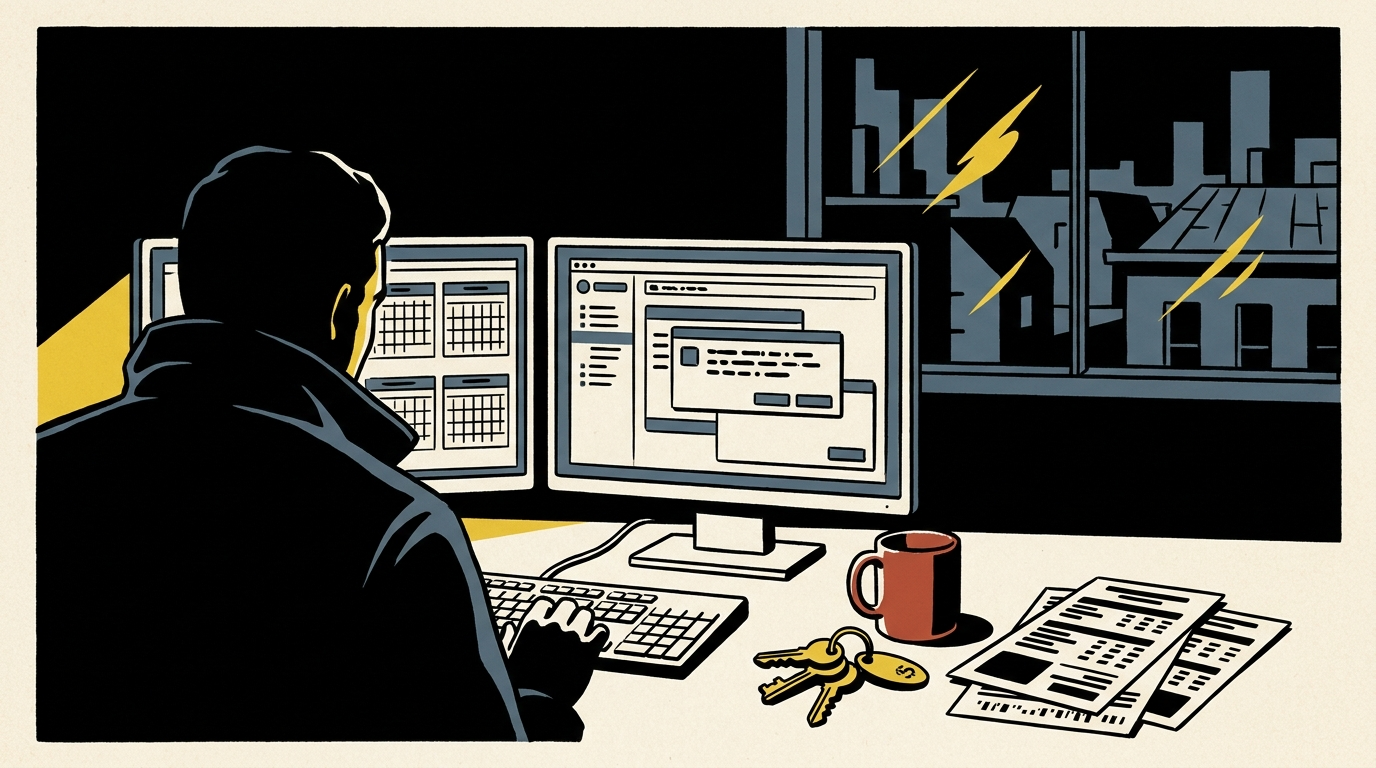
The morning the bank balance flatlined, thirty-two separate guest parties were opening lockboxes from the Carolina coast to the Blue Ridge foothills. Keypads beeped, deadbolts turned, and luggage rolled over hardwood floors without a hitch. The cleaning crews had reported their tasks completed on schedule, the electronic guidebooks had sent their automated welcome messages, and the calendar software displayed wall-to-wall green ribbons marking full occupancy across the portfolio. Every operational indicator pointed toward an exceptionally lucrative holiday weekend. The operational machinery was humming, but the money was running in the opposite direction, flowing straight into a digital routing trap engineered hundreds of miles away.
No customer service alarms sounded. No locks were forced. No guests called the emergency dispatch line to complain that their reservations had been canceled or double-booked. The properties were full, the air conditioners were running at full blast, and the water heaters were burning through kilowatt-hours, yet the operating account remained dead silent. By the time the head of operations sat down with a ledger to cross-check expected morning deposits against bank receipts, the scheduled disbursements had already cleared the automated clearinghouse pipeline. The funds had vanished into a string of intermediary accounts, leaving behind a pristine dashboard and an empty checking ledger.
This is the payout diversion attack, an aggressive strain of credential theft quietly draining short-term rental operators across the sector. Unlike standard vandalism or amateur extortion schemes that deface listings or blast ransom notes to guests, this heist relies on utter quiet. The attackers do not care about the properties, the guests, or the ratings. They want only the financial plumbing. By exploiting the complex network of software integrations that connect property management software, central reservation engines, and major distribution channels, criminals alter a single line of banking text, sit back, and allow the normal operations of a busy rental company to funnel thousands of dollars directly into their pockets.
How it actually works
The mechanics of the scam exploit the exact structural design that makes modern property management possible: centralized automation. In an earlier era of hospitality management, a property manager manually verified each booking, charged cards through a standalone countertop terminal, and hand-deposited paper checks at a local branch. Today, scale demands total digital integration. A mid-sized operator running forty doors relies on a property management system to synchronize calendar availability, process dynamic pricing updates, dispatch automated cleaning notifications, and handle messaging across Airbnb, Vrbo, Booking.com, and direct booking engines. At the center of this web sits the software dashboard, holding the keys to merchant processing accounts and automated bank disbursements.
The breach almost never starts with a brute-force assault on a platform core database. Attackers do not need to crack the institutional encryption shields protecting multi-billion-dollar travel platforms when front-line hospitality employees will willingly hand over login credentials if asked with sufficient urgency. The attack begins with targeted social engineering tailored directly to the daily pressures of hospitality operations. A reservation coordinator receives an email or an in-platform guest message marked urgent. The message claims that a booking for an upcoming high-value stay cannot process identity verification, or it contains a link masquerading as an official platform security update warning that payout releases will be halted within twenty-four hours unless tax documentation is renewed.
The link leads to a forged login interface designed down to the pixel to mirror the login portal of a major channel manager or software platform. When an overworked reservation clerk or virtual assistant enters their username, password, and two-factor authentication code, the attacker intercepts the session token in real time. Armed with administrative or elevated user permissions, the intruder does not touch the calendar, touch the rates, or interfere with upcoming check-ins. Touching the guest experience creates instant noise, and noise kills the heist. Instead, the attacker moves directly to the financial administration menu, locates the payout preference tab, and changes the routing number and account number tied to automated ACH disbursements.
From that second onward, the platform automated payout protocol works entirely against the host. Major booking channels operate on standardized release schedules. On Airbnb, payouts are released approximately twenty-four hours after a guest checks in. On Vrbo, funds disburse according to the property manager established schedule, often tied directly to check-in dates or set settlement cycles. When thousands of dollars in daily accommodation fares, cleaning fees, and collected local taxes clear the merchant processor, the automated clearinghouse system obediently routes every dollar to the fraudulent bank account. Because the calendar remains active and guests continue to arrive without incident, the operator has no immediate operational trigger to investigate. The money simply flows into a digital siphon until someone performs a manual reconciliation against bank statements.
The vulnerability of integrated tech stacks
The modern short-term rental balance sheet is a masterclass in operational friction reduction. A single management dashboard connects to third-party channel managers through open Application Programming Interfaces, synchronizes with automated messaging services, feeds data to smart locks, and dispatches schedules to commercial laundry operations. Every connection represents an efficiency gain, eliminating hours of repetitive manual data entry. Yet every connection also expands the potential attack surface of the business, creating interconnected points where a single credential failure can compromise the entire financial apparatus.
Channel managers and property management systems frequently maintain master administrative credentials with broad authority over downstream platform connections. When an operator connects a property management platform to their channel accounts, they grant broad read-and-write permissions. If an employee with elevated permissions uses a weak password, reuses credentials across personal and work services, or operates on an unsecured network without hardware-based security keys, the entire distribution network becomes vulnerable. The danger multiplies when management companies outsource guest messaging and guest triage to third-party remote teams or virtual assistants working across international jurisdictions, often using shared, non-individualized platform logins.
When an attacker captures credentials for a centralized dashboard, they frequently gain lateral access to every connected listing across multiple platforms. If the central software manages bank routing directly, altering the master payout account alters disbursements for every property under contract simultaneously. If the attacker chooses instead to compromise individual channel logins by scraping credentials saved within the management software, they can systematically alter bank parameters on individual channel profiles while leaving the channel manager messaging stream untouched. The separation between operational communication and financial control breaks down, allowing the intrusion to persist unnoticed across an entire booking cycle.
The reconciliation blind spot
The greatest asset of a credential thief is the operational chaos of peak season. During periods of high occupancy, a property management firm running fifty units may process hundreds of unique reservation disbursements in a single week. Each disbursement represents a complex bundle of gross rental rates, channel commission deductions, credit card processing charges, cleaning fee allocations, and pass-through lodging taxes. Because accommodation funds do not land in a single lump sum but rather arrive as an erratic, rolling stream of individual ACH deposits, immediate detection requires rigorous, real-time daily ledger reconciliation.
In practice, very few independent management firms reconcile every single incoming deposit on the day it occurs. High season demands that operational bandwidth be poured into turnovers, maintenance emergencies, guest noise complaints, and inventory management. Accounting teams or bookkeepers typically reconcile platform payout notices against bank statements on a weekly, bi-weekly, or monthly cycle. A professional property manager might glance at their software dashboard and see hundreds of thousands of dollars marked as paid or disburser processed. The software records the payment as successful because the channel platform completed the wire transfer. The software has no native way of knowing that the receiving destination was swapped from a local commercial bank to an out-of-state challenger bank or a prepaid digital debit account.
This information lag creates a lethal window of exposure. If an attacker swaps routing details on the third day of a month, and the operating firm conducts comprehensive financial reconciliations on the first of the following month, the attacker enjoys nearly four full weeks of uninterrupted diversion. Every guest check-in during that window serves to finance the criminal enterprise. By the time an accounting manager notices that the actual cash balance in the operating account falls tens of thousands of dollars short of the software projected cash flow, the funds have long since cleared the initial receiving accounts, been split into smaller increments, and been transferred into cryptocurrency or overseas accounts beyond the reach of domestic legal processes.
Anatomy of the phishing trap
The sophistication of short-term rental phishing operations has evolved far beyond the clumsy, generic spam emails of the past decade. Modern attacks are highly contextualized, demonstrating an intimate understanding of platform policies, guest messaging interfaces, and the psychological triggers that compel property management staff to act quickly. Cybercriminals actively study the operating procedures of platforms like Airbnb, Vrbo, and Booking.com, building phishing templates that match the exact typography, color palettes, and transactional phrasing of official corporate communications.
One prevalent vector begins directly within the native guest messaging inbox. Attackers create bogus guest profiles and submit booking inquiries for high-season dates. Attached to the inquiry is a message stating that the prospective guest has an elderly family member with severe mobility limitations or a child with severe medical allergies. The message contains a link or an external attachment purportedly showing photos of the medical equipment required or floor-plan questions. In other variations, the attacker claims they have already paid through the platform but received a notification that their reservation is held in pending status until the host clicks a link to confirm receipt. When the property staff member clicks the link, they are directed to a spoofed platform login screen that harvests their credentials.
A second vector targets administrative email addresses directly, exploiting fear of platform suspension. Short-term rental operators live in perpetual anxiety regarding account deactivation, algorithm demotion, or administrative cancellation. Phishing emails frequently carry aggressive subject lines warning of immediate account termination due to alleged regulatory non-compliance, unverified identity credentials, or unpaid platform service fees. The email demands that the operator log in within twelve hours to resolve the dispute. The manufactured urgency short-circuits normal security skepticism. A manager fearing the loss of their primary distribution channel clicks the link, inputs administrative credentials, and unknowingly hands over control of the financial routing hub.
The banking disconnect and recovery hurdles
When the fraud is finally uncovered, operators encounter an unforgiving financial reality: the protections afforded to commercial business accounts bear little resemblance to consumer fraud protections. Under federal banking regulations in the United States, consumer bank accounts enjoy substantial safeguards against unauthorized electronic fund transfers under Regulation E. Consumer banks are generally required to investigate claims of unauthorized access and restore stolen funds if notified promptly. Commercial operating accounts, however, are governed by the Uniform Commercial Code and private clearinghouse rules that place the burden of security squarely on the business entity.
Under the operating rules established by Nacha, the governing body for the Automated Clearinghouse network, the window for a commercial bank to recall an unauthorized ACH credit or debit is razor-thin. While consumer accounts often have up to sixty days to dispute unauthorized charges, commercial returns for unauthorized entries frequently must be initiated within forty-eight hours of settlement. In a payout diversion scheme, the money is not pulled out of the host account via an unauthorized debit; rather, funds are sent out by the distribution platform via direct credit to a fraudulent account. Because the originating transfer was dispatched by an authorized channel platform pursuant to its internal system commands, traditional fraud recall mechanisms stall immediately.
When a manager calls their bank, the bank accurately points out that no unauthorized transaction occurred on that specific checking account; rather, expected incoming funds simply never arrived. When the manager contacts the booking platform, the platform response is equally bureaucratic. The platform asserts that its systems functioned exactly as intended: automated payouts were sent to the routing numbers entered under the authenticated account profile. Unless the operator can definitively prove that the platform internal infrastructure suffered a systemic data breach—which is rarely the case, as the compromise occurred at the operator endpoint—the platform typically disclaims all liability for disbursements directed to the modified banking destination.
Who eats the loss
The financial fallout from a payout diversion attack lands with crushing weight on the property management company. A professional property manager operates on thin net margins, often collecting between fifteen and thirty percent of gross rental revenue as a management commission. The remaining seventy to eighty-five percent of gross booking proceeds belongs to third-party property owners, earmarked to cover real estate mortgages, property taxes, insurance premiums, and maintenance reserves. When three weeks of gross revenues vanish, the manager cannot simply pass the loss along to their property owners without facing immediate contractual breach, owner revolts, and potential civil litigation.
If an operator loses one hundred thousand dollars in diverted gross booking revenue, their actual earned commission on that volume might only have been twenty thousand dollars. Yet the property manager remains legally and contractually obligated to disburse the eighty thousand dollars owed to their client property owners on schedule. Absorbing that cash deficit out of working capital can instantly push an independent management firm into technical insolvency, wiping out months or even years of operating profits. If the firm cannot meet its owner disbursement obligations, property owners will cancel contracts, pull inventory, and file complaints with real estate licensing commissions.
Turning to commercial insurance rarely provides an easy rescue. Standard commercial general liability policies exclude financial losses resulting from cyber events. Even specialized commercial property and business interruption policies routinely exclude losses stemming from social engineering, voluntary wire transfers, or unauthorized computer access unless the business has purchased a dedicated cyber liability rider. Even when a firm carries cyber insurance, policies frequently draw sharp distinctions between direct network extortion and funds transfer fraud. If an employee willingly entered credentials into a phishing portal, the insurer claims adjuster may classify the event as voluntary credential relinquishment, triggering policy exclusions or subjecting the claim to drastically reduced sub-limits that cover only a fraction of the total stolen sum.
The operational machinery keeps humming while the money runs in the opposite direction, flowing straight into a digital routing trap.
The dark market for host credentials
The theft of property management credentials is not an isolated crime of opportunity committed by lone actors; it is an organized, industrial enterprise operating within illicit digital marketplaces. Stolen credentials for hospitality platforms, channel managers, and property software are traded openly on underground forums and encrypted messaging channels. Within these illicit ecosystems, compromised logins are treated as commoditized financial assets, categorized by portfolio size, monthly transaction volume, and platform identity.
Credential harvesters who run large-scale phishing campaigns rarely execute the actual banking diversions themselves. Instead, they sell authenticated session cookies, API tokens, and administrative logins to specialized financial fraud rings. These secondary actors specialize in cash-out infrastructure: establishing networks of synthetic identities, recruiting commercial money mules, and setting up accounts at digital-first fintech platforms that permit rapid account creation with minimal physical verification. The buyers know exactly how long a payout diversion remains undetected on each specific software platform, executing their bank modifications with surgical timing to maximize the volume of transfers before the account is flagged.
The rise of digital-only banking entities and non-bank financial intermediaries has made the monetization of stolen credentials faster and harder to trace than ever before. Attackers route stolen property payouts into accounts opened under synthetic identities, instantly sweep the incoming funds into peer-to-peer payment networks, convert the fiat currency into privacy-focused digital assets, and exit the banking system entirely within minutes of settlement. By the time an operator notices an irregularity on their dashboard, the stolen capital has traversed half a dozen international financial jurisdictions, rendering domestic law enforcement subpoenas completely ineffective.
The limits of platform safeguards
In response to mounting credential fraud, major booking channels and enterprise software vendors have introduced secondary layers of verification. When a user attempts to alter banking payout details on platforms like Airbnb or Vrbo, the system often triggers an automated email confirmation to the primary administrative email address, or requires an SMS verification code sent to the phone number on file. Some systems impose a mandatory waiting period, holding payouts for twenty-four to seventy-two hours following a change to bank routing instructions before dispatching accumulated funds.
While these technical safeguards represent progress, they remain fundamentally vulnerable to determined social engineering. If an attacker captures session credentials through an adversary-in-the-middle phishing kit, they can intercept two-factor SMS codes and session tokens instantaneously. Furthermore, if the operator uses a single administrative email account that has also been compromised, the attacker simply logs into the email inbox, approves the platform verification request, and deletes the security alert before the property staff ever sees it. Automated notification emails are easily lost in the deluge of hundreds of automated reservation confirmations, message pings, and cancellation notices that flood an operator inbox every single day.
Moreover, the fragmentation of the short-term rental technology ecosystem creates critical blind spots. An operator may establish rigid security parameters on their primary channel account, but leave a connected channel manager or pricing tool secured by a single, shared password without two-factor authentication. Attackers systematically probe the weakest link in the chain. If a secondary tool has write-access to the distribution channel via API, compromising the smaller, less-secure third-party application provides an open back door into the primary financial hub, completely bypassing the channel front-door security alerts.
The human factor in hospitality security
Technology alone does not cause credential breaches; operational culture does. Hospitality is inherently an industry built on accommodation, responsiveness, and trust. Property managers train their front-line staff to be helpful, to resolve guest problems instantly, and to avoid friction at all costs. When an incoming message claims a guest is stranded outside a property or cannot access essential verification materials, the employee natural instinct is to assist immediately. Cybercriminals actively weaponize this service-first orientation against the business, transforming an employee professional empathy into an operational vulnerability.
Furthermore, the widespread adoption of distributed, remote staffing models across the short-term rental industry has intensified this vulnerability. To manage around-the-clock guest messaging across multiple time zones, many operators employ offshore virtual assistants who are paid modest wages and receive minimal structured cybersecurity training. These remote staff members often operate on personal laptops lacking enterprise endpoint detection and response software, utilizing public internet connections without virtual private networks, and sharing unified administrative passwords across shared communication dashboards. A single remote worker falling for a realistic spear-phishing message can compromise an entire corporate account holding millions of dollars in annualized booking volume.
Until management companies treat cybersecurity training as an essential operational discipline—equivalent to housekeeping inspections, local safety compliance, and fire code enforcement—these breaches will continue to multiply. An organization that conducts regular fire drills but never runs simulated phishing tests against its reservation desk is operating on borrowed time. Security awareness cannot remain a one-time onboarding video; it must be an active, continuously tested operational standard integrated into daily shift routines.
What hosts should do now
Halting payout diversion requires property managers to abandon casual operational habits and construct rigorous technical and procedural barriers around their financial settings. Taking defensive action immediately significantly reduces vulnerability to credential harvesting:
- Enforce mandatory hardware-based authentication: Eliminate SMS-based two-factor authentication across all software, channel, and business email accounts. Transition every staff member to physical security keys or app-based authenticators that cannot be intercepted by adversary-in-the-middle phishing kits.
- Segregate administrative and messaging roles: Implement strict role-based access controls within property management software. Staff members responsible for guest communications, calendar adjustments, and dispatch must never possess administrative privileges to view or modify banking details, payout preferences, or API connections.
- Lock down banking change protocols: Require dual-custody authorization for any modification to payout routing numbers. Establish an internal protocol mandating that any change to banking settings must be confirmed verbally between two designated corporate principals before confirmation codes are approved.
- Institute daily ledger reconciliations: Do not wait for end-of-month accounting statements to track platform cash flows. Assign a daily task to cross-reference every platform disbursement notice against incoming funds in the commercial checking account to identify diversion within twenty-four hours.
- Secure the administrative email gateway: Isolate the master email account tied to platform administrative logins from daily customer service operations. Protect this master address behind advanced phishing filters, conditional access policies, and aggressive login location restrictions.
The short-term rental sector has entered an era where physical real estate assets are entirely dependent on digital security architecture. Running a pristine portfolio of vacation homes means nothing if the digital pipe feeding the business operating cash is hijacked. The hosts who survive the coming years will not merely be those who offer exceptional hospitality, but those who protect their balance sheets with the vigilance of an institutional financial enterprise.
Checked by the standards desk (Eleanor Quist): every specific in this story was traced to its source material before publication.
About this piece
An original expert-analysis column by the Stay Gazette desk. Figures are illustrative of how the market behaves; confirm specifics for your own market before you act.




Read the desk every morning.
The day's crackdowns and platform moves, the money, the design and the stays going viral, plus the desk's verdict, in one short email every morning.