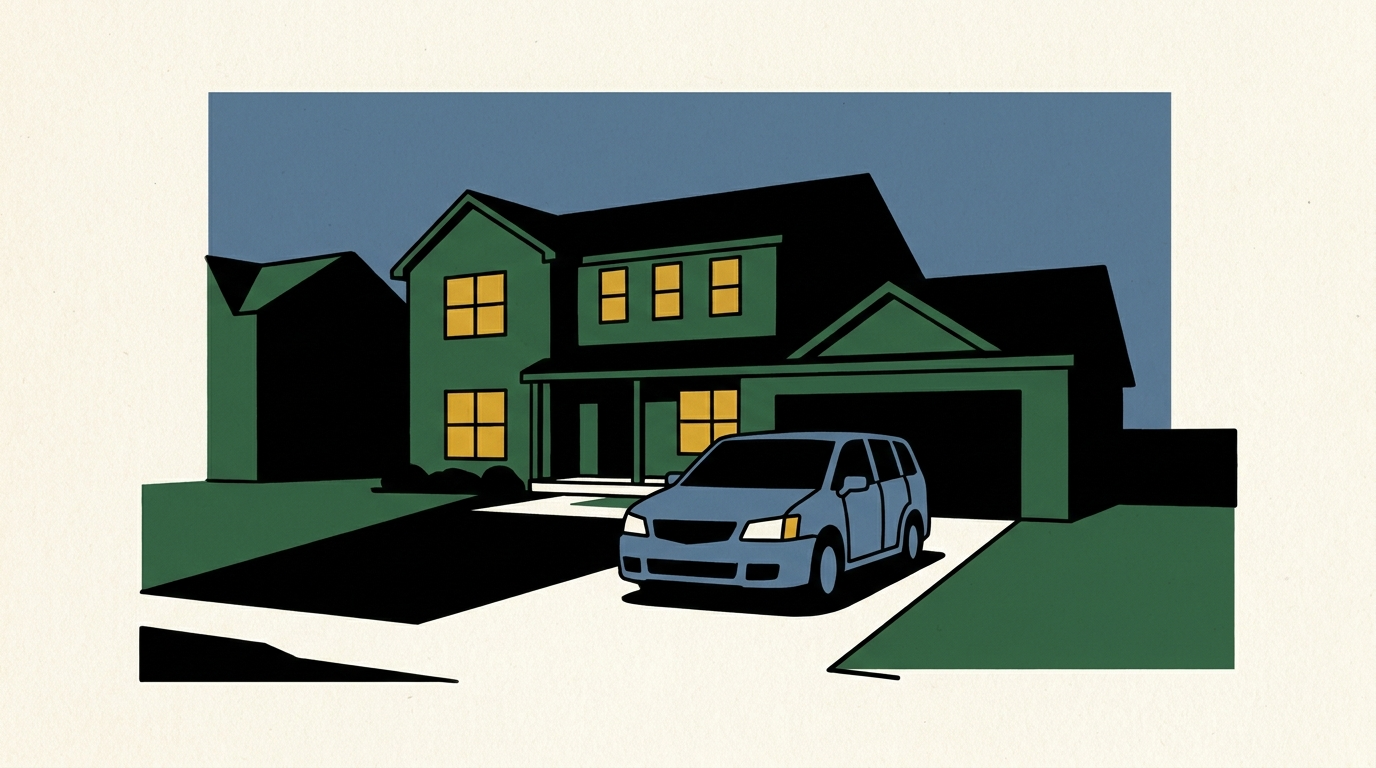
The Secondary Debt Trap Gutting Vacation Rental Portfolios
During the post-pandemic vacation rental rush, thousands of retail investors tapped their primary home equity to fund down payments. Now, the double-leverage trap is springing.
A quiet crisis is unfolding in the driveways of suburban neighborhoods across the country. It does not announce itself with the dramatic shuttering of storefronts or public liquidation sales. Instead, it exists as a series of ledger entries, variable-rate interest calculations, and sleepless nights for thousands of retail property owners. During the speculative mania of the post-pandemic housing expansion, a highly seductive financial playbook circulated through online forums, local meetup groups, and real estate seminars. The strategy was simple: extract the paper wealth accumulated in a primary residence through a Home Equity Line of Credit, deposit that cash as a down payment on a distant vacation rental, and let the incoming guest bookings pay off both debts. It was presented as a frictionless path to wealth creation, requiring none of the borrower's actual savings.
Today, that playbook is being exposed as a mechanism for compounding financial risk. The structural architecture of this trade relied on three highly volatile assumptions: that home values would continue their upward trajectory indefinitely, that interest rates would remain anchored near historic lows, and that the short-term rental market would maintain its unprecedented occupancy and pricing power. None of these assumptions survived the macroeconomic adjustments of the last two years. As the Federal Reserve aggressively raised interest rates to combat inflation, and as the supply of vacation rentals expanded far faster than consumer demand, the economics of the double-leveraged property portfolio collapsed. The result is a dangerous cross-collateralized trap where the underperformance of a mountain cabin or a beachside condo directly threatens the ownership of the investor's family home.
To understand the depth of this vulnerability, one must look past the polished marketing materials of the short-term rental platforms and examine the cold plumbing of residential finance. This is not a story of institutional failure; it is a story of retail balance sheets structured with systemic fragility. When an investor uses a subordinate lien on their primary dwelling to purchase a highly cyclical hospitality asset, they are not merely diversifying their investment portfolio. They are tying their central housing security to the weekly whims of leisure travelers, the algorithms of booking platforms, and the shifting regulatory landscapes of municipal governments. When the wind shifts, the entire structure begins to slide.
How it actually works
The mechanics of the home equity extraction trade are straightforward but inherently fragile. A Home Equity Line of Credit is a revolving loan secured by the borrower's primary residence. It sits in a second-lien position, subordinate to the primary mortgage. During the real estate appreciation spike of 2020 through 2022, millions of homeowners found themselves sitting on substantial paper equity. A home purchased for $400,000 in 2017 was suddenly appraising for $700,000. Because lenders are generally willing to extend credit up to a Combined Loan-to-Value ratio of 80% or occasionally 90%, these homeowners were suddenly eligible for lines of credit worth $150,000 to $250,000, even after accounting for their outstanding primary mortgage balances.
In a typical transaction, the investor draws the maximum allowable cash from this line of credit. This cash is not spent on home renovations or debt consolidation; instead, it is designated as the 20% or 25% down payment required by conventional lenders for a investment property purchase. The remaining 75% or 80% of the purchase price is funded through a new, first-position mortgage on the vacation home itself. This second mortgage is frequently structured as a Debt Service Coverage Ratio loan, which qualifies the borrower based on the projected rental income of the property rather than their personal debt-to-income ratio. Alternatively, it is written as a conventional second-home loan, which carries slightly lower interest rates but stricter personal liability guidelines.
This creates a capital stack built entirely on borrowed money. The investor has acquired a commercial-grade hospitality asset with zero cash down. The primary home's equity serves as the foundation, while the vacation home's mortgage serves as the superstructure. In the financial industry, this is known as double leverage. The investor is now obligated to make three separate monthly payments: the original primary mortgage on their family home, the variable-rate interest payment on the outstanding HELOC balance, and the fixed-rate principal and interest payment on the vacation property's mortgage. For the model to succeed, the cash flow generated by the vacation rental must not only cover its own operating expenses and primary mortgage, but also generate a surplus large enough to service the HELOC interest on the primary residence.
The interest rate shockwave
The structural flaw in this double-leveraged model is that HELOCs are almost universally variable-rate financial instruments. Unlike standard primary mortgages, which are typically locked in for 30 years at a fixed interest rate, HELOC rates are tied directly to index rates, most commonly the Prime Rate. The Prime Rate, in turn, moves in lockstep with the Federal Reserve's federal funds rate. When the central bank began its aggressive tightening cycle in March 2022, raising interest rates by 525 basis points over the course of sixteen months, the cost of servicing HELOC debt underwent a dramatic and immediate transformation.
Consider a typical retail investor who drew $150,000 from a primary residence HELOC in late 2021 to fund a vacation rental down payment. At the time, with the Prime Rate sitting at 3.25%, the investor’s variable interest rate was approximately 3.75%. Under the standard interest-only draw terms common to most HELOC structures, the monthly payment on this line of credit was a manageable $468. This minor cash outflow was easily absorbed by the household budget or covered by the early, lucrative booking revenues of the newly acquired vacation property.
By July 2023, however, the Prime Rate had surged to 8.5%. Consequently, the variable rate on that same $150,000 HELOC climbed to 9.0%. Without the principal balance reducing by a single dollar, the monthly interest-only payment spiked from $468 to $1,125. This represents an annual increase of nearly $8,000 in debt service costs, completely unrelated to the operation of the vacation rental itself. This rate adjustment occurred silently, appearing on monthly bank statements while the investor was simultaneously grappling with rising operational costs and cooling guest demand at the investment property. The cash-flow cushion that once made the double-leverage model appear viable was instantly erased by the realities of monetary policy.
When the spread dies: RevPAR vs. debt service
While debt service costs were climbing, the revenue side of the vacation rental balance sheet was experiencing its own severe correction. Short-term rentals are not passive real estate investments; they are operational hospitality businesses. Their revenue is determined by two primary metrics: Average Daily Rate and occupancy, which together yield Revenue Per Available Room. During the domestic travel boom of the pandemic era, both metrics hit historic highs as remote workers and stir-crazy families flooded drive-to vacation destinations. This temporary surge in demand was mistaken by many novice investors for a permanent structural shift in consumer behavior.
This miscalculation led to a massive supply response. Attracted by stories of easy cash flow, thousands of new hosts entered the market. Data from industry analytical firms like AirDNA indicates that in many high-profile vacation markets, the supply of available listings grew at double-digit rates throughout 2022 and 2023, far outstripping the growth in traveler demand. As a result of this supply saturation, occupancy rates began a steady downward normalization. A property that enjoyed a 70% occupancy rate in 2021 might find itself struggling to maintain 50% occupancy in 2023 and 2024. To attract bookings in a crowded market, hosts were forced to lower their ADR, leading to a compounding decline in monthly RevPAR.
The compression of gross revenues immediately exposed the high fixed operating costs of the short-term rental business. Unlike long-term residential rentals, where tenants typically pay for utilities, internet, and basic maintenance, a short-term rental host must cover all these operational expenses. These costs have been heavily impacted by broader inflationary pressures. Electricity, water, and high-speed internet rates have risen steadily. Property insurance premiums, particularly in coastal regions vulnerable to hurricanes or forested areas prone to wildfires, have experienced astronomical increases, with some premiums doubling in a single year.
Furthermore, the friction surrounding cleaning fees has reached a breaking point. To offset the rising cost of professional cleaning services, hosts historically passed these expenses directly to guests. However, a significant consumer backlash, combined with platform changes by Airbnb to display total price inclusive of cleaning fees in search results, has forced hosts to either absorb a portion of the cleaning costs or face a dramatic drop in search visibility and bookings. When you subtract these rising operational expenses, local occupancy taxes, the platform’s transaction fees, and the 15% to 30% commission charged by professional property managers, the remaining Net Operating Income is often wholly inadequate to service the underlying primary mortgage on the vacation property, let alone the variable-rate HELOC on the primary home.
The anatomy of a negative yield
To view this dynamic through a concrete financial lens, we can analyze the monthly cash-flow statement of a representative underperforming investment. Let us examine a vacation property purchased in a popular mountain market in early 2022 for $600,000. The investor utilized a $150,000 draw from their primary residence HELOC to cover the 20% down payment of $120,000, using the remaining $30,000 for closing costs, basic furnishing, and initial capital reserves. The remaining $480,000 was financed with a conventional second-home mortgage at a fixed rate of 5.5%, resulting in a monthly principal and interest payment of approximately $2,725.
In its first year of operation, the property performed reasonably well. It maintained an average occupancy of 62% at an ADR of $300, generating gross monthly revenues of roughly $5,580. After deducting the platform transaction fees, local lodging taxes, utilities, and minor maintenance costs, the property’s Net Operating Income stood at $3,800. This comfortably covered the $2,725 primary mortgage and the initial $468 HELOC payment, leaving the investor with a modest positive monthly cash flow of just over $600. The investment appeared to be working exactly as the online tutorials had promised.
Two years later, the picture is radically different. Market saturation has driven the occupancy rate down to 48%, while price competition has compressed the ADR to $250. Gross monthly revenue has fallen to $3,600. Meanwhile, operating expenses have crawled upward. After subtracting these costs, the property’s Net Operating Income has shriveled to $2,200. At the same time, the variable-rate HELOC payment has surged to $1,125 due to the rise in the Prime Rate. The investor’s total monthly debt service obligation is now $3,850 ($2,725 for the vacation mortgage plus $1,125 for the HELOC). The property is now running a net monthly deficit of $1,650. This is not a paper loss; it is a hard cash drain that the investor must fund out of their personal household income every single month just to prevent default.
The cross-collateralized trap
This is where the structural danger of the double-leverage model shifts from a cash-flow problem to an existential threat to housing security. In a standard real estate investment structure, where the down payment is sourced from cash reserves, the investor’s liability is largely compartmentalized. If the investment fails spectacularly, and the property's value falls below the outstanding mortgage balance, the investor can make the cold-blooded business decision to walk away. They can surrender the vacation property to the lender through foreclosure or a deed-in-lieu of foreclosure. While their credit score will suffer severe damage, their primary residence remains entirely insulated from the fallout. The loss is capped at the cash down payment they originally committed to the deal.
The HELOC-funded investor has no such escape hatch. Because the down payment was sourced via a second lien on their primary residence, their family home is directly collateralized to the success of the vacation rental. If the investor decides to default on the vacation property's mortgage, the first-position lender will indeed foreclose on that asset. However, that foreclosure does nothing to extinguish the debt owed on the HELOC. The $150,000 line of credit remains fully active, fully interest-bearing, and fully secured by the primary residence. The regional bank or financial institution that issued the HELOC has no interest in the occupancy rates of a distant beach condo or mountain cabin; they hold a legal claim against the brick-and-mortar structure where the investor and their family sleep every night.
If the investor, wiped out by the losses on their failed vacation rental and the damage to their credit, is unable to continue making the monthly payments on the HELOC, the issuing bank can and will initiate foreclosure proceedings on the primary residence. This is the compounding risk that was rarely discussed during the boom. By using home equity as a speculative checking account, retail investors transformed their secure, long-term housing assets into high-beta derivatives of the discretionary tourism economy. A downturn in luxury travel or a shift in platform search algorithms can lead directly to a foreclosure notice delivered to a quiet suburban mailbox.
By using home equity as a speculative checking account, retail investors transformed their secure, long-term housing assets into high-beta derivatives of the discretionary tourism economy.
The regulatory squeeze
As if macroeconomic headwinds and interest rate pressures were not enough, double-leveraged investors are also facing an unprecedented wave of municipal regulatory intervention. Across the globe, local governments in popular tourist destinations and major metropolitan areas have realized that the unchecked expansion of short-term rentals has had a detrimental impact on local housing affordability and neighborhood character. Consequently, they are implementing restrictive ordinances that can instantly destroy the economic viability of an investment property.
Consider the regulatory shifts in cities like New York, which implemented Local Law 18 in September 2023. This ordinance required strict registration, banned entire-apartment rentals for terms under 30 days, and limited occupancy to a maximum of two paying guests who must have unrestricted access to all parts of the home where the host is residing. Overnight, thousands of active listings were effectively banned from major platforms. Similar, highly restrictive measures have been enacted or are under serious consideration in communities ranging from coastal towns in Oregon to mountain villages in Colorado. These are not minor zoning adjustments; they are existential threats to the short-term rental business model.
When a municipality bans or severely caps short-term rentals, a double-leveraged investor is left with very few viable alternatives. They cannot simply transition the property to a long-term rental, because the local long-term rental market is governed by entirely different pricing dynamics. A property that required $3,850 in monthly debt service might only command $2,000 a month on a standard 12-month lease. The investor is left with a permanent, unsustainable monthly deficit. Their only alternative is to sell the property into a cooling market where other distressed hosts are trying to do the exact same thing, driving down asset values and ensuring that the sale proceeds may not even cover the outstanding first mortgage, leaving nothing to pay down the HELOC balance on their primary home.
Who wins and who liquidates
In every real estate cycle, there is a distinct transfer of wealth from those who overextended themselves during the period of easy credit to those who maintained liquidity and discipline. The current unwinding of the double-leveraged short-term rental trade is no exception. As distressed retail hosts are forced to liquidate their properties to protect their primary residences, a specific group of market participants is preparing to capitalize on the fallout.
First among these are institutional cash buyers and well-capitalized private equity firms. These buyers do not rely on variable-rate HELOCs or high-interest DSCR loans to fund their acquisitions. They maintain massive pools of dry powder, waiting for asset prices to fall to valuations that make sense as long-term rental conversions or professionally managed boutique hospitality offerings. When a retail host is forced to sell their vacation home at a 20% discount to prevent foreclosure on their primary residence, these institutional buyers are waiting to sweep up the asset at a fraction of its peak replacement cost.
The traditional banking sector also occupies a highly secure position in this capital stack. The senior lenders who holds the first mortgage on the primary residence are protected by years of principal paydown and the substantial equity cushions that remain even after recent market corrections. The regional banks that issued the HELOCs hold senior claims on primary residential real estate, which is historically the last asset a borrower will voluntarily default on. The borrower will exhaust their retirement savings, cut back on healthcare, and work multiple jobs to avoid losing their home. The banks know this, which gives them immense leverage in any modification or repayment negotiations. The platform operators, meanwhile, continue to collect their service fees on whatever booking volume remains, insulated from the real estate debt obligations of the hosts who populate their systems.
What hosts should do now
For hosts currently navigating the realities of a double-leveraged property portfolio, passive hope is a dangerous strategy. The financial pressures of variable-rate debt and compressed rental revenues require active, decisive intervention. To protect your primary residence and stabilize your financial position, consider taking the following concrete steps:
- Stress-test your portfolio under worst-case scenarios. Calculate the monthly cash flow of your short-term rental with a further 15% drop in occupancy and a 10% reduction in ADR, while simultaneously modeling a further 1% increase in your variable HELOC rate. Determine exactly how many months your personal household reserves can sustain this deficit before your primary mortgage is put at risk.
- Explore HELOC refinancing options. Contact your lending institution to inquire about converting your variable-rate HELOC into a fixed-rate home equity loan. While the fixed rate may be higher than the initial teaser rate of your line of credit, it provides absolute predictability and protects your household budget from further upward interest rate movements.
- Pivot to alternative rental strategies. If local short-term rental regulations or market saturation have decimated your holiday bookings, analyze the viability of transitioning the property to a medium-term rental model. Target traveling nurses, corporate relocations, or displaced insurance policyholders, which often yield higher occupancy rates and lower operational expenses than traditional short-term rentals.
- Implement a strict cost-reduction program. Ruthlessly audit your operating expenses. Eliminate unnecessary subscriptions, renegotiate property management fees, transition to self-management if feasible, and optimize your utility consumption with smart thermostats and remote monitoring systems to squeeze every dollar of margin out of the property.
- Prepare for a strategic liquidation. If the property is consistently draining your personal savings and your stress-test indicates an unsustainable path, list the property for sale immediately. Do not wait for a formal default or a foreclosure notice. Liquidating the asset, even at a modest loss that reduces your primary home's equity, is vastly superior to risking the outright foreclosure of your family residence.
The coming months will continue to separate disciplined real estate operators from speculative investors. The double-leverage model was a product of an extraordinary, unrepeatable economic environment characterized by zero-bound interest rates and forced consumer savings. That environment has vanished. The hosts who survive the current correction will be those who recognize this reality early, accept the loss of paper wealth, and take swift, decisive action to secure the roof over their own heads.
Checked by the standards desk (Eleanor Quist): every specific in this story was traced to its source material before publication.
About this piece
An original expert-analysis column by the Stay Gazette desk. Figures are illustrative of how the market behaves; confirm specifics for your own market before you act.




Read the desk every morning.
The day's crackdowns and platform moves, the money, the design and the stays going viral, plus the desk's verdict, in one short email every morning.