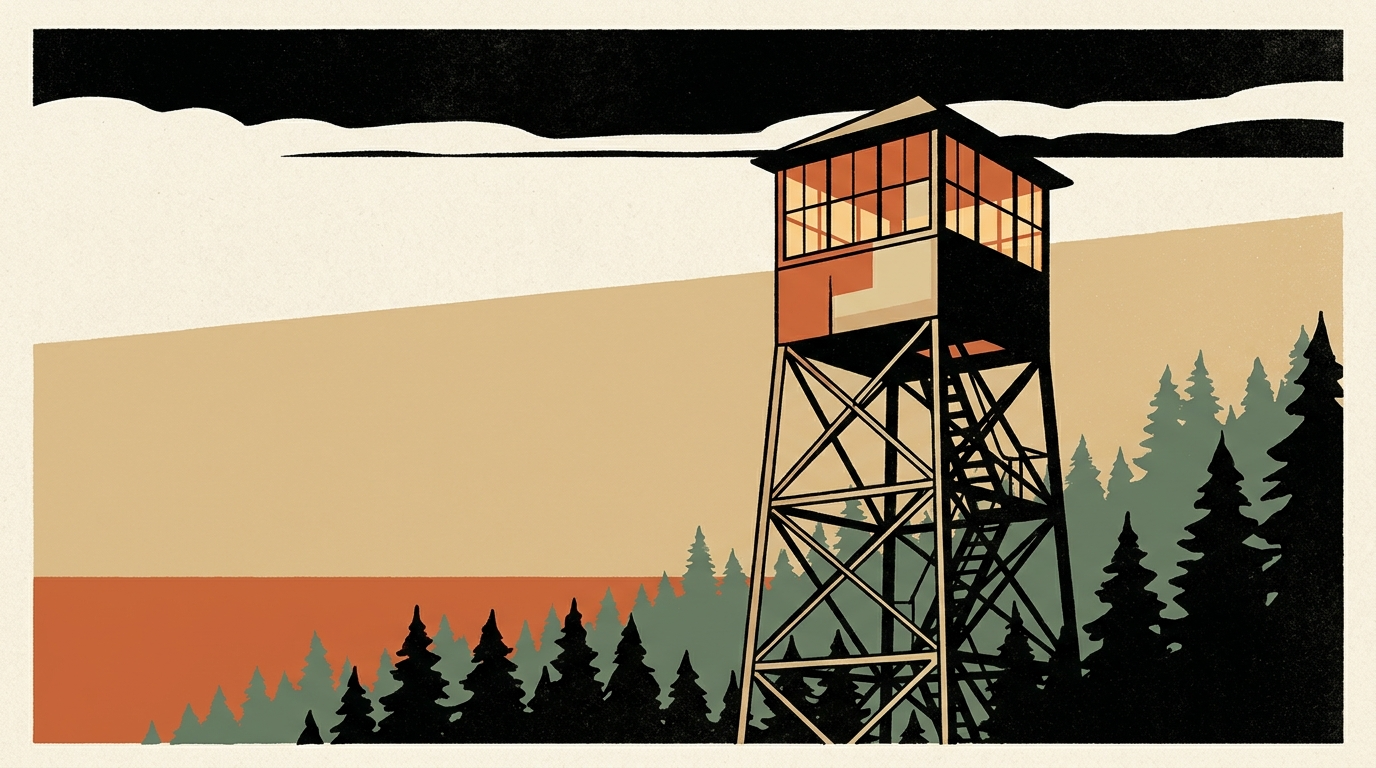
Renovated West Virginia Fire Tower Highlights the Brutal Reality of Novelty STRs
A newly renovated lookout tower in West Virginia highlights the extreme costs, liabilities, and operational realities of experiential short-term rental hosting.
The modern short-term rental market has entered its late-stage architectural arms race. For years, the formula for a profitable listing was simple: buy a suburban three-bedroom home near a mid-sized city, paint the walls white, throw in some mid-century modern furniture from a flat-pack warehouse, and wait for the bookings to roll in. That era is dead. Today, hosts are confronted with a saturated market, rising interest rates, and an audience that has grown deeply bored of standard drywall. The consumer no longer just wants a place to sleep; they demand an experience that can be photographed, posted, and envied.
This shift has driven a small but highly visible group of property developers and amateur hosts into the wilderness, armed with structural steel, off-grid solar arrays, and a willingness to gamble on the extreme. The latest manifestation of this trend is hovering high above the canopy of the Monongahela National Forest in West Virginia, where a newly renovated historic fire tower has officially entered the short-term rental market. It is a striking property, but it also serves as a monument to the lengths hosts must now go to capture the wandering eyeballs of the modern platform traveler.
For the industry as a whole, this listing is more than just a novelty booking; it is a case study in the modern economics of extreme hosting. It represents the intersection of historic preservation, high-angle structural engineering, and the algorithmic incentives of the world's largest booking platforms. But behind the spectacular photos and the inevitable social media hype lies a cold, hard set of financial and operational realities that would make the average suburban real estate investor run for cover.
What happened
According to a report by the Charleston Gazette-Mail, a historic fire tower located within the boundaries of the Monongahela National Forest has been meticulously renovated and opened to the public as a short-term rental listing. The property, situated in the rugged highlands of West Virginia, represents a growing niche of historic preservation fused with high-yield hospitality. Fire towers, once the frontline defense of the United States Forest Service against devastating woodland blazes, have largely been rendered obsolete by modern satellite imaging, aerial surveillance, and digital communication networks. Consequently, dozens of these steel-and-wood sentinels have been decommissioned, sold off, or left to decay.
In this case, developers have stepped into the gap, transforming a structure built for lonely, spartan watchmen into a high-end wilderness cabin perched dozens of feet in the air. The Charleston Gazette-Mail notes that the property has been positioned as an experiential booking, allowing guests to sleep in the "cab" of the tower with panoramic views of the surrounding national forest. While the specific financial terms of the acquisition and renovation remain closely held, the listing represents a significant capital investment designed to capture premium rates from travelers seeking isolation, novelty, and architectural drama in one of the East Coast's largest expanses of wild land.
The project is a classic example of adaptive reuse, a trend that has gained massive traction in the short-term rental space over the last decade. By taking a structure that has outlived its original utility and converting it into commercial lodging, the developers have created an asset that is almost impossible to replicate. However, the path from a decommissioned government lookout to a commercial hospitality asset is paved with regulatory hurdles, engineering challenges, and operational complexities that are unique to this high-altitude niche.
The algorithmic gravity of the OMG category
To understand why an investor would buy a rusty iron tower in the middle of West Virginia and spend hundreds of thousands of dollars turning it into a single-bedroom rental, one must first look at the digital architecture of the booking platforms. In May 2022, Airbnb rolled out a fundamental redesign of its user interface. Instead of forcing users to input a specific city and date range from the outset, the platform introduced "Airbnb Categories." Suddenly, users opening the app were greeted with icons for "OMG!," "Treehouses," "Towers," "Domes," and "Caves."
This was not a cosmetic tweak; it was an algorithmic revolution. By presenting travelers with highly unusual properties regardless of their geographic location, Airbnb fundamentally altered the supply-and-demand dynamics of the industry. A host in a remote county of West Virginia, who previously struggled to attract guests because their county lacked a major airport or a famous ski resort, could suddenly find themselves on the homepage of millions of global travelers simply because their property looked like a spaceship, a giant boot, or a historic fire tower.
The algorithm reward structure shifted from location-centric to design-centric. For the small investor, this changed the underwriting math. A standard cabin in the woods might command an average daily rate of one hundred and fifty dollars with fifty percent occupancy. A fire tower, placed in the "OMG!" or "Towers" category, can easily command five hundred to eight hundred dollars a night, with occupancy rates pushing past eighty percent, drawing travelers who are willing to drive six hours just to experience the structure itself. The property is no longer a basecamp for a vacation; the property is the vacation.
This search architecture has created a new class of "algorithmic developers" who build specifically to trigger the platform's categorization filters. They understand that a unique silhouette on a mobile screen is worth more than ten thousand dollars of traditional marketing. However, this absolute reliance on a single platform's search algorithm is a dangerous game. If Airbnb decides to modify its user interface again—perhaps prioritizing local experiences or shifting focus back to traditional search criteria—the organic traffic to these highly specialized, remote listings could evaporate overnight, leaving owners with massive capital investments in areas with little to no local rental demand.
Moreover, the competition within these specialty categories is intensifying rapidly. When the "OMG!" category first launched, a host could stand out simply by having a dome tent or a converted shipping container. Today, the standard has been raised to an absurd degree. To get noticed now, hosts are building fully functional UFOs, underground hobbit homes, and, as seen in West Virginia, suspended historic lookouts. This architectural inflation means that the capital required to enter the novelty market is climbing, even as the return on investment begins to face downward pressure from a growing supply of competing weirdness. The goal was no longer to build a comfortable house; the goal was to build a thumbnail that stops a user from scrolling.
The brutal reality of off-grid structural engineering
Yet, the gap between an algorithmic dream and engineering reality is wide, expensive, and frequently terrifying. Renovating a structure designed in the early to mid-twentieth century for a single forest ranger presents structural and civil engineering challenges that would break the spirit of most residential contractors. These towers were built for utility, not comfort. They are steel or timber skeletons designed to sway in high winds, topped by a small, uninsulated wooden box.
To turn a fire tower into a viable short-term rental, a host must address fundamental human needs: water, electricity, waste, and climate control, all while suspended forty, sixty, or eighty feet in the air. Bringing water up a steel structure requires specialized high-pressure pumping systems or insulated chase pipes that must be heated to prevent freezing during brutal Appalachian winters. Waste management is even more complicated. If the local municipality or environmental protection agency requires a conventional septic system, the plumbing must run down the exterior of the tower structure, which presents both aesthetic challenges and significant risks of catastrophic freezing.
Furthermore, these structures are highly exposed to the elements. A fire tower perched on a ridge in the Monongahela National Forest is subject to wind loads that can exceed eighty miles per hour and is a natural target for lightning strikes. Structural retrofits require professional engineering stamps, heavy steel reinforcement, and specialized lightning protection systems. In remote forest areas, finding contractors who are willing—let alone qualified—to perform high-angle structural welding or high-altitude glass installation is a logistical nightmare. The labor costs alone can easily run three to four times the standard rate for ground-level construction.
Consider the structural calculation of wind load. A standard house is a low-profile box anchored to a wide concrete foundation, protected by surrounding trees and neighboring structures. A fire tower, by contrast, is a sail. It is designed to catch the wind. When a major storm rolls through the Appalachian chain, a tower will sway. This sway is intentional; a perfectly rigid steel tower would snap under the immense lateral forces. However, while a steel skeleton can handle a three-inch sway, plumbing pipes and glass windows cannot. If a developer installs standard residential double-hung vinyl windows, the structural deflection of the tower during a high-wind event can shatter the glass or pop the frames out of the wall. Instead, builders must use heavy-duty commercial storefront glass or specialized flexible glazing systems that can absorb the movement of the structure.
The plumbing is an even greater engineering headache. In the Monongahela National Forest, winter temperatures routinely drop below zero degrees Fahrenheit, accompanied by howling winds that create extreme wind-chill factors. If a host wants to offer a flushing toilet and a hot shower in the tower cab, they must run water lines up forty feet of exposed steel. Standard pipe insulation is wholly inadequate in these conditions. The pipes must be wrapped in heavy-duty electric heat tape, encased in thick closed-cell foam insulation, and then enclosed within a protective structural chase—often a steel or heavy wooden column that is itself anchored to the tower frame. If the electricity fails for even a few hours during a winter storm, the water in the pipes will freeze, expand, and rupture the lines, resulting in a waterfall of ice and water cascading down the structure and a repair bill that can easily reach five figures.
The liability nightmare at eighty feet
Beyond the physical challenges of construction lies the regulatory and liability landscape, a minefield that many enthusiastic hosts fail to calculate until they are already deep in debt. Most commercial general liability insurance policies designed for standard short-term rentals are built around traditional single-family homes. The moment an underwriter sees the words "fire tower," "steep steel stairs," or "heights exceeding thirty feet," the risk profile changes dramatically.
Consider the average short-term rental guest. They are not trained forest rangers. They are often arriving after dark, carrying heavy luggage, perhaps fatigued from a long drive, and occasionally under the influence of alcohol. Forcing these guests to ascend a near-vertical staircase or a series of exposed steel ladders to reach their bed is an insurance underwriter's worst nightmare. A single slip on a wet metal step in November can result in a catastrophic injury lawsuit that exceeds the limits of standard liability coverage.
To mitigate this, hosts of extreme properties are forced to seek out specialized surplus lines insurance. These policies come with eye-watering premiums and strict exclusions. Some policies may require guests to sign extensive liability waivers before arrival, though the legal enforceability of such waivers varies wildly by jurisdiction. In West Virginia, where premises liability laws hold property owners to a high standard of care for invitees, a waiver may not protect a host if a court finds that a staircase was improperly maintained or lacked adequate safety netting and lighting.
The safety retrofits required to make a fire tower acceptable to a commercial insurer can significantly alter the historic look of the structure. It is not simply a matter of painting the steel and replacing the floorboards. Insurers often demand the installation of continuous steel mesh netting along all stairways to prevent falls, self-closing safety gates at every platform landing, and high-visibility, slip-resistant treads on every step. These additions can cost tens of thousands of dollars and can conflict with the guidelines of historic preservation boards, which often require that renovations maintain the original, sparse aesthetic of the structure.
Furthermore, hosts must implement strict guest policies to manage these safety risks. This often includes age restrictions that ban children under a certain age, strict prohibitions on pets, and clear warnings about the physical demands of the property in the listing description. However, even the most explicit warnings cannot prevent a guest from overestimating their physical capabilities or ignoring safety rules once they are on-site. When a guest suffers a panic attack halfway up the tower at midnight because of sudden vertigo, it is the host or their local manager who must handle the emergency, highlighting the intense operational stress of managing a high-altitude listing.
The geopolitics of forest service inholdings
The location of this new West Virginia listing—within the Monongahela National Forest—highlights another complex layer of the short-term rental industry: the use of private inholdings within public lands. The federal government owns millions of acres of national forests and parks, but scattered throughout these public lands are parcels of private property known as inholdings. These private tracts are subject to county zoning laws rather than federal forest service regulations, creating unique opportunities for enterprising developers.
Owning an inholding is the ultimate real estate hack for outdoor hospitality. It allows a host to market their property as being located "in" a national forest, surrounded by thousands of acres of protected wilderness, without having to navigate the strict commercial permitting process of the United States Forest Service. Guests can step off the private deck and directly onto public hiking trails, enjoying the benefits of a massive federal park while staying in a private, high-end rental.
However, this relationship is often fraught with tension. Local forest rangers and conservation groups keep a close eye on private developments within forest boundaries. Increased vehicular traffic on narrow, unpaved forest service roads, improper waste disposal that could attract wildlife, and light pollution from high-altitude structures can draw the ire of federal authorities and local environmental advocates. If a host's guests repeatedly violate national forest rules, block access roads, or require emergency rescues from difficult terrain, the local county commission may face intense pressure to restrict or ban short-term rentals on private inholdings altogether.
To truly understand the land-use dynamics of the Monongahela National Forest fire tower, one must look at the history of the American conservation movement. In the late nineteenth and early twentieth centuries, the federal government began aggressively acquiring land to protect watersheds and timber reserves, creating the national forest system we know today. However, these acquisitions were rarely clean, contiguous blocks. Many landowners refused to sell their holdings, leaving a checkerboard pattern of private parcels scattered inside the newly established federal boundaries.
Today, these private inholdings are highly prized real estate. They offer a level of privacy and natural beauty that is impossible to find anywhere else. But they also exist in a state of permanent geopolitical tension with the surrounding federal land. The United States Forest Service is managed under a mandate of multiple use, which includes timber harvesting, wildlife protection, and public recreation. It is not designed to cater to high-end private tourism. When a private landowner builds a high-profile short-term rental on an inholding, they are essentially capitalizing on a public asset for private gain, creating a complex dynamic that requires careful diplomatic handling by the host.
The economics of remote management
A fire tower in the Monongahela National Forest is, by definition, remote. For guests, this isolation is the primary selling point. For the property manager, it is an operational crisis that occurs every three days. The math of short-term rental management is governed by the "turnover"—the window between a guest checking out at eleven o'clock in the morning and the next guest checking in at four o'clock in the afternoon.
In a dense urban market, a cleaning crew can service three or four apartments in a single afternoon. In the rugged mountains of West Virginia, a cleaning crew may have to drive an hour each way on winding dirt roads just to reach a single listing. If the previous guests left a mess, or if the off-grid generator failed, or if the water pump lost pressure, the cleaning crew becomes the first line of defense.
Finding reliable cleaning and maintenance staff in rural, sparsely populated counties is one of the greatest operational bottlenecks in the STR industry. Because the labor pool is small, wages are high, and reliability is premium. A host cannot simply call a commercial plumbing service at two o'clock on a Saturday afternoon to fix a clogged toilet in a fire tower. They must rely on local caretakers who must be paid handsomely to remain on call. These operational costs eat directly into the high average daily rates that novelty properties command, a reality that many spreadsheet-driven investors fail to realize until they are actively managing the property.
Consider the simple task of linen management. A host cannot easily wash sheets and towels at the property if they are running on a limited off-grid water system and solar power, as commercial washing machines and dryers are massive energy and water consumers. Instead, the cleaning crew must haul dirty linens out of the forest, drive them to a commercial laundry facility or their own home, wash and fold them, and then haul them back up the mountain for the next turnover. This logistical burden means that the cost of cleaning a single-bedroom fire tower can easily exceed three hundred dollars per stay.
Furthermore, emergency maintenance in a remote area is incredibly difficult to coordinate. If a guest reports that the water pump has failed at eight o'clock on a rainy Friday night, the host cannot simply call a commercial plumbing service. Even if they can find a plumber willing to drive into the national forest after hours, the travel time alone could be two hours, and the service call fee will be astronomical. If the issue cannot be resolved immediately, the host faces not only a refunded stay but also a potential negative review that can permanently damage the listing's search ranking. To survive, remote hosts must build redundant systems, installing backup water pumps and dual generators, which further drives up the initial capital expenditure and ongoing maintenance costs.
The decay curve of novelty architecture
While a renovated fire tower is guaranteed to generate immediate buzz, media coverage, and a flood of initial bookings, long-term success requires surviving the "novelty decay curve." When a unique property first launches, it benefits from what marketers call the "halo effect." The listing is shared on design blogs, featured in local newspapers like the Charleston Gazette-Mail, and pushed to the top of platform search engines. Bookings are easily secured twelve months in advance.
However, novelty is a depreciating asset. Over time, other hosts copy the concept. What was once a unique fire tower in West Virginia is joined by three more fire towers in neighboring counties, a converted lookout in Oregon, and a steel tower in Tennessee. The initial media buzz fades, and the listing must begin to compete on the fundamentals of hospitality: comfort, accessibility, and value.
Furthermore, the physical wear and tear on these properties is severe. High-altitude structures exposed to extreme weather require constant, expensive maintenance. Wooden decks rot faster, steel structures rust and require wire-brushing and repainting, and off-grid solar batteries degrade. If a host does not reinvest a significant portion of their rental revenue back into the physical structure, the property quickly begins to look tired, leading to a decline in review scores. In the short-term rental business, a drop from a 4.9-star rating to a 4.7-star rating can be the difference between a highly profitable enterprise and a property that sits vacant for weeks at a time.
The phenomenon of the novelty decay curve is one of the most overlooked risks in the short-term rental industry. When a unique property first hits the market, it enjoys a period of artificial market dominance. The listing's sheer uniqueness makes it highly shareable on social media platforms, resulting in a flood of organic, free marketing. Bookings pour in, and the host can charge premium prices while maintaining near-perfect occupancy.
But this honeymoon period is inevitably short-lived. The short-term rental market is highly efficient and deeply competitive. When other developers see a fire tower in West Virginia commanding high nightly rates, they do not stand by and watch. They immediately begin looking for their own towers, silos, or domes to renovate. Within two to three years, the market becomes saturated with similar unique properties, and the original listing's uniqueness is diluted. To combat this decay, hosts must continuously reinvest in the property to maintain its premium status, adding new amenities or offering exclusive outdoor experiences, which further eats into the profits generated during the initial boom years.
The preservation versus monetization debate
The conversion of historic infrastructure into commercial short-term rentals also touches on a deeper cultural and ethical debate within the preservation community. Historic fire towers are more than just interesting pieces of engineering; they are physical symbols of a specific era in American history. They represent the nation's early conservation efforts, the labor of the Civilian Conservation Corps during the Great Depression, and the solitary, rugged lifestyle of the early forest rangers who spent months scanning the horizon for smoke.
For some preservationists, converting these historic sentinels into high-priced vacation rentals is a form of cultural degradation. They argue that these structures should be preserved as public historic sites, accessible to all, rather than being locked behind a paywall for wealthy travelers. When a private developer buys a historic tower and turns it into an exclusive rental, it removes a piece of public heritage from the common domain, transforming a monument to public service into a vehicle for private capital accumulation.
On the other side of the debate, proponents of private adaptive reuse argue that short-term rental monetization is often the only viable way to save these historic structures from destruction. The federal and state agencies responsible for public lands are chronically underfunded and face massive maintenance backlogs. They simply do not have the budget to restore and maintain dozens of obsolete fire towers. Left to the elements, these structures decay rapidly, eventually becoming structural hazards that must be demolished.
By allowing private developers to lease or purchase these towers and convert them into short-term rentals, the structures are meticulously restored and maintained at no cost to the taxpayer. The rental revenue provides a sustainable, long-term funding source that ensures the tower's physical survival for decades to come. While access may be limited to paying guests, many developers argue that this is a reasonable trade-off to prevent the total loss of the historic architecture. This debate is likely to intensify as more historic infrastructure—from lighthouses and railway stations to old schoolhouses and grain silos—is eyed by short-term rental investors looking for the next viral listing.
Ultimately, the success of these projects hinges on finding a middle ground. Some developers have successfully partnered with local historical societies or conservation groups, offering public tour days or donating a portion of their rental revenue to local forest preservation funds. This approach helps to defuse local resentment and positions the short-term rental not as an exclusive playground for the wealthy, but as a critical partner in the community's efforts to preserve its physical history.
The macroeconomics of the Appalachian STR boom
The rise of high-end novelty listings in West Virginia is also a symptom of a broader macroeconomic transformation occurring throughout the Appalachian region. Historically, the economy of West Virginia and the surrounding mountain states was driven by extractive industries—primarily coal mining, timber harvesting, and heavy manufacturing. As these industries have declined over the past several decades, rural communities have faced severe economic stagnation, population loss, and a declining tax base.
In response, state and local leaders have aggressively pivoted toward outdoor recreation and tourism as the primary engines of economic revitalization. West Virginia, with its dramatic topography, pristine rivers, and vast public lands, is perfectly positioned to capture this market. The state government has invested heavily in marketing campaigns and infrastructure improvements, seeking to position the state as the premier adventure tourism destination on the East Coast.
The short-term rental industry has been a critical partner in this transition. In rural counties where hotel infrastructure is sparse or non-existent, short-term rentals provide the lodging capacity needed to support a growing tourism economy. When a host renovates a fire tower or builds a unique cabin, they are not just creating a rental listing; they are bringing high-spending out-of-state visitors into communities that desperately need economic activity. These guests buy gas, dine at local restaurants, hire local rafting and hiking guides, and shop at independent retail stores, injecting fresh capital directly into the local economy.
However, this rapid transition from an extractive economy to a tourism-based hospitality economy is not without its challenges. The influx of wealthy out-of-state investors buying up land and historic properties for short-term rentals has driven up real estate values in many rural areas, making it increasingly difficult for local residents to purchase homes or land. The jobs created by the hospitality industry—primarily cleaning, maintenance, and retail service—are often seasonal, low-wage, and lack benefits, replacing stable manufacturing and mining jobs with precarious gig-economy employment. As rural West Virginia embraces the short-term rental boom, local communities must navigate the delicate balance between economic growth and the preservation of local affordability and community character.
Moreover, the long-term sustainability of this tourism boom remains an open question. While outdoor recreation saw a massive surge during the global pandemic, as travelers sought out wide-open spaces and remote escapes, that demand has begun to normalize. Rural destinations that built their entire economic strategy around a permanent high-growth short-term rental market are now facing a reality check as travel patterns return to pre-pandemic baselines. To build a resilient economy, local governments must ensure that short-term rental development is integrated into a broader, diversified economic strategy that supports local businesses and residents rather than relying solely on the fleeting whims of platform travelers.
The goal was no longer to build a comfortable house; the goal was to build a thumbnail that stops a user from scrolling.
What hosts should do now
If you are a host or investor inspired by the West Virginia fire tower listing and considering a plunge into the world of extreme experiential rentals, you must proceed with caution. The high nightly rates and massive social media buzz are highly seductive, but the underlying operational and financial risks are real and unforgiving. Before you purchase a historic tower, a grain silo, or a remote parcel of forest land, you must conduct rigorous due diligence that goes far beyond standard real estate underwriting.
- Perform a comprehensive engineering and structural assessment of the property before closing, paying specific attention to wind loads, lightning protection, and the feasibility of running water and waste lines in extreme weather conditions.
- Secure written insurance quotes from specialized surplus lines underwriters before committing capital, and ensure you fully understand the liability exclusions, safety retrofits, and guest waivers required to maintain coverage.
- Build redundant off-grid utility systems, including dual backup generators, secondary water pumps, and industrial-grade solar battery banks, to ensure the property remains functional during severe weather events and utility failures.
- Establish a dedicated local operations team, including on-call maintenance technicians and highly paid, reliable cleaning crews who are willing and able to access remote locations in difficult weather.
- Plan for a rapid capital reinvestment cycle, setting aside a significant portion of your initial rental revenue to fund ongoing physical maintenance, safety upgrades, and amenity enhancements to combat the novelty decay curve.
- Engage proactively with local county commissioners, zoning boards, and forest service staff to ensure your development complies with local regulations and does not create friction with the surrounding community or public land managers.
By treating the development not as a passive real estate investment but as a highly complex, capital-intensive hospitality enterprise, you can build a unique brand that survives the inevitable market saturation and platform shifts.
Checked by the standards desk (Eleanor Quist): 13 specifics were flagged and are under review.
Sources
- Charleston Gazette-Mail - reported September 18, 2026.
Read and analysed by the Stay Gazette desk.



Read the desk every morning.
The day's crackdowns and platform moves, the money, the design and the stays going viral, plus the desk's verdict, in one short email every morning.