The Mid-Century Maintenance Trap: Renting Frank Lloyd Wright’s Michigan Masterpieces
Frank Lloyd Wright’s Usonian homes in Michigan are architectural masterpieces. But running these historic properties as short-term rentals is an operational minefield.
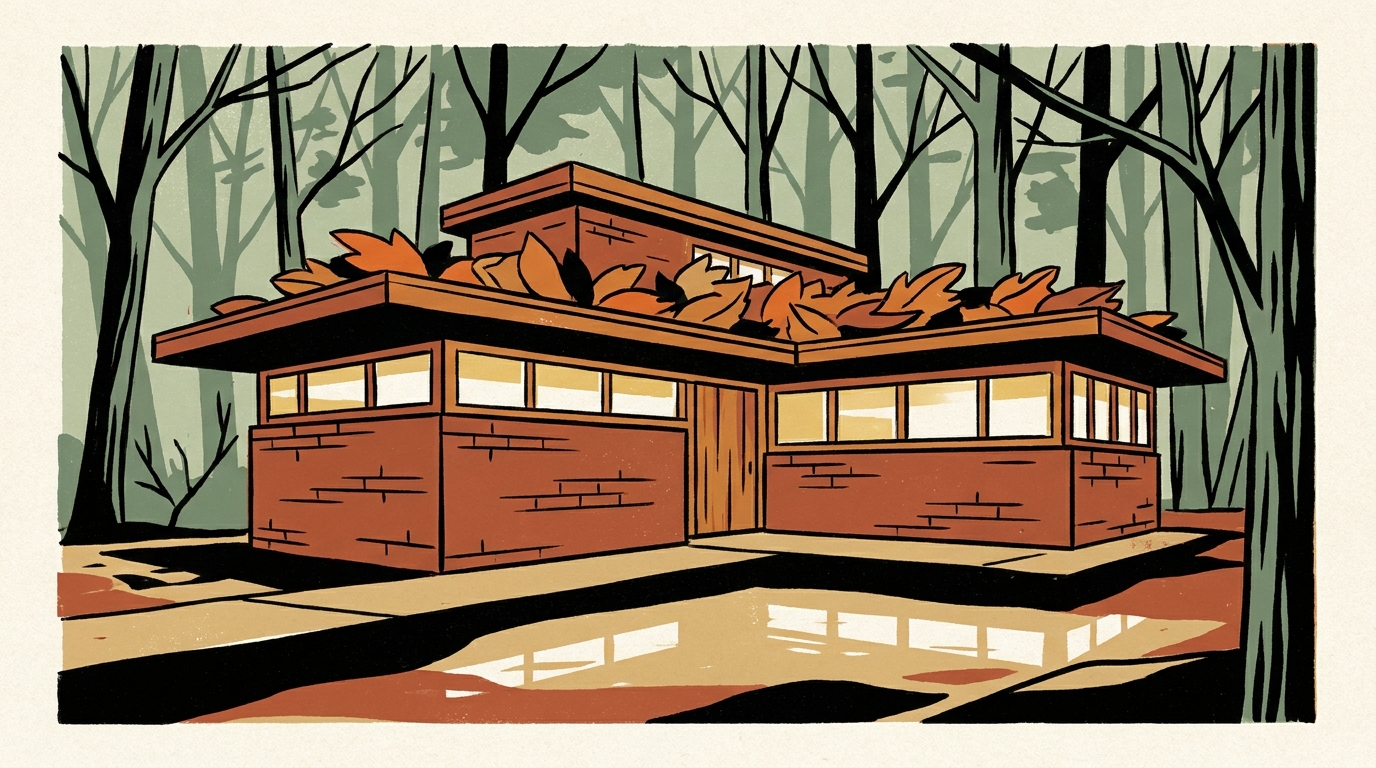
The heavy cypress door swings open on brass hinges designed eighty years ago, making a low, resonant click that sounds more like a vault than a home. A guest drags a heavy wheeled suitcase over the threshold, its plastic wheels rattling against a floor of deep Cherokee Red concrete. Inside, the ceiling is low, almost oppressive, designed to force the eyes downward and forward. Then, with a few steps, the hallway opens. The ceiling shoots upward, and a wall of glass reveals a dense Michigan forest, making the trees outside feel like the only decoration the room needs. This is the classic architectural sequence of compression and release, the unmistakable signature of Frank Lloyd Wright. For the traveler who booked this night on a short-term rental platform, it is a bucket-list encounter with architectural history. For the host watching the security camera, it is a high-stakes operational gamble where a single careless suitcase scrape on original cypress woodwork can wipe out an entire month of rental revenue.
The short-term rental industry has spent the last decade obsessed with scale, professionalization, and cookie-cutter efficiency. We have seen the rise of the standardized rental: gray vinyl floors, white shaker cabinets, and flat-pack furniture designed to survive a hundred rowdy weekenders. But as travelers grow weary of these generic spaces, a highly lucrative counter-trend has emerged. Architectural tourism is no longer confined to museum tours and coffee-table books. It has become a premium segment of the hospitality market, where guests are willing to pay astronomical nightly rates to sleep inside historic masterpieces.
At the absolute peak of this market are the residential works of Frank Lloyd Wright, particularly his Usonian homes. These structures, built as mid-century experiments in affordable housing for the American middle class, have become some of the most exclusive and operationally complex short-term rentals in the world. Operating these properties is not a standard hospitality play. It is a high-wire act that forces hosts to balance the delicate requirements of historic preservation against the relentless demands of modern travelers and the harsh realities of mid-century engineering.
What happened
According to a recent profile by Newcity Art, Frank Lloyd Wright's Usonian homes in Michigan stand as brilliant masterpieces designed for the middle class. Originally constructed between the late 1930s and the late 1950s, these homes represented Wright's vision for affordable, democratic housing in the United States. In communities like Okemos, Kalamazoo, and Galesburg, Wright laid out planned developments of modest, single-story homes built from native wood, brick, and concrete, designed to harmonize with the local landscape while remaining accessible to schoolteachers, salesmen, and mid-level office workers.
Today, however, the democratic dream of Usonia has met the high-end reality of the short-term rental market. Several of these Michigan masterpieces, alongside other Wright-designed properties across the Midwest, have transitioned into commercial hospitality assets. Properties like the Palmer House in Michigan and the Schwartz House are regularly listed on major short-term rental platforms. Instead of housing local families on modest budgets, these properties now command nightly rates that often exceed one thousand dollars.
This shift has caught the attention of both architectural preservationists and real estate investors. The Newcity Art profile highlights the architectural value of these homes, noting how their design principles—low-slung roofs, open floor plans, integrated built-in furniture, and a deep connection to nature—pioneered the modern residential layout. But as these homes enter the short-term rental ecosystem, they expose a deep structural tension. The very design elements that make these homes artistic triumphs also make them incredibly difficult, and incredibly expensive, to manage as commercial lodging.
As the short-term rental market matures, the demand for unique properties has reached a fever pitch. Investors are looking past traditional vacation markets and focusing on architectural significance as a primary differentiator. But the reality of operating a Frank Lloyd Wright home is far removed from the passive-income fantasies popularized by online real estate gurus. It requires an intense commitment to physical preservation, a deep understanding of mid-century building techniques, and a willingness to absorb massive, unpredictable maintenance costs.
The Usonian blueprint: High art meets low ceilings
To understand why Usonian homes are both a dream and a nightmare for short-term rental operators, one must first understand the architectural philosophy that created them. Wright coined the term “Usonian” to describe a new, uniquely American style of architecture that rejected European historicism in favor of organic design. These homes were designed to be cheap to build and easy to maintain for families without domestic servants. Wright eliminated basements, attics, plastering, painting, and conventional garages. Instead, he pioneered the concrete slab foundation with integrated radiant floor heating, flat roofs with wide overhangs, and carports.
For a modern short-term rental guest, these design choices create an incredibly atmospheric environment. The open floor plans, built-in banquettes, and expansive glass walls create a sense of spaciousness that belies the homes' relatively small footprints. The use of natural materials like cypress, redwood, and local brick creates a warm, organic feel that modern construction simply cannot replicate. Guests feel as though they have stepped back in time, experiencing the home exactly as Wright intended.
However, Wright's mid-century innovations present severe operational challenges for modern hospitality. Consider the lack of storage. Wright despised clutter and actively designed his homes with almost no closet space, believing that families should own fewer possessions. A modern guest staying for a week, traveling with multiple suitcases and expecting ample hanging space, will quickly find themselves frustrated by the tiny, narrow wardrobes integrated into the wood-paneled walls. Furthermore, the low ceilings and narrow hallways, designed to create the dramatic effect of compression, can feel cramped to guests accustomed to the soaring ceilings of modern suburban homes.
The kitchens, which Wright referred to as “workspaces,” present another major hurdle. Designed in an era before the microwave, the dishwasher, and the giant double-door refrigerator, these spaces are often tiny, galley-like corridors. They were built for a single person preparing simple meals, not for a group of modern vacationers who want to cook together while sharing a bottle of wine. Upgrading these kitchens to meet modern guest expectations without destroying the original wood panels and custom cabinetry is nearly impossible, leaving hosts to walk a fine line between historic authenticity and basic functional utility.
Finally, there is the issue of lighting. Wright designed his Usonian homes to be illuminated primarily by natural light during the day and by low, indirect, built-in light fixtures at night. The result is a cozy, moody atmosphere that is perfect for a quiet evening but frustrating for a guest trying to read a book, apply makeup, or work on a laptop. Hosts must carefully add supplementary lighting that respects the original design aesthetic, avoiding the temptation to install modern recessed lighting or bright LED fixtures that would ruin the historic integrity of the space.
The design-premium economy: Why guests pay for history
Despite these operational quirks, the economic argument for operating an architectural masterpiece is compelling. Over the last five years, the short-term rental market has experienced a severe supply glut. According to data from AirDNA, the number of active listings in the United States has reached historic highs, leading to a drop in average occupancy rates and downward pressure on pricing for standard properties. In a saturated market, differentiation is the only reliable way to protect margins.
This is where architectural pedigree becomes a powerful economic engine. Travelers are increasingly willing to pay a premium for unique, narrative-driven stays. When Airbnb reorganized its platform around categories, placing a heavy emphasis on “Design” and later launching its “Iconic” collection, it institutionalized this trend. A standard four-bedroom home in a Michigan suburb might struggle to command two hundred dollars a night during the winter months. A certified Frank Lloyd Wright home in the same region, however, can easily command five times that rate, maintaining strong booking volumes even during the off-season.
The guests booking these properties are not typical tourists. They are architectural pilgrims, design professionals, and affluent travelers looking for a cultural experience rather than just a place to sleep. They are booking the property because of the architect, not the destination. This shift in traveler motivation changes the entire investment thesis. It allows operators to generate high yields in secondary and tertiary markets that would otherwise not support luxury rates. A Usonian home in a quiet enclave outside Kalamazoo becomes a global destination, drawing visitors from Chicago, New York, and even Europe who travel specifically to spend forty-eight hours inside Wright's vision.
This high-yield potential has attracted a new class of investors who specialize in architectural preservation. These are not corporate yield-chasers looking to build a hundred-unit portfolio of identical apartments. They are design-focused entrepreneurs who recognize that historic preservation can be a highly profitable business model if managed correctly. By positioning the property as a private museum that you can sleep in, they are able to capture a market segment that is completely insulated from the price wars affecting standard rentals.
However, this premium pricing model relies entirely on maintaining the absolute integrity of the design. If a host begins to cut corners, replacing original custom furniture with modern replicas or using cheap materials for repairs, the illusion is shattered. The design-conscious guests who pay these premium rates are highly sensitive to detail. They will notice if a light switch has been replaced with a cheap plastic toggle or if the wood paneling has been repaired with modern plywood. Maintaining the premium rate requires maintaining museum-grade authenticity, which brings us to the core financial challenge of these properties.
The maintenance trap: Flat roofs and frozen pipes
But those high nightly rates are not pure profit. In fact, they are often entirely consumed by the astronomical cost of maintaining a mid-century architectural landmark. Frank Lloyd Wright was an artistic genius, but he was also a notoriously stubborn engineer whose structural experiments often failed to withstand the elements, particularly the harsh winters of the American Midwest.
The flat roofs that define the Usonian aesthetic are a primary source of financial pain. Wright disdained sloped roofs, preferring flat planes that mimicked the horizon. In Michigan, where heavy winter snows pile up and freeze, these flat roofs are prone to severe water pooling, ice dams, and chronic leaks. Wright himself was famous for dismissing his clients' complaints about leaking roofs, once telling a client who complained of water dripping on his head during dinner to simply move his chair. A short-term rental guest paying twelve hundred dollars a night will not be so accommodating. Repairing a flat roof on a historic home is not as simple as calling a local roofing contractor. It requires specialized preservation techniques, custom-milled wood trim, and modern membrane materials that must be meticulously hidden to preserve the home's historic profile.
Wright himself was famous for dismissing his clients' complaints about leaking roofs, once telling a client who complained of water dripping on his head during dinner to simply move his chair.
Even more terrifying for hosts is the heating system. Wright pioneered radiant floor heating, running hot water pipes through the concrete slab foundations of his Usonian homes. Over the decades, these original iron and copper pipes corrode and leak. When a radiant heating system fails in a Usonian home, the host faces a devastating choice. They cannot simply cut open a wall to patch a pipe. The pipes are permanently encased in the historic concrete floor. Repairing the system often requires jackhammering the original Cherokee Red concrete, a process that is both astronomically expensive and destructive to the home's historic integrity.
Many hosts are forced to abandon the original gravity heating systems entirely and install ductless mini-split systems, which must be carefully positioned to avoid ruining the clean architectural lines of the wood-paneled walls. Finding a location for these modern units that does not disrupt Wright's carefully planned vistas is an art form in itself. If the local historic preservation commission does not approve the placement, the host can face heavy fines and be forced to remove the units, leaving them with a home that is either freezing in the winter or boiling in the summer.
The materials used in these homes also present a constant sourcing challenge. Wright made extensive use of native woods, particularly tidewater red cypress and redwood, which were affordable and plentiful in the mid-twentieth century. Today, these old-growth woods are incredibly scarce and expensive. If a portion of a wood wall is damaged by a guest's water bottle or a cleaning product, the host cannot simply go to the local home improvement store to buy a replacement board. They must source reclaimed historic wood, match the grain pattern, and find a specialized carpenter who understands how to apply the historic finishes that Wright specified. The labor costs alone for these minor repairs can easily run into thousands of dollars.
Preservation vs. profit: The regulatory and community battleground
Operating a historic masterpiece as a short-term rental also places hosts directly in the crosshairs of local historic preservation commissions, neighborhood associations, and municipal regulators. Many of Wright's Usonian homes are located in quiet, residential neighborhoods or cooperative communities that were originally established with a strong sense of collective identity. Wright's planned developments in Michigan, such as those in Galesburg and Kalamazoo, were designed with a strong sense of collective identity.
When an investor or a host purchases one of these homes with the intention of running it as a high-turnover rental, it often triggers immediate resistance from neighbors. Historic preservationists argue that the high volume of transient guests accelerates the wear and tear on delicate structures that should be preserved for future generations. They worry about heavy luggage scraping against seventy-year-old mahogany paneling, guests leaning on fragile built-in furniture, and the increased risk of accidental fires from guests unfamiliar with historic fireplaces.
These neighborhood concerns are not unfounded. A historic home is a delicate ecosystem. The plaster, wood, and glass are decades old and were never designed to withstand the daily assault of guests who have no personal connection to the property. A single party or a single careless guest can cause damage that is literally irreplaceable. This has led many local preservation boards to lobby for strict bans on short-term rentals for properties on historic registries, arguing that commercial use is incompatible with preservation goals.
Local municipalities are also tightening their grip on short-term rentals in historic districts. In cities across Michigan, local ordinances require strict permitting processes, regular safety inspections, and occupancy limits. For a historic home, these inspections can be a minefield. Modern building codes require handrails on staircases, specific window sizes for emergency egress, and hardwired smoke detectors. Bringing a mid-century home up to modern safety standards without violating historic preservation guidelines—which often prohibit any alterations to the building's fabric—is an incredibly complex and expensive bureaucratic dance.
For example, if a local inspector demands that a host install a modern, brightly colored exit sign or a bulky metal handrail on a low-slung Wright staircase, the host must find a way to comply without violating the historic preservation covenants attached to the deed. This often requires hiring specialized architects to design custom, removable safety features that satisfy the inspectors while preserving the home's historic appearance. The cost of these regulatory negotiations can quickly dwarf the profits of the rental itself, turning what looked like a lucrative investment into a bureaucratic black hole.
The insurance conundrum: Valuing the irreplaceable
If the maintenance costs and regulatory hurdles do not deter an investor, the insurance market might. Sourcing commercial insurance for an architecturally significant historic home is one of the most difficult operational challenges in the short-term rental industry today.
Standard short-term rental insurance policies, designed for suburban tract homes or modern downtown condos, are completely inadequate for a Frank Lloyd Wright property. These standard policies are built on the concept of replacement cost using modern materials. If a kitchen in a standard rental is damaged by a grease fire, the insurance company calculates the cost of replacing the drywall, installing standard cabinets, and laying down new tile.
But in a Usonian home, the kitchen cabinets are custom-built from old-growth cypress milled to Wright's exact drawings. The walls are not drywall; they are three-ply laminated wood panels joined with historic brass screws. The floor is a custom-pigmented concrete slab. If a fire or water leak damages a Wright home, the cost of restoring it to its original condition is astronomical, often far exceeding the market value of the home itself. Standard insurers will simply refuse to write policies for these homes, or they will offer actual cash value policies that would leave the owner financially ruined in the event of a major loss.
To protect these assets, hosts must turn to specialized historic property insurers who write customized inland marine and historic restoration policies. These policies require detailed architectural appraisals, documented inventories of all built-in and freestanding furniture, and specialized riders that guarantee the use of historic materials and specialized craftsmen in the event of a rebuild. The premiums for these policies are eye-watering, often costing five to ten times more than a standard commercial property policy, representing a massive fixed operating cost that must be recouped through high nightly rates.
Furthermore, these specialized policies come with incredibly strict operational conditions. The insurer may require the host to install comprehensive water-leak detection systems, automatic gas shutoff valves, and commercial-grade fire suppression systems that must be carefully integrated into the historic structure without disrupting the design. The policy may also restrict the types of activities allowed on the property, banning any events, commercial photography, or even the use of the home's original fireplaces, which are often the central visual feature of the living area. Operating without these specialized policies is a form of financial Russian roulette; a single major incident could result in a total loss that is completely uncovered by insurance.
Operations as art conservation: The host playbook
To survive in this niche market, successful hosts must abandon the traditional hands-off, automated approach to property management. Operating a Frank Lloyd Wright home requires a model that looks less like modern hospitality and more like museum conservation.
This starts with the guest booking process. Successful hosts do not use instant book. They carefully vet every guest, holding phone calls or exchanging detailed messages to ensure the traveler understands the nature of the property. Guests must be educated that they are staying in a fragile work of art, not a standard hotel room. Hosts must clearly communicate the home's limitations—such as the lack of modern storage, the delicate nature of the built-in furniture, and the strict rules regarding guest behavior.
House rules must be exceptionally strict and vigorously enforced. Many hosts require guests to remove their shoes at the door to protect the historic wood and concrete floors. Dragging wheeled luggage inside the home is strictly prohibited; guests are instructed to carry their bags or use specialized soft-sided luggage carts provided by the host. Children and pets are often restricted, not out of animosity, but because the low railings, open hearths, and delicate low-slung built-ins present genuine safety hazards and are highly vulnerable to damage.
Cleaning protocols must also be completely overhauled. Standard commercial cleaning crews accustomed to blasting surfaces with bleach and abrasive cleaners will ruin a historic home in a matter of weeks. Hosts must employ specialized cleaning staff trained in the care of historic finishes. Original wood paneling must be treated with natural oils and waxes rather than synthetic silicone sprays. Original brass hardware must be polished by hand without stripping the historic patina. This level of care requires significantly longer turnover windows, often forcing hosts to limit check-ins to a maximum of three or four times a week, further capping potential occupancy and revenue.
Finally, successful hosts must build a trusted network of specialized local craftsmen before they ever list the property. When something breaks in a Usonian home, you cannot simply call the first plumber or carpenter listed on Google. You need professionals who understand historic preservation and are willing to work within the strict constraints of Wright's designs. This means having a go-to mason who knows how to match historic mortar, a carpenter who can source reclaimed cypress, and a plumber who can navigate historic piping without tearing up original concrete. Developing this network takes time and money, but it is the only way to protect the asset and keep the rental operational.
What hosts should do now
For hosts who are currently operating historic or architecturally significant properties, or for those who are considering acquiring one, immediate steps must be taken to protect both the asset and the business:
- Audit your insurance policy immediately: Verify that your commercial short-term rental policy includes historic restoration coverage with guaranteed replacement cost using historic materials, rather than standard modern replacement cost.
- Eliminate automated booking: Turn off instant book on all platforms. Implement a mandatory vetting process that includes a direct conversation with the guest to ensure they understand the delicate nature of the historic structure.
- Build a preservation-grade contractor network: Secure commitments from specialized local craftsmen, including masons, historic carpenters, and specialized plumbers, before an emergency repair is needed.
- Establish a dedicated CapEx reserve: Set aside at least twenty percent of your gross monthly revenue into a dedicated capital expenditure fund specifically for structural and historic preservation projects, such as flat roof maintenance and radiant heat repairs.
- Create a physical guest orientation: Do not rely on digital guidebooks. Meet guests at the property or provide a detailed, physical handbook that demonstrates how to operate the home's historic features without causing damage.
Ultimately, operating a historic masterpiece is a major responsibility. By shifting your mindset from standard hospitality manager to historic preservationist, you can protect these architectural treasures for future generations while capturing a highly profitable, completely unique segment of the short-term rental market.
Checked by the standards desk (Eleanor Quist): 2 specifics were removed or attributed as unverified before publication.


Read the desk every morning.
The day's crackdowns and platform moves, the money, the design and the stays going viral, plus the desk's verdict, in one short email every morning.