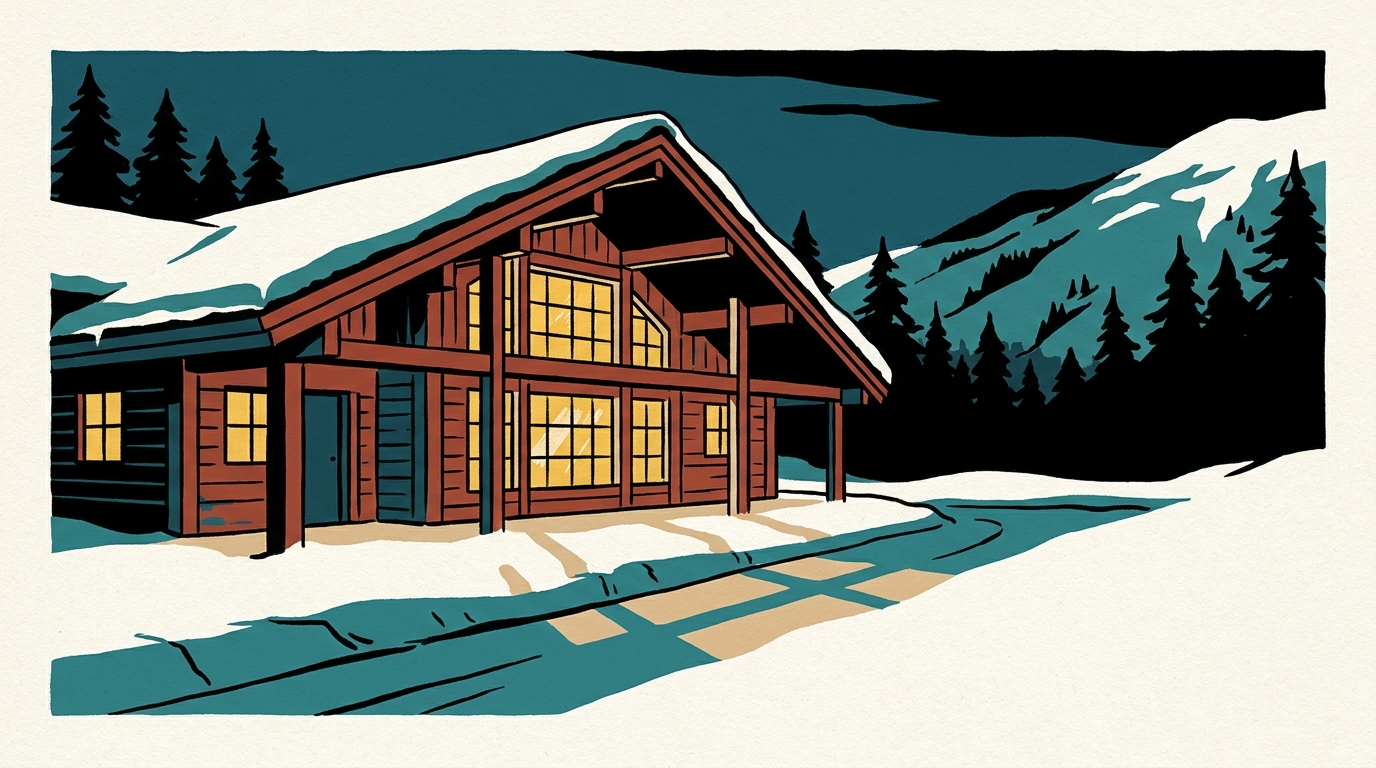
First Chair Destinations Enters the New England Ski Rental Market
A new regional brand is targeting New England ski slopes, proving that the battle for premium vacation rentals has moved from national roll-ups to hyper-focused niches.
When the first major snowstorm of the season hits the spine of the Green Mountains, a quiet, high-stakes scramble begins in hundreds of mudrooms from Stowe to Sunday River. For independent hosts, a blizzard means checking the backup generator, texting the plow guy for the third time, and hoping the guests do not slide their rental sedan into a drainage ditch on the access road. For the corporate entities increasingly moving into these valleys, however, a storm is not an operational headache. It is a highly optimized booking trigger.
The recent debut of First Chair Destinations, a hospitality brand targeting ski vacation rental homes across New England, marks a clear shift in how mountain-town properties are bought, sold, and managed. According to a Business Wire announcement, this new player is entering some of the most supply-constrained, high-yield, and operationally punishing markets in North America. By assembling a focused collection of properties situated near premier ski slopes, the brand is betting that specialization can succeed where massive, national property management roll-ups have repeatedly stumbled.
This is not just another property management company launching a glossy website. It is a sign of a broader restructuring within the short-term rental industry. The era of the giant, generalist property manager attempting to run listings in beach towns, mountain valleys, and urban centers simultaneously is showing its age. In its place, we are seeing the rise of the regional specialist. These brands focus on a specific geography, a specific guest profile, and a highly specific operational model designed to survive the brutal realities of northern winters.
What happened
According to a report published by Business Wire, First Chair Destinations has formally debuted as a new hospitality brand specializing in New England ski vacation rentals. The company is positioning itself as a premium provider, offering a focused collection of homes in close proximity to major ski resorts throughout the region. While the announcement did not disclose the initial number of properties under management or the specific capitalization behind the venture, the strategic intent is clear: to build a recognizable, high-standard brand in a highly fragmented market.
The brand intends to cater directly to winter sports enthusiasts who prioritize proximity to the slopes, high-quality amenities, and reliable guest services. Rather than operating as a passive listing platform, First Chair Destinations is positioning itself as an active hospitality operator. This means taking direct control of the guest experience, property maintenance, and local operations in markets where quality control has historically been highly variable.
By focusing exclusively on New England, the company is targeting a drive-to vacation market that attracts millions of affluent travelers from Boston, New York, and Montreal. The region features some of the oldest and most established ski communities in the country, including Stowe and Killington in Vermont, Loon Mountain and North Conway in New Hampshire, and Sunday River in Maine. These are markets characterized by high average daily rates, strict local regulations, and an extreme seasonal concentration of demand.
The brutal geography of New England ski towns
To understand why a dedicated regional brand like First Chair Destinations is attempting to carve out this niche, one must first understand the unique and often unforgiving nature of New England ski real estate. Unlike the purpose-built resort villages of Colorado or Utah, where modern condos sit steps from high-speed chairlifts, New England ski towns are often historic, centuries-old villages. The housing stock is older, the infrastructure is rural, and the weather is notoriously erratic.
In Vermont or New Hampshire, a short-term rental might be a 150-year-old farmhouse with stone foundations and quirky plumbing, or a cedar-clad chalet built during the ski boom of the 1970s. Managing these properties requires far more than a smart lock and a cleaning checklist. It requires an intimate knowledge of local micro-climates, private septic systems, well water filtration, and the structural limits of roof-shingle snow loads.
For an individual host, the operational costs of maintaining these properties can quickly eat into profit margins. A single frozen pipe during a January cold snap can cause tens of thousands of dollars in water damage and cancel weeks of peak-season bookings. Snow removal is not a casual service; it is a critical utility. If a driveway is not cleared by 7:00 AM on a powder day, guests cannot get to the mountain, and bad reviews will inevitably follow on Airbnb and Vrbo.
Furthermore, the physical geography of these markets limits new construction. In Vermont, the state's famous Act 250 land-use law makes large-scale commercial development slow, expensive, and heavily scrutinized. This means the supply of homes near major resorts is effectively capped. In a market where supply cannot easily expand to meet demand, the existing inventory becomes incredibly valuable. A brand that can secure a significant footprint of these scarce properties holds a major competitive advantage over individual, unbranded hosts.
The consolidation wars: Why national platforms are losing their grip
For the past decade, the dominant story in short-term rental management was consolidation by national giants. Companies like Vacasa went on massive acquisition sprees, buying up local mom-and-pop property managers from coast to coast. The pitch to investors was simple: scale would bring efficiency. By centralizing marketing, dynamic pricing, and guest communication, these national operators promised to lower costs and maximize revenues for homeowners.
In practice, however, the national roll-up model has faced severe headwinds. The public stock performance of major consolidated managers has highlighted the difficulty of scaling a highly physical, localized service industry. A property manager based in a corporate office in Portland or Chicago cannot easily dispatch a technician to fix a broken hot tub heater at 9:00 PM on a Friday night in Ludlow, Vermont, during a whiteout blizzard.
This operational disconnect has led to widespread frustration among property owners. Many hosts who transitioned their properties to national managers found that while booking volumes remained high, guest satisfaction plummeted, property wear-and-tear increased, and communication became distant and automated. The local touch, which is essential for maintaining premium properties, was lost in the drive for corporate efficiency.
First Chair Destinations is entering the market at a moment when owners are actively looking for alternatives to these national giants. By focusing on a single, coherent region and a specific travel niche, a regional operator can maintain a centralized management team while keeping boots-on-the-ground staff within a short drive of every property. It represents a return to the localized property management model, but upgraded with modern booking technology, brand standards, and institutional capital.
The cold math of winter cash flows
The economics of ski rentals are entirely different from those of beach houses or urban apartments. In a typical New England ski market, the entire financial viability of the property is determined in a window of roughly 120 days. From mid-December to late March, demand is relentless, and nightly rates can skyrocket to eye-watering heights. A premium home that rents for $300 a night in October can easily command $1,200 a night during Christmas week or President's Day weekend.
However, once the lifts stop spinning in April, the market enters the dreaded shoulder season. May and November are historically dead months in mountain towns. Mud season, as locals call the spring transition, brings gray skies, melting snow, and closed restaurants. While the summer and autumn foliage seasons provide a secondary bump in bookings, the rates are significantly lower than in the winter peak.
This extreme seasonality creates a major cash flow challenge. A property must generate enough revenue during the winter to cover its fixed costs for the entire year, including high property taxes, insurance, heating fuel, and mortgage payments. This reality makes dynamic pricing and occupancy optimization during the winter months absolutely critical. A single unbooked weekend in February is a financial loss that cannot be easily recovered in July.
Professional brands like First Chair Destinations use sophisticated revenue management systems to squeeze every dollar out of the winter peak. They analyze snowfall forecasts, lift ticket sales, and historical booking lead times to adjust rates in real-time. If a major storm is forecasted for the weekend, rates go up instantly. If midweek occupancy is lagging, they offer targeted packages to remote workers. This level of active management is difficult for individual hosts to replicate, giving branded portfolios a clear financial edge.
A single unbooked weekend in February is a financial loss that cannot be easily recovered in July.
The regulatory guillotine in the Northeast
Perhaps the greatest threat to the short-term rental business in New England is not the weather or the economy, but the local voter. Mountain towns across Vermont, New Hampshire, and Maine are facing severe housing crises. Local service workers, ski patrol members, and restaurant staff are increasingly priced out of the communities where they work, leading to a fierce political backlash against short-term rentals.
In response, municipalities are wielding regulatory tools with increasing aggression. Stowe, Vermont, has debated strict short-term rental registries and safety inspections. Other towns have implemented outright caps on the number of nights a property can be rented, or required that hosts be primary residents of the town. In some coastal and mountain destinations across New England, voters at annual town meetings have pushed for zoning changes that treat short-term rentals as commercial hotels, effectively banning them from quiet residential neighborhoods.
For the independent investor, this regulatory uncertainty is terrifying. A change in local ordinances can instantly destroy the business model of a property purchased with a high-interest mortgage. However, for a professional brand, this regulatory landscape represents both a barrier to entry and a moat.
Larger operators have the resources to hire local counsel, monitor municipal agendas, and comply with complex registration, tax collection, and safety requirements. They can ensure that every property in their portfolio is fully permitted, meets commercial fire codes, and pays its local occupancy taxes on time. By acting as a responsible, compliant corporate citizen, a brand like First Chair Destinations can insulate itself from the regulatory crackdowns that often target unpermitted, poorly managed individual listings.
Operational warfare in sub-zero climates
To appreciate the challenge of running a ski-focused rental brand, one must look at the sheer physical difficulty of maintaining these homes. In New England, winter is a relentless adversary. The list of things that can go wrong with a physical property in sub-zero temperatures is long, expensive, and urgent.
Consider the hot tub. In a ski rental, a hot tub is not a luxury; it is a primary amenity that directly drives bookings and reviews. If the hot tub heater fails on a Friday afternoon when the temperature is five degrees below zero, the water will freeze solid within hours, destroying the plumbing and leading to thousands of dollars in repairs. More importantly, it will lead to an immediate refund request from the guests who paid a premium specifically to soak after a day on the slopes.
Then there is the issue of trash. In rural mountain areas, trash collection is rarely a simple curbside service. It often requires hauling waste to a local transfer station. Guests, unfamiliar with local wildlife, will often leave bags of trash on a deck or in an unlocked garage, inviting black bears or raccoons to scatter debris across the property. A professional manager must have a reliable system for frequent, secure trash removal that keeps the property clean and compliant with local wildlife laws.
These operational realities require a highly coordinated, local labor force. Cleaners must be trained to spot freezing pipes, check propane levels, and test hot tub chemicals during every turnover. Maintenance staff must be equipped with four-wheel-drive vehicles, heavy-duty snowblowers, and emergency generators. By building a centralized regional operational hub, First Chair Destinations can theoretically distribute these high fixed costs across a larger portfolio of homes, achieving an efficiency of scale that is impossible for a single-home host.
The investor premium: Packaging the slopes
Why are we seeing brands like First Chair Destinations emerge now? The answer lies in the financial markets and the changing nature of real estate investment. For years, short-term rentals were viewed by institutional investors as an alternative, highly fragmented asset class. It was too difficult to deploy large amounts of capital into individual cabins and chalets.
That perception has changed. Institutional investors have realized that a branded, professionally managed portfolio of short-term rentals can generate significantly higher yields than traditional multifamily real estate or long-term rentals. By bundling individual properties into a cohesive brand, operators can create a valuable asset that is highly attractive to private equity firms, pension funds, and real estate investment trusts (REITs).
A branded portfolio commands a premium valuation for several reasons. First, it reduces the risk for investors by diversifying income across multiple properties and micro-markets. Second, it creates brand equity, allowing the operator to drive direct bookings through their own website, bypassing the high commissions charged by Airbnb and Vrbo (which typically range from 3% to 15% or more). Third, it establishes standardized operational procedures that can be easily replicated as the portfolio expands.
For the independent homeowner, this institutional interest is a double-edged sword. On one hand, it increases the overall value of ski real estate, making their properties more valuable if they choose to sell. On the other hand, it increases competition. An independent host operating a single home must now compete for bookings against professionally managed, highly capitalized brands that have professional photography, sophisticated marketing budgets, and dedicated guest services teams.
What hosts should do now
The arrival of dedicated regional brands in the New England ski corridor means that independent hosts can no longer rely on passive listing strategies to secure premium bookings. Competition is intensifying, guest expectations are rising, and the margin for operational error is shrinking. To remain competitive and protect their investment, hosts must adapt their approach to property management, marketing, and local community relations.
- Audit your winterization plan immediately: Do not wait for the first deep freeze to find out if your heat tape is working or if your plow contractor has you on their priority list. Ensure your property has backup power, remote temperature monitoring, and clear emergency instructions for guests during winter storms.
- Upgrade your high-yield amenities: If you do not have a professionally serviced hot tub, a reliable boot dryer, and a secure ski locker, you are losing bookings to brands like First Chair Destinations. Invest in the specific physical features that winter sports enthusiasts prioritize.
- Build a direct booking channel: Reduce your dependence on Airbnb and Vrbo by establishing your own website and building an email list of past guests. Offer loyalty discounts for return bookings to bypass platform fees and build a stable base of recurring winter revenue.
- Get active in local politics: Attend town meetings and engage with local housing discussions. Being an absentee host who ignores local concerns is a fast track to getting shut down. Position yourself as a responsible, tax-paying local business owner who supports the community.
The short-term rental market in New England is maturing rapidly. The transition from informal, part-time hosting to professional, branded hospitality is well underway. While this shift brings new challenges, it also highlights the enduring value of high-quality mountain properties. By focusing on operational excellence, local compliance, and the unique needs of the winter traveler, independent hosts can continue to thrive alongside the new wave of regional brands.
Checked by the standards desk (Eleanor Quist): every specific in this story was traced to its source material before publication.




Read the desk every morning.
The day's crackdowns and platform moves, the money, the design and the stays going viral, plus the desk's verdict, in one short email every morning.