One Hero Material Beats a Full Renovation
Why spending thousands on minor cosmetic upgrades is a financial trap, and how a single, dramatic material statement drives bookings and protects your bottom line.
Capital is a finite resource, yet the average short-term-rental operator treats it like confetti during a renovation. The standard playbook for a lagging listing is a slow, expensive slide into mediocrity: a trip to the local home improvement store for a cart full of brass cabinet pulls, mid-tier light fixtures, geometric area rugs, and a dozen mass-produced throw pillows. This is cosmetic whispering, an attempt to coax a higher average daily rate out of a room through a series of tiny, polite suggestions. It does not work. The market is too crowded, the booking platforms are too competitive, and the human brain is too efficient at filtering out visual white noise.
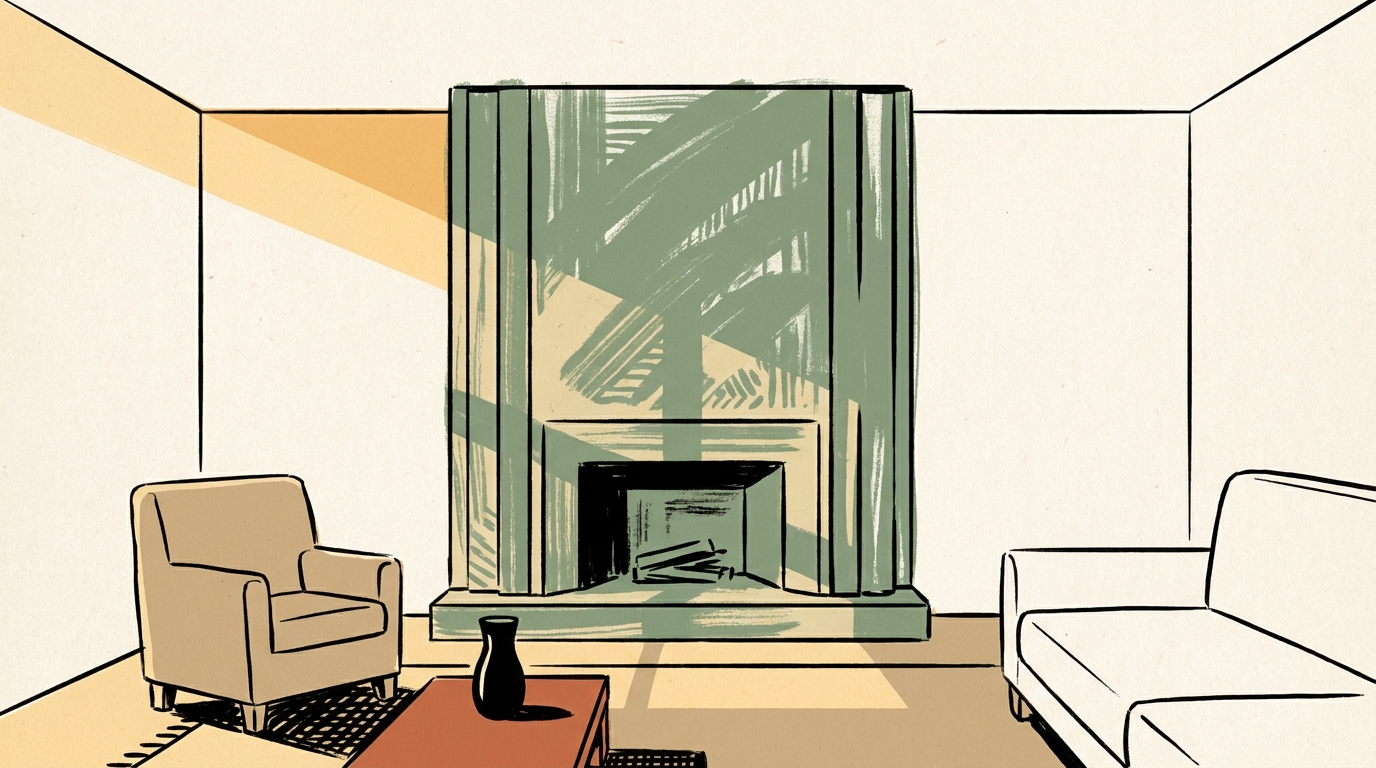
Instead of spreading twenty thousand dollars thin across an entire house like cold margarine on dry toast, the smart money commits. It buys one singular, heavy, undeniable physical statement. A floor-to-ceiling slab of deeply veined marble in a small kitchen; an entire wall of vertical-grain western red cedar behind a bed; a rough, hand-plastered fireplace that looks like it was carved out of a limestone cliff. This is the hero material strategy. It is the practice of concentrating your entire capital expenditure budget into a single, high-contrast visual anchor that dominates the primary listing photo. Everything else in the room can be simple, clean, and inexpensive, because the guest's eye has already made its decision.
The math behind this approach is rooted in the harsh realities of mobile search interfaces, contractor labor costs, and the operational wear-and-tear of the hospitality industry. When travelers scroll through listings on Airbnb or Vrbo, they do not zoom in to admire your high-end bathroom faucets or the quality of your baseboard paint. They scan thumbnails at lightning speed, looking for a reason to stop. A room with fifteen minor upgrades looks like a generic suburban house. A room with one massive, texture-rich material intervention looks like an architectural destination. The former requires a massive budget and yields a forgettable product; the latter uses a targeted budget to create a highly memorable brand.
How it actually works
To understand why a single hero material outperforms a full cosmetic refresh, one must look at the mechanics of the click-through rate on digital booking channels. The search interface of a modern short-term-rental platform is a visual meat grinder. On a standard smartphone screen, a listing has less than two inches of digital real estate and approximately half a second to capture a user's attention. The platform algorithms monitor these interactions with extreme precision. Every time a listing appears in a search result but is bypassed without a click, its search ranking suffers. Conversely, listings that maintain a high click-through rate are rewarded with higher organic visibility.
The primary listing photo is the single most important lever a host controls to influence this metric. Within that photo, the human brain seeks immediate visual hierarchy. In cognitive psychology, this is known as visual weight: the ability of an element in a design to attract the viewer's eye. A room composed of multiple small, mismatched decorative items lacks a clear focal point. The eye wanders across the image, finds nothing to hold its attention, and the thumb scrolls past. A single, massive installation of a raw, premium material creates instant visual weight. It establishes a clear hierarchy, directing the viewer's attention precisely where the host wants it.
Furthermore, digital compression algorithms on booking platforms are notoriously brutal. High-resolution photos are crushed into small, highly compressed files for fast mobile loading. Fine details—the subtle pattern of an expensive wallpaper, the texture of a high-end linen duvet, the craft of custom crown molding—are lost in translation. They turn into muddy, low-contrast noise at thumbnail size. Bold, large-scale material applications, however, survive the compression process perfectly. The thick, dark veins of a marble slab or the deep shadows between vertical wood slats remain highly legible even on a low-end smartphone screen. The guest does not need to zoom in to feel the impact; the material communicates its quality instantly, even at a hundred pixels wide.
Finally, the psychological impact of physical weight cannot be overstated. When guests enter a property, they translate physical weight into financial value. A thin, hollow-core door painted a trendy color feels cheap, regardless of the paint quality. A heavy, solid wood door or a thick stone countertop feels expensive. By anchoring a space with a material that possesses genuine physical mass, you establish an baseline of quality that colors the guest's perception of the entire property. They assume that if the fireplace is hand-plastered, the mattress must be premium, the sheets must be high-thread-count, and the cleaning must be immaculate.
The dilution trap of cosmetic compromises
The most common mistake in short-term-rental design is the compromise renovation. This occurs when an owner decides to update a property but fears taking a bold aesthetic stance. Seeking to maximize appeal while minimizing risk, they split their budget across dozens of small decisions. They buy mid-priced vinyl plank flooring to replace the worn carpet, paint every room a safe neutral shade, swap out old laminate countertops for basic white quartz, and hang a series of generic prints on the walls. By the time the contractor invoices are paid, the owner has spent thirty thousand dollars but has created a space that looks like a corporate housing unit or a staging project for a suburban home sale.
This dilution of capital is a financial disaster for a hospitality asset. In a mature market, safety is not a shield; it is a guarantee of invisibility. When every listing in a ZIP code features the same grey walls, the same flat-pack furniture, and the same modern farmhouse light fixtures, the asset becomes a commodity. Once a listing is commoditized, the host loses all pricing power. They are forced to compete solely on price, driving down their average daily rate and their revenue per available room. The capital spent on the renovation is effectively trapped in a property that cannot command a premium because it fails to stand out.
The dilution trap also ignores the reality of labor costs in residential construction. When a host undertakes a full cosmetic renovation, they must hire multiple trades. An electrician is needed for the light fixtures, a plumber for the faucets, a tile setter for the backsplash, a painter for the walls, and a finish carpenter for the trim. Each of these trades charges a mobilization fee, often called a trip charge, before they even open their toolboxes. Small, scattered jobs are highly inefficient for contractors, who price these projects with significant markups to cover their administrative overhead. The host ends up paying premium labor rates for minor, low-impact upgrades that do not move the needle on bookings.
Moreover, a distributed renovation introduces a high risk of project delays. If the tile setter is late, the plumber cannot install the faucet, which means the countertop fabricator cannot template, which pushes back the entire schedule. In a short-term-rental business, every day of construction is a day of lost revenue. A project that drags on for six weeks does not just cost the contract price; it costs thousands of dollars in lost bookings, platform momentum, and search ranking. By distributing the budget across multiple trades, the host increases the complexity of the project and the likelihood of costly scheduling conflicts.
The financial math of the hero element
Contrast the dilution trap with the financial efficiency of the hero material strategy. Instead of hiring five different contractors to perform fifteen small tasks, the host hires one specialist to execute one major installation. Let us look at the numbers behind a typical living room intervention. A host could spend eight thousand dollars painting walls, replacing baseboards, buying a new rug, and installing new light fixtures. Alternatively, they could spend that same eight thousand dollars on a single, dramatic installation: hiring a skilled plaster artisan to apply a thick, textured, hand-tinted lime-wash finish to an entire double-height fireplace wall, illuminated by a pair of carefully positioned spotlight fixtures.
The labor-to-material ratio of the hero installation is highly favorable. Because the project is concentrated on a single surface, the contractor can complete the work quickly, often in two or three days. There are no scheduling conflicts between different trades, no delays waiting for one contractor to finish before the next can begin, and no administrative chaos. This speed of execution drastically reduces vacancy loss—the hidden cost of any renovation. A full-house cosmetic refresh can easily take three to four weeks, during which the property generates zero revenue. A single-material intervention can be completed between check-out on Monday and check-in on Thursday, preserving valuable booking calendar days.
From a tax and accounting perspective, the single-material investment is equally compelling. Under section 179 of the Internal Revenue Code in the United States, and similar capital allowance rules in other jurisdictions, certain property improvements can be fully depreciated in the first year rather than capitalized over decades. A single, distinct structural design feature, particularly when integrated as a non-permanent decorative element or a specialized wall finish, can often be written off rapidly. Furthermore, because the capital is concentrated in one high-value asset, the host can easily track its depreciation and return on investment. If an eight-thousand-dollar plaster wall increases the property's average daily rate by forty dollars, the investment pays for itself in just two hundred booked nights, a milestone easily achieved within the first year of operation.
This concentrated investment also simplifies future maintenance. When a host has twenty different finishes throughout a house, they must maintain a catalog of paint colors, tile models, light bulbs, and hardware parts. When something breaks or is stained, matching the exact finish can be a logistical nightmare. With the hero material strategy, the rest of the room is kept intentionally simple—standard white walls, durable off-the-shelf flooring, and uncomplicated furniture. If a standard wall is damaged, it is easily patched and painted with a standard white paint that the cleaning crew can keep in the utility closet. The high-value material is localized, protected, and easily managed.
The algorithmic hook in a crowded market
The modern booking platform is not a passive directory; it is an active matchmaker powered by machine learning algorithms. Both Airbnb and Vrbo have transitioned toward highly visual search experiences. Airbnb's introduction of search categories—grouping properties by design styles like cabins, design, historical homes, or creative spaces—has fundamentally changed how traffic is distributed. To be placed in these high-traffic curated categories, a listing must pass a manual or algorithmic visual screening. A property with standard, run-of-the-mill finishes will never qualify for the Design category, regardless of how much money was spent on the plumbing or the HVAC system.
A hero material acts as an immediate qualifier for these high-value categories. A listing featuring a kitchen anchored by an entire wall of raw, unpolished travertine tiles or a bathroom centered around a monolithic soapstone basin instantly signals design intent to both the algorithm and the human editors. It provides a clear, unambiguous visual shorthand for premium quality. This visual signal is processed by the search engine's image-recognition software, which scans listing photos to identify key design elements, materials, and layouts. A listing with a prominent, highly textured wood wall is automatically tagged and categorized far more accurately than one with generic painted drywall.
The search engine also measures user engagement metrics, specifically the time spent viewing a listing's photo carousel. When a searcher clicks on a listing, the algorithm tracks how long they linger on each photo. A standard interior photo of a standard living room holds a viewer's attention for a fraction of a second. A photo of a living room dominated by a massive, floor-to-ceiling slab of green quartzite forces the user to pause, study the natural patterns of the stone, and scroll through the remaining photos to see how the rest of the space relates to that dramatic element. This increased dwell time signals to the search engine that the listing is highly engaging, leading to a bump in the search rankings.
We must also consider the reality of search behavior on mobile devices. Most bookings are now made on mobile phones, where the screen size is small and the user's attention span is short. Users swipe through listings while multitasking, commuting, or watching television. In this high-distraction environment, subtle design details are completely lost. You need a hammer, not a scalpel, to break through the digital noise. A hero material serves as that hammer, delivering a single, powerful visual punch that stops the scroll and forces the user to engage with the listing details.
The structural durability dividend
Beyond the immediate financial and algorithmic benefits, there is a long-term operational advantage to the hero material strategy: structural durability. Short-term rentals are high-abuse environments. Guests drag heavy roller bags down narrow hallways, bumping into walls and chipping paint. They place wet drinks on wooden tables, spill coffee on carpets, and slam bathroom doors. Cheap, trendy finishes—such as peel-and-stick backsplash tiles, thin vinyl wallpapers, and hollow-core doors—deteriorate rapidly under this daily onslaught. Within six months of a cheap cosmetic refresh, the space begins to look tattered, tired, and distinctly un-luxurious.
A hero material, by definition, is heavy, substantial, and durable. Real, natural materials like thick cedar planks, solid stone slabs, and lime-wash plaster do not wear out; they wear in. They develop a rich patina over time that actually enhances their visual appeal. A minor scrape on a painted drywall surface is an eyesore that requires immediate patching and painting. A minor scrape on a hand-plastered wall or a solid wood plank is barely noticeable, often blending seamlessly into the natural texture of the material. This durability dramatically reduces ongoing maintenance costs and extends the lifespan of the renovation by years.
This material resilience also has a direct impact on the property's cleaning fees and guest reviews. When a guest arrives at a property and notices chipped paint, peeling wallpaper, or scratched laminate, they immediately lower their expectations. They are more likely to inspect the property with a critical eye, looking for other flaws, and are far more prone to leaving a negative review or demanding a partial refund. Conversely, when a guest is greeted by a massive, high-quality material intervention, it sets an immediate tone of substance and professionalism. The psychological impact of solid, heavy materials creates a perception of cleanliness and quality that minor decorative elements can never replicate.
Consider the cleaning cycle of a short-term rental. Cleaning crews have a tight window—typically between 11:00 AM and 4:00 PM—to turn over a property. They do not have time to carefully clean delicate, intricate decorative items or polish cheap metal finishes that show every fingerprint. A single, solid surface of a resilient material is incredibly easy to maintain. A solid stone backsplash or a wood-clad wall requires nothing more than a quick wipe down. By eliminating the clutter of minor cosmetic upgrades and replacing them with a single durable material, you streamline the cleaning process, reduce turnover costs, and ensure the property looks pristine for every arriving guest.
Lessons from the boutique hotel playbook
The short-term-rental industry did not invent the science of visual impact; they inherited it from the commercial boutique hotel sector. Professional hoteliers have understood the economics of scale and materiality for decades. When brands like Soho House, Ace Hotel, or Aman design a room, they operate under strict budget constraints per key. They cannot afford to install custom cabinetry, high-end light fixtures, and imported tiles in every single guest room. Instead, they focus their resources on one or two high-impact elements that define the character of the entire space.
In a typical boutique hotel room, the walls may be simple painted concrete or plain drywall, the lighting may be minimal, and the storage may be an open metal rack. However, the headboard of the bed will be a massive, custom-carved piece of reclaimed oak, or the bathroom vanity will be a single, heavy block of cast concrete. The designers understand that these heavy, tactile elements are what the guest will remember, photograph, and share on social media. They do not dilute their budget by trying to make every corner of the room beautiful; they make one corner unforgettable.
This approach is highly scalable for individual short-term-rental hosts. By studying the floor plans and photography of successful boutique hotels, hosts can see exactly where to place their hero material. It is almost always positioned directly opposite the entry threshold or behind the primary functional element of the room, such as the bed or the main seating area. This ensures that the material is the very first thing a guest sees when they walk into the space, and the primary backdrop for any photos they take during their stay. In the age of social-media-driven travel, creating a photogenic backdrop is not a vanity project; it is a core business requirement.
Furthermore, boutique hotels understand the value of spatial contrast. If every wall in a room is covered in wood paneling, the space can feel dark, claustrophobic, and overwhelming. But if three walls are painted a clean, simple white, and the fourth wall is clad in beautiful, vertical-grain timber, the contrast makes the wood pop with incredible intensity. The simple surfaces act as a frame, highlighting the beauty and texture of the hero material. By keeping the rest of your design simple, you actually increase the visual impact of your primary investment, making every dollar spent on that hero material work twice as hard.
In a mature market, safety is not a shield; it is a guarantee of invisibility.
What hosts should do now
To execute this strategy successfully, hosts must move away from retail home-improvement stores and begin thinking like professional procurement officers. It requires a disciplined approach to sourcing, labor management, and visual marketing.
- Identify the primary photo wall: Look at your listing through the lens of a smartphone camera and determine which wall occupies the most visual space in your primary search photo. This is where your hero material must go.
- Source materials directly from wholesalers: Bypass high-end retail showrooms. Purchase stone slabs directly from commercial stone yards, or buy tongue-and-groove wood boards directly from local lumber mills to avoid retail markups.
- Hire a single specialized artisan: Instead of hiring a general contractor who will subcontract the work with a heavy markup, hire a dedicated plasterer, stone fabricator, or finish carpenter directly for a swift, two-to-three-day installation.
- Simplify everything else: Keep the surrounding walls, floors, and furniture simple, clean, and neutral to allow your hero material to command undivided attention and to keep maintenance costs low.
- Hire a professional architectural photographer: Ensure your photographer uses lighting that accentuates the texture, depth, and scale of your hero material, making it the undeniable star of your search thumbnail.
The short-term-rental business is ultimately a game of attention arbitrage. The hosts who survive and thrive in the coming years will be those who understand how to capture and hold a traveler's gaze with the maximum efficiency of capital. By focusing on one exceptional material rather than twenty mediocre ones, you create a listing that is not just a place to sleep, but a physical experience that demands to be booked.
Checked by the standards desk (Eleanor Quist): every specific in this story was traced to its source material before publication.
About this piece
An original expert-analysis column by the Stay Gazette desk. Figures are illustrative of how the market behaves; confirm specifics for your own market before you act.



Read the desk every morning.
The day's crackdowns and platform moves, the money, the design and the stays going viral, plus the desk's verdict, in one short email every morning.